Showing posts with label Cebuano literature. Show all posts

Monday, December 11, 2023

Interview of Author Cecilia Brainard by Lennie Jean Panugaling


Interview of Cecilia Brainard by Lennie Jean Panugaling from Carcar City College

Language Research Subject “The Heart of Cecilia Manguerra’s Masterpieces”

Stories studied: A Very Short Story, Flying a Kite, My Mother Is Dying

Hello Lennie Jean,

Thank you for the interview. I recommend that you also do research about my work aside from the three short shorts. Recommended links:

https://ceciliabrainard.com/   (Check out interviews and sources)

https://cbrainard.blogspot.com/ (On the side are “Cecilia Brainard Fiction” for more stories that you can read, including novel excerpts)

https://www.youtube.com/watch?v=xLo3H-Pdy1g&t=355s  (The Cebuana in the World: Cecilia Manguerra Brainard Writing Out of Cebu. Watch documentary, and please “Like” on Youtube. Thank you.)

Interviewer: Yesterday, our panelists were excited to find out that you responded to me on Facebook, leaving them intrigued about the prevalence of heartbreak in your stories. As you navigate the creative process, what influences or thoughts guide you to infuse your narratives with poignant emotions? Are personal painful memories a significant source of inspiration for you?

Cecilia Brainard:  You have chosen three of my stories referred to as Fast Fiction or Short Shorts, meaning each story is under a thousand words long. Stories this short are written in a precise way, with each word having relevance in the story. In some ways, they are almost like poetry.

Why do my stories deal with poignant emotions? Are personal painful memories a significant source of inspiration for me?

 Two important elements of story telling are “character” and “conflict”. If you analyze good stories, you will find that there is a main character who has some kind of conflict or problem. The story revolves around how the character deals with the conflict. Stories will involve the emotions of the characters. There are other elements in storytelling like plot, dialogue, voice, and so on, but I’m focusing on these two elements in order to answer your question. If you write of a character who doesn’t have conflict, who is perfectly happy for instance, you will not have a story. A character without conflict or a problem will have no challenges; he/she will not be motivated to do anything; your written work will be static or will meander and boring.

            This is why when I work with my characters, when I am figuring out their stories, I have to find out what their conflicts/problems are. And I have to find out how my characters will respond to these conflicts (or stresses). The decisions they make in response to their conflicts constitute what we call plot. Their emotional reactions and changes are called character development (or character arc); and this is what makes the piece feel like a story.

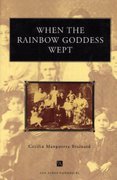
            To answer your second question about whether personal painful memories are a significant source of inspiration for me: I don’t rely solely on my memories for inspiration, but draw from history, from folklore, from personal observation of the people I have come across. For instance, my first novel When the Rainbow Goddess is about World War Two in the Philippines. I used many stories I heard from my parents in this novel. I have many stories that have been inspired by my childhood in Cebu, and these stories integrate memories of the people I knew or had seen and my own personal life.

 Check out the documentary about me The Cebuana in the World: Cecilia Manguerra Brainard Writing Out of Cebu – see link above. The documentary will give you an idea of the various stories I tell and where they come from.

Sunday, December 10, 2023

Interview of Author Cecilia Brainard by Cris Al Maglinte Cagoscos


For Cris Al Maglinte Cagoscos & Classmates

Cebu Technology University-Moalboal Campus

“Literary Analysis: Narrative Strategies and Cultural Implications in Cecilia Manguerra Brainard

Short Stories”

Re "Flip Gothic" and "Woman with Horns", we would like to ask what inspired and motivated you to write these two stories and how they relate to your past experiences.


Hi, Cris,

Thank you and your classmates for your interest.

I highly recommend that you do some research as well about my work – see links below, and there are more links listed in my official website. 

Recommended Links:

https://ceciliabrainard.com/ - Click on “About” and check out Interviews and Sources

The Cebuana in the World: Cecilia Manguerra Brainard Writing Out of Cebu - https://www.youtube.com/watch?v=xLo3H-Pdy1g&t=355s

Visit and search “Woman With Horns” and “Flip Gothic” in my blog: https://cbrainard.blogspot.com/

Re Woman with Horns

Woman with Horns was one of my earlier short stories when I was interested in the historical background of Cebu, albeit transformed as Ubec in my imagination. In schools I had been taught that “Magellan discovered the Philippines” which I realized was a fallacy because the Philippines had people way before Magellan showed up. In other words that statement “Magellan discovered the Philippines” was coming from a Eurocentric point of view. I was keenly aware of the Western orientation in the Philippines, by the books we read, the movies that we saw, the music that we danced to, our awe at American or European cultures.

Monday, June 26, 2023

Interview of Cecilia Brainard by Venice Rian Ong


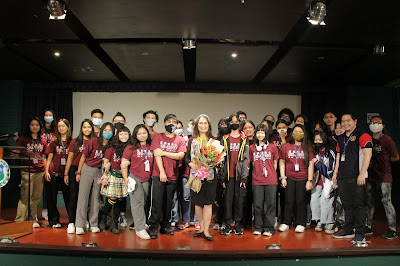
Photo taken at literary event hosted by Cebuano Studies Center last Feb. 2023


Venice Rian Ong, 12th grader from Saint Lorenzo Ruiz school in Cebu interviewed me recently.  I am sharing his questions and my answers.

1.       When did you first realize you wanted to be a writer? 

While I’d been writing since I was around 9 or 10 years old, I didn’t fully realize I wanted or was meant to be a writer until I was a grown woman with three young children.

Let me elaborate: After my father died when I was nine, I began writing him letters to update him of my life. These were my early writings. When I was a teenager I began diary writing. I always enjoyed writing, but after high school I thought I wanted to be an engineer. Later I thought I wanted to be a film maker. It was this interest in film making that led me to California where I went to film school at UCLA. I discovered that film making is an expensive and highly collaborative venture. I did not pursue this career.

            By this time I was a young wife and mother and focused on taking care of my family. It was during this time when stories would come into my head and I had to write them down. I later took Creative Writing Classes at UCLA-Extension’s Writers Program to learn the craft and business. Bit by bit I started to get stories published. But it wasn’t until the children were in school and I looked for work and found work as a fund raiser when I realized that I couldn’t work, take care of the family, and write. I talked to my husband about this and he told me to do what I wanted to do. I told the office that was ready to hire me that I couldn’t take the job, and I decided then to be a writer and take care of my family. 


Tuesday, February 28, 2023

Documentary by Cebuano Studies Center & NCAA about Cecilia Manguerra Brainard


I am reposting the link to the documentary video produced by the Cebuano Studies Center in conjunction with the National Commission for Culture and the Arts --
THE CEBUANA IN THE WORLD: CECILIA MANGUERRA BRAINARD WRITING OUT OF CEBU

 https://www.youtube.com/watch?v=xLo3H-Pdy1g 

The video is approx. 1 hour and 40 minutes long. It includes analyses of my work by Drs. Hope Yu and Bea Lastimosa in the last part.


Please don't forget to "Like" in YouTube. Thank you.


#cebuanowriters #Cebuwriters #cebuanoauthors #cebuauthors #Cebuanostudies #cebubooks #Cebuanobooks #Bisayabooks #bisayaauthors #Filipinoauthors #Filipinowriters #Filipinoliterature #Cebuanoliterature 

Thursday, November 10, 2022

Guest Blogger Manuel Lino Faelnar - Cebuano Advocate


My Guest Blogger is MANUEL LINO FAELNAR, am advocate of the native Cebuano language. I knew him way back in Cebu as a good friend of my brother Jess Manguerra. I was recently surprised and delighted to read some of his poems in Bisaya and asked if he could share those in my blog. He kindly obliged. Here then is information and the poems with translation by Manuel Faelnar. 


Born in  Cebu City  September 23, 1938. 
Education 
Primary schooling (grades 1-4) Colegio de la Inmaculada Concepción, Cebu City. 
Intermediate (grades 5-6) and High School (1st to 4 th year) 
Colegio del Sto.Niño, Cebu City (HS class 1956).
Pre-Law Ateneo de Manila (class 1958).
Law and Jurisprudence (Ll.B and BSJ)
University of the Philippines, Diliman , QC (class 1962)
MBA UP Cebu.
Degré Français Comerciale, Alliance Française de Manille.


Work.
Counsel, Asian Development Bank , 1970-1996.
Resource person of DepEd, Reviewer for Cebuano language materials for the Mother Tongue-Based Multi Lingual Education Program.

  
 I have always felt at ease writing Binisaya poems as, in my view, I would not be constrained by foreign (i.e., Western) structures and straight
jackets. I could write very much as I pleased and as I felt, giving free vent to the flow of my native tongue.  
 
  I would like to share with you some of my poems. The first one, Hinumdom (Memory) was published by Sonny Villafania in Makata 2004 (a web site). In the spirit of World Poetry Day which will fell on on March 21, 2005, I write both the Cebuano and English versions. Both versions can be sung to the tune of  I Wonder Who's Kissing her Now.  copyright is not a problem.The tune is very old so
Here is the first poem.

Hinumdom (Memory)
 
Nganong nahinumdom ako,
Hinumdom ako kanimo,
Ang kagahapon wala magdayon,
Nganong nahinumdum ako.
 
Nganong gimingaw man ako,
Gimingaw ako kanimo,
Akong pagpangga gitalikdan mo, 
Nganong gimingaw man ako.
 
Imong gitalikdan ako,
Nasamdan and kasingkasing,
Apan pag-agi sa mga tuig,
Baga na sabliga'g tubig.
 
Ang palad wala mag-uyon,
Ugod kita magdayon,
Og pag-agi's dugayng panahon, 
Wala nay gibati karon.
 
Hinkalimtam untang tanan,
Lahi na ang kinabuhi,
Nganong mibalik and paghinumdom, 
Batan-on, wala pay dag-um."