Introduction to
VIGAN AND OTHER STORIES, a short story collection by Cecilia Manguerra Brainard (Anvil, 2011)
by Oscar V. Campomanes
Cecilia Manguerra Brainard, Scenographer It gives me great pleasure to introduce this new anthology of Cecilia Manguerra Brainard’s fiction even as she really needs no introduction to a Philippine readership. As the young scholar Marge Rafols discovered in a recently completed study of Brainard’s institutional politics and creative work, Cecilia has consistently pursued a rather telling strategy, of which the publication by Anvil of this collection is only the latest example. Despite extended residence in the US for much of her adult life, and her considerable publishing success in that country, Cecilia has primarily oriented her writing to—and sought to circulate/publish it for the most part in—the Philippines, wanting Filipino readers to have first access to the fruits of her labors as a literary artist. Rafols reads this bifocality of Brainard’s career as an institutional politics on the writer’s part that addresses two major concerns: the constant need for diasporic storytellers like her to affirm and sustain a connection to and an investment in the cultural development of the ancestral homeland; and the endemic institutional invisibility or exclusion of Filipino Americans and migrants in the American cultural and political arenas (Rafols 2010). One, obviously, has everything to do with the other, and both can make sense, as Rafols amply demonstrates in her accomplished study, when construed in the context of the “special” (that is, neocolonial) relationship between the Philippines and the United States.
The cultural and political liminality in US society to which Filipino Americans and migrants had been historically and chronically doomed (a fate that is beginning, fortunately, to look up)—on account of the politics of self-disavowal of the American Empire which is now the object of a flourishing Filipino American postcolonial critique—might in some way explain the effet de retour of diasporic identity politics of the kind Brainard manifests. And the strategy to reorient one’s work as a writer to readers back ‘home’ without much care as to its potential for recognition from an American or international audience could perhaps mean, at one and the same time, an investment in Philippine literary culture, and an oblique but pragmatic realization of the nearly irremediable lot of Filipino American and migrant marginality in the colonizer’s context. One is then led to the unlikely wager that by contributing to homeland cultural development as the priority, the diasporic writer might effectively escape from the limiting and oppressive determinations of American institutional invisibility or paradoxically induce American establishment culture and institutions (still the arbiters of global literary visibility and celebrity) to take notice of one’s iconoclastic work or perspectives resulting from such a politics of location and self-displacement.
Whatever the actual results of such an institutional and publishing strategy in terms of critical and publishing coups in the United States, Cecilia’s ‘wager’ has been rewarded by an unusual number of local critical studies devoted to her writing, and the sustained interest expressed by Filipino academic students in her literary innovations, cultural activism, and personal identity politics. Apart from Rafols at Ateneo and others I know, University of Santo Tomas literature professor John Jack Wigley wrote his splendid MA thesis (2004) on the strategic and political gynocentrism of
Woman with Horns and Other Stories, and the up-and-coming local literary critic of Filipino American literature, Frances Jane Abao of the University of the Philippines has rigorously located
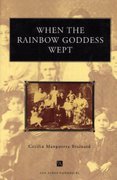
When the Rainbow Goddess Wept in an emergent tradition of the ‘ethnic bildungsroman’ (2001). By the late 1990s and early 2000s, other Filipino American and migrant writers like the poets Eileen Tabios and Ma. Luisa Igloria, the fictionist M. Evelina Galang, even Filipino diasporic writers from other global locations like Australia, Europe, and Japan, had begun to follow Cecilia’s lead and, at the very least, to count publication in the Philippines and access to a Filipino readership as an important component of their individual quests or career aspirations. The ‘return effect,’ in Brainard’s own case, saw not only the eventual republication of
When the Rainbow Goddess by both an American trade publisher and university press after first being published as
Song of Yvonne by New Day in Manila, but also a spate of critical studies of this novel and her other works by feminist and Asian American literary critics like Helena Grice, Dolores de Manuel, Guiyou Huang, C. Hua, Rocio Davis, Alicia Otano, S.T. Leonard, etc. in American learned journals, critical anthologies, and reference volumes.
What has been said of Carlos Bulosan’s village stories that “[they] are so simple as to seem effortless”—something similar having been said of N.V.M. Gonzalez by a crusty American critic that the latter’s stories are “so understated as to seem so artless”—may be said of Brainard’s fictions, generally, and of her stories in this collection, in particular. I qualify this seemingly left-handed assessment by citing a caveat made by the same critic of Bulosan’s village stories that, in fact, “such stories are the most difficult to write.” Cecilia’s style is even more spare or sparing, letting the words do the barest work possible of depicting action, description, or sequencing the events, for example. I’d call this style, which seems fairly unique to her (even when compared to that of old masters like Bulosan and Gonzalez), as scenographic, to borrow a term from cinema. In flash-fiction pieces like “The Dirty Kitchen,” “Flying a Kite,” and “The Che Guevarra Night,” this tendency and skill of staging fictional character, event, or setting as barely apprehensible scene/s—moving at a pace like that of briskly edited montage—is in most evidence. But the scenographic style also marks the stories that seem to form a cycle by their common setting of Ubec (Brainard’s noteworthy fictional inversion and immortalization of her beloved city of birth, Cebu), or are presented as separate pieces that can stand on their own, from their obvious provenance as chapters in an abortive novel (“Vigan,” “The Rice Field,” “Tia Octavia,” “The Last Moon-Game of Summer,” “Sagada” etc).
Like Manuel Puig’s cinematextual idiom in
Kiss of the Spider Woman, Jessica Hagedorn’s filmic crosscuttings in
Dogeaters, or M. Evelina Galang’s phototexts (as I call her ‘verbal pictures’) in
One Tribe, but again less opulently so, Brainard’s fictional scenography seems calculated, by contrast, to allow for the emergence of what Walter Benjamin once predicted, marveling at the power of the cinematic, as a new habitus of perceiving and thinking, to which Benjamin gave the enigmatic appellation “the critic in a state of distraction” (1968 [1955]). This is another way of saying that Cecilia’s stories, by their narrative minimalism (they are so scenographic as to seem uneventful), ostensibly seem to create the ample space for a more active readerly collaboration that is not so much consciously thought out as reflexively elicited. Here I have in mind a story like “Romeo” which willfully violates the rule that first-person narration cannot be omniscient, suggesting that it can be scopic if the forgiving reader is willing to supply the missing angles of vision—a pretty defamiliarizing strategy of rendering fictional action as scene/s best exemplified and demonstrated by the clairvoyant narrator of “My Mother is Dying” or in the epistolary exchanges between immigrant mother Nelia and the Old World grandmother (‘Mama’) about the errant Filipino American daughter Mindy/Arminda in the delightful yet poignant story “Flip Gothic.” In short, Cecilia’s compositional aesthetic allows for that strange physics that the technology of cinematic vision and storytelling—one that penetrates and dissolves dimensional planes—enables, or makes eminently imaginable, according to Water Benjamin.
I would like to speculate that this scenographic style is very much in accord with what the late Southeast Asianist scholar Les Adler once determined to be Brainard’s historiographic politics of keeping the lives of her men and women characters—set as these are in both historical and contemporary milieux—“continually in the camera’s eye” (Adler 1996). Watch these stories unfold, do not simply read them, in other words. When watching them—like they were projected on the screen of one’s osmotic imagination—do so, as Walter Benjamin says, as if one is engulfed by the flood of scenic images (mindful in some way that they are strategically arranged or sequenced by the writer’s filmic and historiographic sensibility), and thus as if moved to connect them, if only half-consciously, to one’s subliminal image-repertoires of a history shared with so many others, which would otherwise remain fragmentary and unarticulated, but, in the hands of a skillful and unobtrusive verbal auteur like Brainard, now form some absorbing montage of seamless and crosscut continuity shots.
Works CitedAbao, Jane Frances P. 2001. “Retelling the Stories, Rewriting the Bildungsroman: Cecilia Manguerra-Brainard’s When the Rainbow Goddess Wept.” Humanities Diliman (January-June).
Adler, Les. 1996. “Acapulco Sunset and Other Stories: A Review.” Pilipinas 26 (Spring).
Benjamin, Walter. 1968 [1955]. “The Work of Art in the Age of Mechanical Reproduction.” In Reflections, transl. Harry Zohn and ed. Hannah Arendt. New York: Harcourt Jovanovich Inc.
Rafols, Margarita. 2010. “Hide and Seek: Redefining ‘Filipino’ in Cecilia Manguerra-Brainard’s Fiction by Filipinos in America (1993) and Contemporary Fiction by Filipinos in America (1997).” BA Literature Thesis, Ateneo de Manila University
Wigley, John Jack. 2004. “Representations of the Female Body in Cecilia Manguerra-Brainard’s Fiction.” MA Literature Thesis, University of Santo Tomas.
PROFESSOR OSCAR V. CAMPOMANES teaches critical theory and literary/cultural studies in the Department of English, Ateneo de Manila University; and semiotics, media criticism, and culture theory in the Communication Program of the UST Graduate School. His recent essays regarding American empire critique, Filipino American postcoloniality and literary history, and cultural semiotics have appeared in such journals as PMLA, Japanese Journal of American Studies, and Philippine Studies; and the anthologies Positively No Filipinos Allowed (Temple 2006; Anvil 2008) and Vestiges of War (NYU Press/Anvil 2002). An anthology of his critical writings is currently under preparation for publication both in the Philippines and the United States

For copies of Vigan and Other Stories, contact ANVIL (www.anvilpublishing.com)
email: anvilpublishing@yahoo.com
Vigan and Other Stories is available as a Kindle Edition at Amazon.com
In the US contact Philippine Expressions or PALHBOOKS.COM.