More on Ubec, there is also an Ubec Band in Cebu.
Saturday, July 30, 2011
UBEC in CEBU - Graffiti
More on Ubec, there is also an Ubec Band in Cebu.
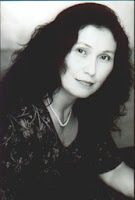
Cecilia Manguerra Brainard's official website is ceciliabrainarddotcom. She is the award-winning author and editor of 22 books, including When the Rainbow Goddess Wept, The Newspaper Widow, Magdalena, Selected Stories, Vigan and Other Stories, and more. She edited Growing Up Filipino 1, 2, & 3, Fiction by Filipinos in America, Contemporary Fiction by Filipinos in America, and other books..
Her work has been translated into Finnish and Turkish; and many of her stories and articles have been widely anthologized.
Cecilia has received many awards, including a California Arts Council Fellowship in Fiction, a Brody Arts Fund Award, a Special Recognition Award for her work dealing with Asian American youths, as well as a Certificate of Recognition from the California State Senate, 21st District, and the Outstanding Individual Award from her birth city, Cebu, Philippines.
She has lectured and performed at UCLA, USC, University of Connecticut, University of the Philippines, PEN, Shakespeare & Company in Paris, and many others. She has served in the Board of literary arts groups such as PEN, PAWWA (Pacific Asian American Writers West), among others.
Friday, March 17, 2017
Cebu as Inspiration to My Writings by Cecilia Brainard #CebuLitFest #Philippines #literature
Cecilia Manguerra Brainard's official website is ceciliabrainarddotcom. She is the award-winning author and editor of 22 books, including When the Rainbow Goddess Wept, The Newspaper Widow, Magdalena, Selected Stories, Vigan and Other Stories, and more. She edited Growing Up Filipino 1, 2, & 3, Fiction by Filipinos in America, Contemporary Fiction by Filipinos in America, and other books..
Her work has been translated into Finnish and Turkish; and many of her stories and articles have been widely anthologized.
Cecilia has received many awards, including a California Arts Council Fellowship in Fiction, a Brody Arts Fund Award, a Special Recognition Award for her work dealing with Asian American youths, as well as a Certificate of Recognition from the California State Senate, 21st District, and the Outstanding Individual Award from her birth city, Cebu, Philippines.
She has lectured and performed at UCLA, USC, University of Connecticut, University of the Philippines, PEN, Shakespeare & Company in Paris, and many others. She has served in the Board of literary arts groups such as PEN, PAWWA (Pacific Asian American Writers West), among others.
Sunday, December 10, 2023
Interview of Author Cecilia Brainard by Cris Al Maglinte Cagoscos
For Cris Al Maglinte Cagoscos & Classmates
Cebu Technology University-Moalboal Campus
“Literary Analysis: Narrative Strategies and Cultural Implications in Cecilia Manguerra Brainard
Short Stories”
Re "Flip Gothic" and "Woman with Horns", we would like to ask what inspired and motivated you to write these two stories and how they relate to your past experiences.
Hi, Cris,
Thank you and your classmates for your interest.
I highly recommend that you do some research as well about my work – see links below, and there are more links listed in my official website.
Recommended Links:
https://ceciliabrainard.com/ - Click on “About” and check out Interviews and Sources
The Cebuana in the World: Cecilia Manguerra Brainard Writing Out of Cebu - https://www.youtube.com/watch?v=xLo3H-Pdy1g&t=355s
Visit and search “Woman With Horns” and “Flip Gothic” in my blog: https://cbrainard.blogspot.com/
Re Woman with Horns
Woman with Horns was one of my earlier short stories when I was interested in the historical background of Cebu, albeit transformed as Ubec in my imagination. In schools I had been taught that “Magellan discovered the Philippines” which I realized was a fallacy because the Philippines had people way before Magellan showed up. In other words that statement “Magellan discovered the Philippines” was coming from a Eurocentric point of view. I was keenly aware of the Western orientation in the Philippines, by the books we read, the movies that we saw, the music that we danced to, our awe at American or European cultures.
Cecilia Manguerra Brainard's official website is ceciliabrainarddotcom. She is the award-winning author and editor of 22 books, including When the Rainbow Goddess Wept, The Newspaper Widow, Magdalena, Selected Stories, Vigan and Other Stories, and more. She edited Growing Up Filipino 1, 2, & 3, Fiction by Filipinos in America, Contemporary Fiction by Filipinos in America, and other books..
Her work has been translated into Finnish and Turkish; and many of her stories and articles have been widely anthologized.
Cecilia has received many awards, including a California Arts Council Fellowship in Fiction, a Brody Arts Fund Award, a Special Recognition Award for her work dealing with Asian American youths, as well as a Certificate of Recognition from the California State Senate, 21st District, and the Outstanding Individual Award from her birth city, Cebu, Philippines.
She has lectured and performed at UCLA, USC, University of Connecticut, University of the Philippines, PEN, Shakespeare & Company in Paris, and many others. She has served in the Board of literary arts groups such as PEN, PAWWA (Pacific Asian American Writers West), among others.
Thursday, November 15, 2018
Book Review The Newspaper Widow, Novel by Cecilia Manguerra Brainard
Book Review reprinted from PALH (palhbooks.com), 11/09/2018
Cecilia Manguerra Brainard's official website is ceciliabrainarddotcom. She is the award-winning author and editor of 22 books, including When the Rainbow Goddess Wept, The Newspaper Widow, Magdalena, Selected Stories, Vigan and Other Stories, and more. She edited Growing Up Filipino 1, 2, & 3, Fiction by Filipinos in America, Contemporary Fiction by Filipinos in America, and other books..
Her work has been translated into Finnish and Turkish; and many of her stories and articles have been widely anthologized.
Cecilia has received many awards, including a California Arts Council Fellowship in Fiction, a Brody Arts Fund Award, a Special Recognition Award for her work dealing with Asian American youths, as well as a Certificate of Recognition from the California State Senate, 21st District, and the Outstanding Individual Award from her birth city, Cebu, Philippines.
She has lectured and performed at UCLA, USC, University of Connecticut, University of the Philippines, PEN, Shakespeare & Company in Paris, and many others. She has served in the Board of literary arts groups such as PEN, PAWWA (Pacific Asian American Writers West), among others.
Wednesday, August 26, 2020
Herminia Meñez Coben Reviews The Newspaper Widow by Cecilia Manguerra Brainard
Book Review by Herminia Meñez Coben, Ph.D.
Professor Emerita from California State University of
Sonoma
Title:
The Newspaper Widow
Author:
Cecilia Manguerrra Brainard
Publisher: University of Santo Tomas Publishing House, 2017, Beato Angelico Bldg., Espana, Manila, Philippines;
Available from Amazon in hard copy and in Kindle format
Number of pages: 234 pages
Softcover, $18.95 in the US
The Newspaper Widow,
a fast-paced, multi-layered novel of romance and mystery, presents an
international cast of characters: a Spanish friar; an ill-fated lawyer; an
expatriate Frenchwoman and her gay friends, a Tagalog and a Catalan; an
American doctor and researcher at the leper colony; and finally, the
enterprising publisher widow of the novel’s title, Ines Maceda.
Cecilia Manguerra Brainard's official website is ceciliabrainarddotcom. She is the award-winning author and editor of 22 books, including When the Rainbow Goddess Wept, The Newspaper Widow, Magdalena, Selected Stories, Vigan and Other Stories, and more. She edited Growing Up Filipino 1, 2, & 3, Fiction by Filipinos in America, Contemporary Fiction by Filipinos in America, and other books..
Her work has been translated into Finnish and Turkish; and many of her stories and articles have been widely anthologized.
Cecilia has received many awards, including a California Arts Council Fellowship in Fiction, a Brody Arts Fund Award, a Special Recognition Award for her work dealing with Asian American youths, as well as a Certificate of Recognition from the California State Senate, 21st District, and the Outstanding Individual Award from her birth city, Cebu, Philippines.
She has lectured and performed at UCLA, USC, University of Connecticut, University of the Philippines, PEN, Shakespeare & Company in Paris, and many others. She has served in the Board of literary arts groups such as PEN, PAWWA (Pacific Asian American Writers West), among others.
Saturday, August 4, 2018
Book Review - Cecilia Brainard's Acapulco at Sunset and Other Stories by Isagani R. Cruz
Book Review
Acapulco at Sunset and Other Stories
by Cecilia Manguerra Brainard
Review by
Isagani R. Cruz, Critic at Large
Starweek, The Sunday Magazine of the Philippine Star/October 29, 1995
THE PLEASURES OF UBEC, OTHERWISE KNOWN AS CEBU
Modern, modernist, postmodern, post-modernist, magic realist, postcolonialist, or simply new fiction has successfully removed many of the traditional restrictions imposed on the short story genre.
Ironically, these restrictions were imposed not by creative writers but by literary critics, not by the producers of the short story but by its consumers. While in other areas of everyday life customers may always be right, they are not always right - and may in fact be incredibly wrong - when it comes to fiction.
For fiction - as Aristotle so wisely saw centuries ago - is not an art of the possible, but may even be an art of the impossible. Even wise old Aristotle, however, did not see (how could he?) that his dead, white, male, two-valued mind was hopelessly limited by temporality, color, biology, and patriarchy, nor could he foretell - despite everything he foretold so well - that fiction would remain unchangingly changing.
Fiction has changed so much in the last century or so that it has finally become recognizable. New fiction - perhaps all fiction - has become, perhaps always was, not an art of the real or - to use the serendipitous word of the Latinate English - of verisimilitude. As critics love to say, poking fun at themselves, fiction is constitutive of reality. Or put it in a shamelessly Derridean way, fiction precedes reality - before there was reality, there was fiction.
Cecilia Manguerra Brainard's stories, collected in Acapulco at Sunset and Other Stories (Anvil Publishing, 1995, 157 pages) is a case in print.
Brainard's short stories are refreshingly new, therefore comfortably old-fashioned; they are delightfully conventional, therefore startlingly innovative. They are written according to the strict conventions of new fiction, therefore not conventional or new. Or perhaps more precisely put, they are new fiction, written as though they are old, or old fiction, written as though they were new.
In Brainard's stories, Acapulco and Intramuros are the same, and at the same time, completely different places. Dead characters and live characters talk to each other nonchalantly. A young poor boy falls in love with an older rich woman, and by loving her, kills her. Filipinos find their identity in, of course, San Francisco, but not so ordinarily, in Alaska. The green card - actually blue - spells the difference between authenticity and an authentic life, between dreaming and the American dream.
In Brainard's stories, the mind does wondrous things: aside from creating an Evil-Thing that makes one do good things, for instance, it may recreate good people that spell the difference between good and evil. It may make characters live in worlds they themselves create, distinct from - often destructive of - the world that has created them. A young girl, for instance, may live for the handsome object of her adolescent fantasies, then so suddenly recognize these fantasies as mere "silly daydreams." A very old woman, saving herself for her one and only love, finally surrenders her virtue - and her life - on her death bed, of course to her one and only, now long dead, love,
Needless to say, since Brainard comes from Cebu (although she is, of course, now a leading Los Angeles writer, having had her New Day novel, Song of Yvonne published as When the Rainbow Goddess Wept by Dutton of New York, not to mention her several other publications), she sets many of her stories in Cebu, so transparently respelled as Ubec, so powerfully casting a spell as a place tied to the Cebu of her memory but developed into a Cebu of her imagination. Ubec, like Cebu, is an old and new city - it is modern yet traditional, a large metropolis yet a smal town, a capital that is not a capital. Beside Ubec, Cebu looks unreal, fictional: before Cebu was born, there was Ubec.
Brainard's imagination spans not just the space between Mexico and Manila - a space traversed by galleons two centuries ago - but the time betewen then and now, the time traversed by the Philippines as it moved, moves forward - some say backward - from a postcolonial to a post-colonial societ.
~end of excerpt~
Cecilia Manguerra Brainard's official website is ceciliabrainarddotcom. She is the award-winning author and editor of 22 books, including When the Rainbow Goddess Wept, The Newspaper Widow, Magdalena, Selected Stories, Vigan and Other Stories, and more. She edited Growing Up Filipino 1, 2, & 3, Fiction by Filipinos in America, Contemporary Fiction by Filipinos in America, and other books..
Her work has been translated into Finnish and Turkish; and many of her stories and articles have been widely anthologized.
Cecilia has received many awards, including a California Arts Council Fellowship in Fiction, a Brody Arts Fund Award, a Special Recognition Award for her work dealing with Asian American youths, as well as a Certificate of Recognition from the California State Senate, 21st District, and the Outstanding Individual Award from her birth city, Cebu, Philippines.
She has lectured and performed at UCLA, USC, University of Connecticut, University of the Philippines, PEN, Shakespeare & Company in Paris, and many others. She has served in the Board of literary arts groups such as PEN, PAWWA (Pacific Asian American Writers West), among others.
Tuesday, February 22, 2022
UBEC: CEBU REIMAGINED Talk by Cecilia Brainard, Cebuano Studies Center & YOUTUBE
Cecilia Brainard's Talk: UBEC: CEBU REIMAGINED (Feb. 19, 2022) is streaming in the FB site of the Cebuano Studies Center:
Cecilia Brainard's Talk can also be viewed on YouTube:
The complete 1 hour 41 minute program with Introductions, talk, and Open Forum can be viewed here:
>>>>
Following is the transcript of her talk.
UBEC: CEBU REIMAGINED
Cecilia
Manguerra Brainard
Copyright 2022 by Cecilia M. Brainard
Cecilia Manguerra Brainard's official website is ceciliabrainarddotcom. She is the award-winning author and editor of 22 books, including When the Rainbow Goddess Wept, The Newspaper Widow, Magdalena, Selected Stories, Vigan and Other Stories, and more. She edited Growing Up Filipino 1, 2, & 3, Fiction by Filipinos in America, Contemporary Fiction by Filipinos in America, and other books..
Her work has been translated into Finnish and Turkish; and many of her stories and articles have been widely anthologized.
Cecilia has received many awards, including a California Arts Council Fellowship in Fiction, a Brody Arts Fund Award, a Special Recognition Award for her work dealing with Asian American youths, as well as a Certificate of Recognition from the California State Senate, 21st District, and the Outstanding Individual Award from her birth city, Cebu, Philippines.
She has lectured and performed at UCLA, USC, University of Connecticut, University of the Philippines, PEN, Shakespeare & Company in Paris, and many others. She has served in the Board of literary arts groups such as PEN, PAWWA (Pacific Asian American Writers West), among others.
Saturday, December 18, 2021
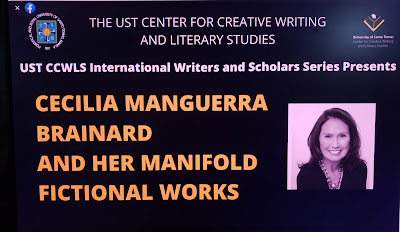
Author Cecilia Brainard Talk University of Santo Tomas CCWLS
Filipino FilAm Author Cecilia Manguerra Brainard gives a talk for the University of Santo Tomas Center for Creative Writing and Literary Studies. This is part of their UST International Writers and Scholars Series.
This same video can be viewed in the Facebook site of UST Center for Creative Writing and Literary Studies:
Following is the transcript of Cecilia's talk:
Celebrating Writing and My Selected Short Stories
For the International Authors Series of UST Center for Creative Writing and Literary Studies
by Cecilia Manguerra Brainard, copyright by Cecilia Brainard
Cecilia Manguerra Brainard's official website is ceciliabrainarddotcom. She is the award-winning author and editor of 22 books, including When the Rainbow Goddess Wept, The Newspaper Widow, Magdalena, Selected Stories, Vigan and Other Stories, and more. She edited Growing Up Filipino 1, 2, & 3, Fiction by Filipinos in America, Contemporary Fiction by Filipinos in America, and other books..
Her work has been translated into Finnish and Turkish; and many of her stories and articles have been widely anthologized.
Cecilia has received many awards, including a California Arts Council Fellowship in Fiction, a Brody Arts Fund Award, a Special Recognition Award for her work dealing with Asian American youths, as well as a Certificate of Recognition from the California State Senate, 21st District, and the Outstanding Individual Award from her birth city, Cebu, Philippines.
She has lectured and performed at UCLA, USC, University of Connecticut, University of the Philippines, PEN, Shakespeare & Company in Paris, and many others. She has served in the Board of literary arts groups such as PEN, PAWWA (Pacific Asian American Writers West), among others.
Wednesday, October 30, 2013
Vintage Pictures that Help me Write my Novel - Paris, Barcelona, Ubec
I've included short excerpts. The published story, The Old Mansion Near the Plaza, is part of this novel that I'm struggling with.
It is a struggle, but it's a lot of fun.
For those who don't know Ubec is the mythical world I've created that is something like Cebu. Note that Ubec is Cebu backwards.
"...and I said, "My aunt owns a dress shop on Avenue Bouquet; I'll be fine."
"Encouraged, my aunt continued, “I remember watching them build it platform by platform, from ’87 to ‘89. I prayed it would get better — or topple down — but the higher it went, the more hideous it became. The skyline of Paris has been ruined by that ghastly protrusion.”
" and they had taken the exhilarating steam engine ride from Ubec to Carcar, in a first class car, which was finished in teak. The locomotives, steel rails, and parts came from America and everything was as solid as the spanking new railway system installed in earthquake-shattered San Francisco. The second class cars, where they now sat, were finished in yellow pine."
Cecilia Manguerra Brainard's official website is ceciliabrainarddotcom. She is the award-winning author and editor of 22 books, including When the Rainbow Goddess Wept, The Newspaper Widow, Magdalena, Selected Stories, Vigan and Other Stories, and more. She edited Growing Up Filipino 1, 2, & 3, Fiction by Filipinos in America, Contemporary Fiction by Filipinos in America, and other books..
Her work has been translated into Finnish and Turkish; and many of her stories and articles have been widely anthologized.
Cecilia has received many awards, including a California Arts Council Fellowship in Fiction, a Brody Arts Fund Award, a Special Recognition Award for her work dealing with Asian American youths, as well as a Certificate of Recognition from the California State Senate, 21st District, and the Outstanding Individual Award from her birth city, Cebu, Philippines.
She has lectured and performed at UCLA, USC, University of Connecticut, University of the Philippines, PEN, Shakespeare & Company in Paris, and many others. She has served in the Board of literary arts groups such as PEN, PAWWA (Pacific Asian American Writers West), among others.
Thursday, February 16, 2012
Writeups re OUT OF CEBU Book Launch

USC Press holds book launching
www.usc.edu.ph/news_and_announcements/?news=526
The University of San Carlos Press successfully launched the book, Out of Cebu: Essays and Personal Prose, by Cecilia Manguerra Brainard on Sunday, February 5, 2012 at the Granada Room of Casino Español.
Brainard personally came to Cebu from California to grace the event and sign copies of the book in the well-attended event that was graced by Cebu City Mayor Michael Rama and USC President Fr. Dionisio Miranda, SVD, together with old political families, heritage advocates, and writers. This is Brainard’s 10th book but the first one to be published in Cebu. Out of Cebu collects 28 essays about the author’s Cebuano ties, including colorful accounts about her mother’s family, the Cuencos, a prominent political family in Cebu. The book also includes writings about the author’s life and travels outside of Cebu.
The occasion was also highlighted by the reading of six chapters of the book by Dr. Louie Nacorda, Marlinda “Mayen” Angbetic-Tan, Dr. Ludinito “Dodong” Cañete, Pia Mercado, Gavin Sanson Bagares and Fr. Generoso Rebayla Jr., SVD.
The author answering questions posed by the audience, Mayor Mike Rama in particular (Photo by Lorens Gibb Lapinid)
The book has received early praise from the educator, Dr. Edmundo Litton of Loyola Marymount University who says, “These essays celebrate a pride in a heritage. Brainard is clearly proud of her Cebuana heritage and this pride shows in this magnificent collection of essays.”
Likewise, Dr. Susan Evangelista of Palawan State University comments, “I knew Cecilia Manguerra Brainard first as a fiction writer, writing from the U.S., but grounded in the physicality of Ubec, Cebu, of course. Later when I got to know her as a friend, I discovered another layer which involved her deep interest, research in and thinking about Filipino history, particularly Magellan, who died,of course, in Cebu.”
Brainard was born and raised in Cebu by her parents, Engr. Mariano Manguerra and Concepcion Cuenco Manguerra. She attended St. Theresa’s College in Cebu and San Marcelino and obtained her AB in Communication Arts from Maryknoll College. She went on to do graduate work in film making at UCLA, but later went into writing when she was a young wife and mother. Aside from writing and editing, she teaches at the prestigious Writers’ Program at UCLA Extension.
Brainard has written nine other books, including the internationally-acclaimed novel, When the Rainbow Goddess Wept, which chronicles the coming of age of a young girl in Ubec (Cebu backwards) during World War II, a novel inspired by her own parents’ experiences during the war. Brainard first coined the mythical place “Ubec” in her first short story collection, Woman with Horns and Other Stories, and she continued to use this setting in her other works of fiction: Magdalena, Acapulco at Sunset and Other Stories, Vigan and Other Stories.
She has also written books of nonfiction, edited four books, and co-edited six more. Her writings have been translated into Finnish and Turkish.
Brainard has received a California Arts Council Fellowship in Fiction, a Brody Arts Fund Award, a Special Recognition Award for her work dealing with Asian American youths, as well as a Certificate of Recognition from the California State Senate, 21st District. She has also been awarded by the Filipino and Filipino American communities she has served. She received the prestigious Filipinas Magazine Arts Award, and the Outstanding Individual Award from her birth city, Cebu, Philippines. She has received several travel grants in the Philippines, from the USIS (United States Information Service).
The author (center) poses with Mayor Michael Rama and Fr. Pres. Dionisio Miranda, SVD together some of the readers (Photo by Lorens Gibb Lapinid)
Brainard’s latest book, Out of Cebu: Essays and Personal Prose, is available from the University of San Carlos Press, USC Museum, Catholic Trade Center, Museo Sugbo and will soon be at National Bookstore as well as Fully Booked outlets. Orders may be placed at USC Press Office (Tel. 2531000 loc. 175; email: uscpress@usc.edu.ph or sancarlospublications@yahoo.com
Author: USC Press
15 / February / 2012

~~~~~
Out of Cebu' launched
C'EST CEBU By Honey Jarque Loop (The Philippine Star) Updated February 16, 2012 12:00 AM Comments (0) View comments
www.philstar.com/Article.aspx?articleId=777858&http://www.blogger.com/img/blank.gifpublicationSubCategoryId=81http://www.blogger.com/img/blank.gif
It was an intimate gathering when California-based author Cecilia Manguerra Brainard launched her latest book Out of Cebu at the Casino Español de Cebu.
The book contains 28 essays about the author’s Cebuano ties, including memorable experiences with her mother’s family, the Cuencos, a prominent, well-respected political dynasty in Cebu.
The program started with welcome remarks by Jobers Bersales of the University of San Carlos Press. This was followed by short readings from the book. Louie Nacorda read “My Grandfather” while Freeman executive lifestyle editor Mayen Angbetic Tan brought life to “Death of a Carnival Queen.” Dodong Cañete, Pia Mercado, Gavin Bagares and Fr. Jun Rebayla, SVD narrated “Where the Daydreaming Comes, “ “Diaspora in Italy,” “Kiki” and “Museo Sugbo,” respectively.
The book has received early praise from the educator Dr. Edmundo Litton of Loyola Marymount University, who says, “These essays celebrate a pride in a heritage. Brainard is clearly proud of her Cebuana heritage and this pride shows in this magnificent collection of essays.”
Likewise, Dr. Susan Evangelista of Palawan State University comments, “I knew Cecilia Manguerra Brainard first as a fiction writer, from the United States, but grounded in the physicality of Ubec, Cebu, of course. Later when I got to know her as a friend, I discovered another layer which involved her deep interest, research in and thinking about Filipino history, particularly Magellan, who died in Cebu.”
Author Brainard was born and raised in Cebu. Her parents are Mariano Manguerra, an engineer, and Concepcion Cuneco Manguerra. She attended St. Theresa’s College in Cebu and San Marcelino. She continued her studies at Maryknoll College, where she obtained her AB in Communication Arts. She went on to do graduate work in filmmaking at UCLA, but later went into writing when she was a young wife and mother. Aside from writing and editing, she teaches at the prestigious Writers Program at UCLA Extension.
Brainard has written nine books, including the internationally acclaimed novel When the Rainbow Goddess Wept, which chronicles the coming of age of a young girl in Ubec (Cebu backwards) during World War II, a novel inspired by her own parent’s experiences during the war. Brainard first coined the mythical place Ubec in her first short story collection Woman with Horns and Other Stories, and she continued to use this setting in her other works of fiction, Magdalena, Acapulco at Sunset and Other Stories, Vigan and Other Stories.
Brainard has received a California Arts Council Fellowship in Fiction, a Brody Arts Fund Award, a Special Recognition Award for her work dealing with Asian American youths as well as a Certificate of Recognition from the California State Senate, 21st District. She has also been awarded by the Filipino and Filipino- American communities she has served. She received the prestigious Filipinas Magazine Arts Award and the Outstanding Individual Award from her birth city, Cebu, Philippines.
Brainard’s book Out of Cebu, Essays and Personal Essays is available at Cebu’s University of San Carlos Press.
Cecilia Manguerra Brainard's official website is ceciliabrainarddotcom. She is the award-winning author and editor of 22 books, including When the Rainbow Goddess Wept, The Newspaper Widow, Magdalena, Selected Stories, Vigan and Other Stories, and more. She edited Growing Up Filipino 1, 2, & 3, Fiction by Filipinos in America, Contemporary Fiction by Filipinos in America, and other books..
Her work has been translated into Finnish and Turkish; and many of her stories and articles have been widely anthologized.
Cecilia has received many awards, including a California Arts Council Fellowship in Fiction, a Brody Arts Fund Award, a Special Recognition Award for her work dealing with Asian American youths, as well as a Certificate of Recognition from the California State Senate, 21st District, and the Outstanding Individual Award from her birth city, Cebu, Philippines.
She has lectured and performed at UCLA, USC, University of Connecticut, University of the Philippines, PEN, Shakespeare & Company in Paris, and many others. She has served in the Board of literary arts groups such as PEN, PAWWA (Pacific Asian American Writers West), among others.
Monday, December 7, 2015
World War II Fiction - Excerpt, Cecilia Brainard's When the Rainbow Goddess Wept

It was a scary thought:
I, Yvonne Macaraig, entangled with heavy chains, barred from heaven, barred
even from purgatory, destined only to drag myself and the chains, and scare
people away. There was a condemned soul
who frightened the people in the house down the street from where we
lived. He had borrowed fifty pesos and never paid it back, that's why his soul
was not at peace.
Cecilia Manguerra Brainard's official website is ceciliabrainarddotcom. She is the award-winning author and editor of 22 books, including When the Rainbow Goddess Wept, The Newspaper Widow, Magdalena, Selected Stories, Vigan and Other Stories, and more. She edited Growing Up Filipino 1, 2, & 3, Fiction by Filipinos in America, Contemporary Fiction by Filipinos in America, and other books..
Her work has been translated into Finnish and Turkish; and many of her stories and articles have been widely anthologized.
Cecilia has received many awards, including a California Arts Council Fellowship in Fiction, a Brody Arts Fund Award, a Special Recognition Award for her work dealing with Asian American youths, as well as a Certificate of Recognition from the California State Senate, 21st District, and the Outstanding Individual Award from her birth city, Cebu, Philippines.
She has lectured and performed at UCLA, USC, University of Connecticut, University of the Philippines, PEN, Shakespeare & Company in Paris, and many others. She has served in the Board of literary arts groups such as PEN, PAWWA (Pacific Asian American Writers West), among others.
Thursday, May 16, 2019
Manila Times Book Review: Cecilia Brainard's novel, The Newspaper Widow
Book Review:
The Newspaper Widow: A cut above other whodunits
by Faye Valencia, May 12, 2019, The Manila Times
https://www.manilatimes.net/the-newspaper-widow-a-cut-above-other-whodunits/553054/?fbclid=IwAR3-AdSGYnAD11rv0xVmFzvjO6b0SXX3jbVPpAqXFW16xbQr0_DOvUUeRtM
FOR the most part, crime fiction, also called the “whodunit,” is considered escapist entertainment. After all, it follows a formula. Crime — most often murder — serves as the centerpiece of the story, whose main character is usually a detective or expert of some sort who is guaranteed to catch the perpetrator. Consider: Sir Arthur Conan Doyle’s brilliant sleuth Sherlock Holmes closes every case, Stieg Larsson’s hacker extraordinaire Lisbeth Salander never fails to dish out justice, and so on.
In her paper “Murder as Social Criticism,” professor Catherine Nickerson theorizes: “The world of the detective novel is a place of untimely death, cruelty, suspicion and betrayal. If detective fiction is a literature of escape, why would anyone want to be transported to such anxious locales? Perhaps, detective fiction produces its pleasurable effects by allowing us to feel that no matter how overwhelming our own situations seem, something much worse is happening to someone else.”
The Newspaper Widow (University of Santo Tomas Publishing House; 238 pages; 2017) by Cecilia Manguerra Brainard may be classified as crime fiction, but it doesn’t really follow the formula — and that, in this case, is a very good thing. The opening scene of Brainard’s murder mystery, set in the small town of Ubec in Cebu province, indicates that this isn’t your usual detective novel.
“In the summer of 1909, Ubec was overrun by rats. Rodents larger than cats scampered throughout the seaside city, fearless of man even during the daytime when the scorching sun shone down on them exposing their hideousness — their wiry brown fur, long snouts, and naked tails as long as their bodies,” it reads.
Brainard’s disturbingly vivid introduction serves as a warning that people are not always what they seem, and there are far worse things that could happen to a town than a rat infestation. In fact, the rodents were the reason for the discovery of Father Nicolas Zafra’s body. The novel’s title character, the quietly tenacious Ines Maceda, ends up covering the story for The Ubec Daily. The paper is something that Ines inherits from her late husband, the cerebral Pablo.
Ines becomes more involved in the investigation of the priest’s murder when her son Andres is identified as the main suspect. In her attempt to clear her son’s name, Ines knocks over a few cans of worms and what-not. Thankfully, Brainard does not resort to cheap tricks when it comes to the novel’s dark revelations.
“My original intention had been to write a mystery, but I rely too much on character and character development more than the plot, and so I present a novel that is more about Ines Maceda than it is about the mystery of the dead priest,” she explains.
In this sense, The Newspaper Widow follows crime fiction writer Raymond Chandler’s perspective on the genre. In his critical essay “The Simple Art of Murder,” Chandler asserts: “Murder, which is a frustration of the individual and hence a frustration of the race, may have and, in fact, has a good deal of sociological implication.”
The other quality that makes The Newspaper Widow stand out is that even the supporting characters are fully fleshed out. And they’re not just the basic personas, either. For instance, the one who becomes the title character’s unexpected best friend is a French expatriate named Melisande Moreau, who also happens to be the town’s most sought-after dress designer. Brainard gives Melisande the sauciest lines. In one scene, the Frenchwoman tells Ines: “I should go. I have to finish the mayor’s wife’s gown. She’s in the Maria Elena procession of the carnival. You know she is big-boned and it took me a while to come up with the right design, but finally I discovered that the accent has to be on her big bosom. She has beautiful breasts, so we have some cleavage, and we have to tell all eyes to look there…and not elsewhere.” Ultimately, it is Melisande who convinces Ines that she should think of The Ubec Daily as her own instead of just something that was left behind by her husband.
Then there’s a character named Juan dela Cruz, whose common name belies his extraordinary reality. Brainard writes: “People learned that Juan dela Cruz was the only son of the owner of Sandoval Rum and that father and son were like oil and water. His father had wanted Juan to go to business school, but Juan preferred fine arts and music. His father had pressured him to marry the daughter of his business partner, an unacceptable situation for Juan. Juan’s mother finally sold some of her jewelry to finance her son’s studies at the Reial Academia Catalana de Belles Arts de Sant Jordi in Barcelona.”
Juan goes on to fall in love with a Spaniard named Esteban Magri. The couple live in Ubec and are well-respected members of the community. The only real problem they encounter is when Juan also becomes a suspect in Father Zafra’s murder.
Aside from its complex characters, The Newspaper Widow also contains a lot of historical detail. These include even the most disturbing things, such as instruments of torture. Brainard writes: “The garrote, an all-time Spanish favorite, was used for capital punishment during the Spanish time, and for a few years, the American military government availed of the garrote for executions.
“The principle behind garroting was simple: Crush the larynx while applying pressure to the victim’s back. All you needed was a chair with a back rest and a neck clamp which could be tightened by crank, wheel, or hand, thereby strangling the victim.”
The Newspaper Widow may not have a flashy detective as its protagonist, but it is definitely crime fiction that’s a cut above the usual whodunits. Thanks to Brainard’s elegant prose and insights, it’s also a social commentary that attempts to shine the light on the dark corners of organized religion. It does not demonize the Church, but it recognizes the fact that there are a few demons posing as angels within it.
Brainard’s masterpiece also reminds us that in life, things are not always resolved as neatly as we would like them to be. There’s a clear demarcation between good and bad, but there are also a lot of gray areas that we have to learn to navigate.
The Newspaper Widow costs P400 and is available in leading bookstores.
“The Newspaper Widow” by Cecilia Manguerra Brainard can be purchased by visiting the UST Bookstore or by clicking this link:http://bit.ly/USTPHOrderForm.
Cecilia Manguerra Brainard's official website is ceciliabrainarddotcom. She is the award-winning author and editor of 22 books, including When the Rainbow Goddess Wept, The Newspaper Widow, Magdalena, Selected Stories, Vigan and Other Stories, and more. She edited Growing Up Filipino 1, 2, & 3, Fiction by Filipinos in America, Contemporary Fiction by Filipinos in America, and other books..
Her work has been translated into Finnish and Turkish; and many of her stories and articles have been widely anthologized.
Cecilia has received many awards, including a California Arts Council Fellowship in Fiction, a Brody Arts Fund Award, a Special Recognition Award for her work dealing with Asian American youths, as well as a Certificate of Recognition from the California State Senate, 21st District, and the Outstanding Individual Award from her birth city, Cebu, Philippines.
She has lectured and performed at UCLA, USC, University of Connecticut, University of the Philippines, PEN, Shakespeare & Company in Paris, and many others. She has served in the Board of literary arts groups such as PEN, PAWWA (Pacific Asian American Writers West), among others.
Wednesday, December 6, 2017
From Cebu to Ubec: Inspiration for The Newspaper Widow, novel by Cecilia Brainard
I enjoy movies like Shakespeare in Love and The Man Who Invented Christmas. The first one is a fictional romantic comedy about Shakespeare infatuated with Viola de Lesseps during the time he was working on Romeo and Juliet. The Man Who Invented Christmas relates how Charles Dickens came to write the novella, A Christmas Carol.
These movies amuse me because it's true that some writers will take bits and pieces and weave these into their stories. The facial expression that the movie-Charles Dickens gets when a name or event strikes him as "material", reminds me of when something hits me too, and my creative self recognizes this as important in my work, and I feel as if I'm in twilight zone.In some cases, these bits of inspiration are a throw-away statement or anecdote overheard, or some bit of information that the author read, or a name that strikes his/her fancy, a bit of truth, a bit of fantasy, a memory, some imaginings. Even the author hardly knows just where exactly the characters, or scenes, or details from his/her creation came from -- not with precision, because the creative mind whips around here and there collecting material and tailoring these until the end product is new.
Cecilia Manguerra Brainard's official website is ceciliabrainarddotcom. She is the award-winning author and editor of 22 books, including When the Rainbow Goddess Wept, The Newspaper Widow, Magdalena, Selected Stories, Vigan and Other Stories, and more. She edited Growing Up Filipino 1, 2, & 3, Fiction by Filipinos in America, Contemporary Fiction by Filipinos in America, and other books..
Her work has been translated into Finnish and Turkish; and many of her stories and articles have been widely anthologized.
Cecilia has received many awards, including a California Arts Council Fellowship in Fiction, a Brody Arts Fund Award, a Special Recognition Award for her work dealing with Asian American youths, as well as a Certificate of Recognition from the California State Senate, 21st District, and the Outstanding Individual Award from her birth city, Cebu, Philippines.
She has lectured and performed at UCLA, USC, University of Connecticut, University of the Philippines, PEN, Shakespeare & Company in Paris, and many others. She has served in the Board of literary arts groups such as PEN, PAWWA (Pacific Asian American Writers West), among others.
Wednesday, August 2, 2017
Literature: Cecilia Manguerra Brainard Books in Kindle Amazon
These writings of Cecilia Manguerra Brainard are available in Amazon's Kindle:
https://www.amazon.com/dp/B074JTGBFD
The story "Winning Hearts and Minds (1967)" is set during the height of the Vietnam War. An American Colonel stationed in Ubec, Philippines, reflects on US involvement in Asia and Asia's poverty despite its great potential. His encounter with a Filipina bar-girl who years for a better life for her son allows him to see Asia and Asians in a deeper way.
"Winning Hearts and Minds (1967)" is part of the novel, Magdalena (UST Publishing House), also available in Kindle form.
https://www.amazon.com/dp/B074JJPD1S

The short story "Woman with Horns" by Cecilia Manguerra Brainard is about a broken American doctor and a wild woman, the widow Agustina, and how the former learns to live life to the fullest once again. It is set in mythical Ubec, Philippines in 1903 during the American occupation of the Philippines. This beloved story is used in many classrooms in the Philippines. This story is part of the collection, Woman with Horns and Other Stories, by Cecilia Manguerra Brainard.
https://www.amazon.com/dp/B074FQ4R92
The short story "Flip Gothic" by Cecilia Manguerra Brainard is about an incorrigible Philippine American Goth in New York who is sent to the Philippines to spend time with her grandmother and her parents' culture. In Ubec, Philippines, she develops an understanding of her roots and identity and a love not only for her own self but of animals and others.
https://www.amazon.com/dp/B004EPYZ4Y
Woman With Horns and Other Stories is the first short story collection by Cecilia Manguerra Brainard. Called "a welcome addition to Filipiniana" by the Manila Times, the stories draw from historical and contemporary sources. Many of these stories set in mythical Ubec, Philippines, explore the clash of Philippine culture with foreign influences that reached the archipelago during different historical periods.
https://www.amazon.com/dp/B004RK0EM8
Magdalena is a powerful novel about the lasting effects war has on people’s lives. Playing with time and point of view, multi-award author, Cecilia Manguerra Brainard, explores the loves and secrets of three generations of women in the Philippines from the time of the Philippine American War, World War II, and Vietnam War.
https://www.amazon.com/dp/B008OWGAEQ
Magnificat: Mama Mary's Pilgrim Sites collects 24 Marian devotees' accounts of their experiences in Marian pilgrim sites. The sites are found in Bosnia-Herzegovina, Eritrea, Ethiopia, France, India, Mexico, Poland, Portugal, Spain, Turkey, the United States, and there are eight pilgrim sites in the Philippines. The book includes short writeups of other international pilgrim sites and some Catholic prayers. Archbishop Tagle of Manila has issued an Imprimatur for the book, Magnificat: Mama Mary's Pilgrim Sites.
https://www.amazon.com/dp/B004FGMT5Y
Fundamentals of Creative Writing is a powerful resource to encourage students and/or aspiring writers to strive for excellence in their writing skills. Not only does it guide readers through the basics of setting, scene, character, conflict, dialogue, plot, point of view, voice, style, theme and tone but it also provides useful activities that challenges the writer to get their creative juices flowing.
Brainard's treatments of writerly voice and left brain/right brain theory as it connects to writing are among the best available in today's writing textbooks. Her story examples cover a variety of story types, techniques, points of view, and historical as well as contemporary topics and themes. This book will indeed help writing students write strong stories and improve their craft.
https://www.amazon.com/dp/B00A7JPXWY
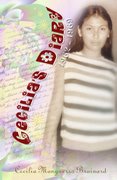
Cecilia’s Diary: 1962-1969, is a faithful record of Brainard’s days as a young colegiala in the Philippines. It is refreshing and funny, replete with references to a religious upbringing and a privileged lifestyle. The diary is a look back at a special decade, the 60s. That was a time when young girls wore party dresses made of breathless organdy that went with “flowers, ribbons, pearls, diamonds”. Jack Kennedy was assassinated, Chubby Checker came, interesting Peace Corps Volunteers arrived in town, Birdman of Alcatraz was shown, guileless children played jackstones, the Vietnam War was stepped up.”
https://www.amazon.com/dp/B004DUMZL0
Growing Up Filipino II: More Stories for Young Adults is the second volume of the Growing Up Filipino series by PALH. In this collection of 27 short stories, Filipino and Filipino American writers explore the universal challenges and experiences of Filipino teens after the historic events of 9/11. The modern demands do not hinder Filipino youth from dealing with the universal concerns of growing up: family, friends, love, home, budding sexuality, leaving home. The delightful stories are written by well known as well as emerging writers. While the target audience of this fine anthology is young adults, the stories can be enjoyed by adult readers as well.
https://www.amazon.com/dp/B007BGU3TY
Out of Cebu collects 28 essays by award-winning author, Cecilia Manguerra Brainard. Many of the essays are about Cebu, Philippines: its history, the places to see in this southern Philippine city, her experiences growing there, and colorful accounts about her mother's family, the Cuencos, a powerful political family in Cebu and the Philippines. There are also travel and food essays, all told from Brainard's unique point of view of a Cebu-born writer now living in the United States.
https://www.amazon.com/dp/B007NE0NZS
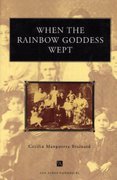
This highly-acclaimed novel, set in mythical Ubec, Philippines during World War II, is a lyrical portrayal of a girl's blossoming into young womanhood. Publishers Weekly notes that "the strengthening of the national spirit; the loss of innocence in two generations -- these themes are explored by the author... with persuasive conviction and stark realism.
https://www.amazon.com/dp/B004EYT1H6
Acapulco at Sunset and Other Stories is Cecilia Manguerra Brainard's second short story collection. The seventeen enchanting Filipino short stories are grouped into four categories: Long Ago Tales, Stories from the '60s and '70s, Stories from the '90s, and American Tales.The author, a Cebuana residing in Southern California, hopes readers will "learn something...about Filipinos or about mankind in general." Adding to her cast of Filipino characters in Philippine settings during the twentieth century, Brainard includes other nationals, Mexican and American settings, and the eighteenth century to communicate universal and timeless truths…Brainard's treatment of Filipinos and cultural assumptions and social practices regarding men and women, marriage, and social roles and relationships across the life cycle is insightful.
https://www.amazon.com/dp/B007HEXPDQ
Growing Up Filipino: Stories for Young Adults is the highly-acclaimed collection of stories about the experience of growing up Filipino. Emerging and established award-winning writers are the authors of this fine collection of 29 stories about what it means to be young and Filipino in the Philippines and in the United States. Filipinos in America are now the second largest in the umbrella group of Asian Americans, yet there is a scarcity of books by and for Filipinos. This impressive array captures the complexities of both the Filipino culture and history and the realities of the lives of young adults no matter what their ethnic affiliation. Each story is assigned to one of five universal themes: family, angst, friendship, love, and home. Each story is introduced by a thumbnail sketch of the author and a paragraph or two about some element of Filipino culture or history that is relevant to the story. Authors include those born and continuing to live in the Philippine, emigres, and American-born Filipinos.
BOOKLIST says, "The stories are delightful!" while SCHOOL LIBRARY JOURNAL says, "These 29 short stories offer a highly textured portrait of Filipino youth and an excellent sampling of creative writing."
https://www.amazon.com/dp/B004EEOIVK
In this, her third collection of short stories, Cecilia Manguerra Brainard shows an uncanny talent for speaking in varied voices that bridge time and place: she is at home in Vigan, the mythical Ubec (Cebu), Sagada, Manila, Cusco, Peru, Calcutta, Chartres, California, bringing each location alive with loving detail. She speaks as a school girl, an older woman, a love-struck boy, a stolen child, an underground revolutionary. She writes of her own family and childhood with love and sadness and a deep sense of humanity. The book collects 20 stories by the award-winning author.
https://www.amazon.com/dp/B013R8CKGI
Fiction by Filipinos in America is a highly acclaimed collection of stories by established and emerging Filipino and Filipino American writers. World Literature Today says, "(Editor) Manguerra Brainard's selection is a delight. Some of the stories are masterly, especially those written by such reliables as Carlos Bulosan, Linda Ty-Casper, N.V.M. Gonzalez, and Alberto S. Florentino. None is less than highly competent, and all are worth reading. Manguerra Brainard has done an excellent job of mixing critical judgement and personal taste."
Tags: Philippine, Philippines, literature, Cebu, Visayan, fiction, book, writer, stories, short stories
Cecilia Manguerra Brainard's official website is ceciliabrainarddotcom. She is the award-winning author and editor of 22 books, including When the Rainbow Goddess Wept, The Newspaper Widow, Magdalena, Selected Stories, Vigan and Other Stories, and more. She edited Growing Up Filipino 1, 2, & 3, Fiction by Filipinos in America, Contemporary Fiction by Filipinos in America, and other books..
Her work has been translated into Finnish and Turkish; and many of her stories and articles have been widely anthologized.
Cecilia has received many awards, including a California Arts Council Fellowship in Fiction, a Brody Arts Fund Award, a Special Recognition Award for her work dealing with Asian American youths, as well as a Certificate of Recognition from the California State Senate, 21st District, and the Outstanding Individual Award from her birth city, Cebu, Philippines.
She has lectured and performed at UCLA, USC, University of Connecticut, University of the Philippines, PEN, Shakespeare & Company in Paris, and many others. She has served in the Board of literary arts groups such as PEN, PAWWA (Pacific Asian American Writers West), among others.
Thursday, January 1, 2009
Leonard Casper's Possibilities of Humaneness in an Age of Slaughter (critique of When the Rainbow Goddess Wept)

Song of Yvonne (or When the Rainbow Goddess Wept)
Possibilities of Humaneness in an Age of Slaughter
By Leonard Casper
(From Sunsurfers Seen From Afar Critical Essays 1991-1996, by Leonard Casper, Anvil 1996)
With each passing generation, Filipinos are more inclined to let slip from their collective memories the horrendous events of the Japanese Occupation fifty years ago. One result is that unwittingly, they become accomplices to the attempt of Japanese revisionists, in recent “historical” accounts, to deny that their war ministry ever dreamed of aggressive empire building and to assert that they were forced by American treachery to invade the Philippines. In addition, during nearly half of the “postwar period” Filipinos had had reason to examine violence done by themselves against their hopes of national fulfillment; and therefore to be grateful for gifts and loans from the financial giant which Japan has become since determining to leave war and the production of war materials to other countries. Who then would feel guilty of having no knowledge whatsoever of A.V. H. Hartendorp’s The Japanese Occupation of the Philippines, I and II (1967), or Teodoro Agoncillo’s The Fateful Years (also in two volumes, 1965), or Hignio de Uriarte’s A Basque Among the Guerrillas of Negros (1962), or Jesus A. Villamor’s They Never Surrendered (1982), or the many books about Bataan and Corregidor, the Death March, guerrilla action in Mindanao, liberation of survivors in Sto. Tomas and Los Baños, recorded by American writers? Only in the early 1990s did the United States begin to honor its battlefield promise of American citizenship to Filipino veterans, should they choose it. Nationalists were properly outraged by the protracted delay; but how many Filipinos themselves cared to know details of those war years, not out of perpetual thoughts of revenge or reparation, but so that lessons learned would not be lost; and so that the heroic or powerless dead would not be “killed again” by forgetfulness?
Faded from memory too is the fiction by those who personally endured the hardships, the soul-testing, of the early forties: such as J.C. Laya’s This Barangay (1950); Stevan Javellana’s Without Seeing the Dawn (1947); Edilberto tiempo’s Watch in the Night (1953), More than Conquerors (1964), and The Standard-Bearer (1984). More memorable perhaps are Wilfrido D. Nolledo’s But for the Lovers (1970; 1994) and F. Sionil Jose’s Ermita (1985) whose events flow largely from the rape of a Filipina by a Japanese soldier; but their seriousness may be lost on readers attracted only to their pungent eroticism.
Unlike these authors, Cecilia Manguerra Brainard was born, in Cebu, after the war. However her father was a guerrilla engineer, just as Papa is in Song of Yvonne; and both real and fictional fathers brought their families temporarily to Mindanao, to survive under the renowned Col. Wendell Fertig. Brainard has listened to “endless” anecdotes about the war, until she began to imagine herself the child Yvonne narrating this composite story. In her preface she laments the fact that “Unlike Filipinos, the Japanese are very good at immortalizing injustices to them”; they remember Nagasaki and Hiroshima, while Filipinos forget their own numerous dead, their own cultural as well as material wounds. Yet her principal motive in memorializing the days of wrath and wounds, Brainard says, is not to authenticate that victimization so much as thereby to dramatize the “triumph of the Filipino spirit over foreign oppression.”
She does not flinch from describing atrocities: the rape and mutilation of a nurse; the beheading of Doc Mendez’s family; the torture of a former governor, after his wife is shot and his sons bayoneted because he refuses to join the puppet government; the massacre of entire towns; the loss of limbs from booby traps. Other events equally terrible but not caused by the enemy are presented: Nida’s pregnancy, which results when she distracts a Japanese guard from imminent discovery of contraband in Mama’s possession; Bitong’s accidental severing of his toe with a bolo; Doc’s nearly fatal penitential self-crucifixion; the betrayal of guerrilla leaders by Martin Lewis, an American amok. Each episode is as carefully detailed as if the narrative were autobiographical. Yet Brainard prevents the novel from descending into either melodrama or polemic by maintaining young Yvonne as her singular narrator through, a gilr not yet in her teens. “I lived that terrible War through Yvonne,” she writes in her preface, meaning that in a special way she intended a story of innocence/naivete gradually tested and tempered but never wholly torn to shreds by a violence for which the close, simple family life in Ubec (Brainard’s code word for Cebu) could hardly prepare Yvonne. Even as the girl’s experience darkens and she realized that only a thin line separates night and day, death and life, the perspective of a growing child is faithfully kept. Adults are making war. Her share of its pain is naturally scaled down – except as she is constantly aware of and responding to the greater trials of her family or their friends.
It is this controlled resonance which raises Song of Yvonne even beyond its evident importance as a documentary of Visayan resistance to the Japanese invasion; and which adds an unexpected dimension to this story of ritual passage into premature adulthood. By the time of liberation Yvonne finds herself bleeding, and her mother explains to her that this is the beginning of her period. What is symbolized but not stated is the fact that blood, so recklessly shed in ambush and torture chamber, also signifies life and the promise of continuity. Her menstruation, for example, parallels Nida’s ultimate decision not to abort the child which rape has placed inside her; Biton’s determination to go on despite loss of a crucial big toe; crucified Doc Mendez’ near-death experience and “resurrection”; Engineer Macaraig’s vision of Ubec rebuilt, based on his understanding of even pre-history: “I saw people living in Ubec centuries before me and centuries after me – an endless parade of humanity through time. And I knew that invaders would not really destroy Ubec, could never destroy its people.” He is including self-interested Americans like Lewis among those who threaten the Filipino dream not just of nationalism but of peaceful, communal life. The question of excessive American interference (Lolo Peping and Gil Alvarez’ grandparents have all witnessed the atrocities and needless deaths of famine which occurred during the Philippine-American War) is treated forthrightly, though with forgiveness for those who later fought alongside the Filipino scouts and guerrillas.
What is acknowledged is that the resoluteness of Filipinos under fire is final proof of their loyalty not to American sovereignty but to democratic ideals of self-determination consonant with a viable Filipino nation. The Macaraigs and Alvarezes take no lasting in their victories; war weariness, both in conscience as well as in body, sets in early. Their sole wish is merely to return safely to one another, once more. Symbolic of the price of violence eve in self-defense is the loss of Doc Mendez’ strange ability to judge the health of his patients on the basis of colorful auras surrounding them, as he engages more and more in military action.
Though Yvonne herself understands that the prewar world can never be wholly regained (the lost eden theme common to much of Philippine literature), in the midst of change she senses the need to conserve/restore constancy drawn from the native culture’s narratives of faith. At first it is only curiosity which makes her listen to Laydan, the family cook, tell of her youth as a disciple of Inuk, singer of epic tales. Laydan herself once briefly became a singer of legendary events, until excessive pride stole her voice away because she failed to follow Inuk’s advice, to become the epic; to surrender self-image to folk feeling and need. But having been humbled by war, Laydan’s voice is restored by the serenity of the land. Meanwhile her stories of many-breasted goddess Meybuyan, mother to all those in need, and of woman warrior Bongkatolan who helped save the Ilianon tribe from rapacious Maguindanaos, teach Yvonne the means of comforting those who suffer and sorrow. When Laydan dies (apparently summoned by a companionate angel of death across a country river), it is Yvonne who chants the tale of Tuwaang and the Maiden of the Buhong Sky: the rainbow brings promise of sunnier days, after a giant creates havoc; the slain are raised to life through the application of betel juice. (In the 1992 U.S. edition the novel’s title became When the Rainbow Goddess Wept.)
Other mythic remembrances become similar counterforces to the horrors of war. Nida’s unwanted pregnancy moves Yvonne to sing of how Tuwaang rescued the Maiden of Monawon from Deathless Man by discovering his soul concealed in a flute and smashing it. When Yvonne finds the corpse of a Japanese airman and contemplates the possibility that he too might have a child at home, she sings of Lam-ang whose bones were reassembled after he was swallowed by a monster fish and his mother’s apron restored him to life. Later Yvonne distracts Cris, the distraught survivor of the Alvarez family, with the tale of Banna, turned into a python that restored to full humanity and to marriage by a stranger’s betel juice. Finally, at the time of liberation and the family’s return to Ubec City, Yvonne rediscovers Inuk’s vet originally given her on Laydan’s deathbed. Immediately the girl thinks of how the Ilianons, ravaged and dispirited by Maguindanao warriors, were resurrected and, by ship, guided by Agyu to a place of paradise, Nalandagan…
Like Laydan, Yvonne has become the spine and flesh of her people. They are her song. She is their future; the past recreated, recovered; her song is the spirit of healing, the resilience of trial/national memory that will not let essence die.
By splicing together folktale, family anecdotes, and the realities of slaughter mitigated by the possibility of humaneness, Brainard has herself become Yvonne; has become singer of the songstress who commemorates a people at their finest, in times at their worst; and Brainard has managed that singularity-rising -from-complexity by finally finding the proper form for images from her earlier work. Stories of Ubec previously occurred in Woman with Horns and Other Stories (1987) where however they were mixed indiscriminately with other sketches and anecdotes and where they were in careful disorder themselves. Several, for example, could have been arranged chronologically but were not. “1521” offers as Lapu-Lapu’s reason for killing Magellan revenge for the death of his infant son at Spanish hands. “Alba” is more acquiescent to the mixed heritage brought to the islands by Europeans when, during the English occupation of Manila in 1763, Doña Saturnina gives birth to a fair-skinned son who nevertheless is tacitly accepted by her husband. And in “The Black Man in the Forest” old guerrilla general Gregorio, seeking Macario’s troops for a linkup in 1901, kills an Afro-American soldier but, despite his own men being near starvation, does not allow the body to be cannibalized. The title story recounts how, in 1903, an American Public Health director/widower finds a renewal of interest in life with seductive widow Agustina whose flirtation, though unconventional, is considered less than scandalous. The postwar period is marked, in “Miracle of Santo Niño Church,” by Tecla’s dreams of the Japanese who bayoneted her family; the 1960s, in “The Blue-Green Chiffon Dress,” when Gemma has a brief encounter with a GI headed back to Viet Nam; and the updating, in “The Discovery,” of a Filipina’s torn loyalties between her American husband and a former Filipino lover who however, like her homeland itself, seems corrupted and ravaged by time. The remaining stories are less amenable to chronological sequencing, yet do reach toward one another through the recurrence of identical characters, as if in search of a novel form.
Brainard’s occasional control over her short story, combining quietude with certitude, perhaps is best exemplified by “Friday Evening at the Seashore,” in which a young priest tries to console a lovelorn girl without realizing that he is the object of her love and despair. In Song of Yvonne the author joins this reliance on restraint and the focus on Ubec to a growing girl’s plainsong, further dimensioned by a chorus of folk echoes finally heard as one irrevocable voice, one song of diversified unity that sings itself.
Cecilia Manguerra Brainard's official website is ceciliabrainarddotcom. She is the award-winning author and editor of 22 books, including When the Rainbow Goddess Wept, The Newspaper Widow, Magdalena, Selected Stories, Vigan and Other Stories, and more. She edited Growing Up Filipino 1, 2, & 3, Fiction by Filipinos in America, Contemporary Fiction by Filipinos in America, and other books..
Her work has been translated into Finnish and Turkish; and many of her stories and articles have been widely anthologized.
Cecilia has received many awards, including a California Arts Council Fellowship in Fiction, a Brody Arts Fund Award, a Special Recognition Award for her work dealing with Asian American youths, as well as a Certificate of Recognition from the California State Senate, 21st District, and the Outstanding Individual Award from her birth city, Cebu, Philippines.
She has lectured and performed at UCLA, USC, University of Connecticut, University of the Philippines, PEN, Shakespeare & Company in Paris, and many others. She has served in the Board of literary arts groups such as PEN, PAWWA (Pacific Asian American Writers West), among others.