Showing posts sorted by relevance for query Journey of 100 years review. Sort by date Show all posts

Monday, June 19, 2017

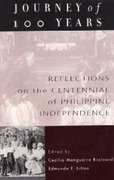
Book Review: Journey of 100 Years: Reflections on the Centennial of Philippine Independence, Eds Brainard & Littom


BOOK REVIEW
JOURNEY OF 100 YEARS: REFLECTIONS ON THE CENTENNIAL OF PHILIPPINE INDEPENDENCE
Edited by Cecilia Manguerra Brainard & Edmundo F. Litton
PAWWA (1999), 260 pages
AMERASIA JOURNAL
JOURNEY OF 100 YEARS
by Roger J. Jiang Bresnahan
As in most colonies in the nineteenth century, the grievances of Filipinos were many and resistance became more frequent, resulting in 1896 in the first phase of the Philippine Revolution. After its suppression, its leaders were paroled to Hong Kong. Two years later, the United States declared war on Spain, ostensibly on behalf of Cuba. With American help, Emilio Aguinaldo, the leader of the exiles in Hong Kong, was returned to the Philippines with a mandate to complete the revolution. In 1898, he inaugurated the Republic of the Philippines but eventually ran afoul of the Americans who opted for imperialism. Thus, the fledgling republic was short-circuited and the Philippines subjected to a harsher colonial rule than after Spain, involving a level of cultural and linguistic co-optation and economic domination that prevails even today.

Monday, March 20, 2017

Review of Journey of 100 Years, ed Brainard and Litton


BOOK REVIEW
JOURNEY OF 100 YEARS: REFLECTIONS ON THE CENTENNIAL OF PHILIPPINE INDEPENDENCE
Edited by Cecilia Manguerra Brainard & Edmundo F. Litton
PAWWA (1999), $17.95, 260 pages
AMERASIA JOURNAL

JOURNEY OF 100 YEARS
by Roger J. Jiang Bresnahan
As in most colonies in the nineteenth century, the grievances of Filipinos were many and resistance became more frequent, resulting in 1896 in the first phase of the Philippine Revolution. After its suppression, its leaders were paroled to Hong Kong. Two years later, the United States declared war on Spain, ostensibly on behalf of Cuba. With American help, Emilio Aguinaldo, the leader of the exiles in Hong Kong, was returned to the Philippines with a mandate to complete the revolution. In 1898, he inaugurated the Republic of the Philippines but eventually ran afoul of the Americans who opted for imperialism. Thus, the fledgling republic was short-circuited and the Philippines subjected to a harsher colonial rule than after Spain, involving a level of cultural and linguistic co-optation and economic domination that prevails even today.

The present volume has resulted from a conference held at Loyola Marymount University in Los Angeles in 1998. Like the conference, the book is a collaborative effort of many participants brought together by Edmundo F. Litton, a faculty member of Loyola Marymount University, and Cecilia Manguerra Brainard, a respected author, writing teacher, and proponent of Filipino American literary activities. What comes through all seventeen of the "reflections" in this volume is their intensely personal character. In the first essay, for example, Brainard offers a sustained meditation on Enrique, Magellan's Sumatran slave, who became the first person to circumnaviate the globe. Enrique comes alive for Brainard because "he spoke the same language as the people of Cebu," where Brainard herself was born, thus becoming her "kababayan," [countryman], she comments exultingly (5). Drawing from extant written sources, Brainard re-reads the history of the voyage from the contrary perspectives of the natives.

The first section focuses on Philippine history over the past hundred years. Damon Woods introduces us to Los Agraviados [the oppressed], a peasant-based, sometimes millenialist force operating in northern Luzon, antithetical to both the Spanish and the mainline revolutionaries. Elizabeth A. Pastores-Palffy recapitulates a large number of sources to show that a consequence of American rule was the cleavage between the political cultures of the elits and the masses that doggedly persists even today. Santiago Sia optimistically hopes that the legacy of Spanish Christianity can restore human dignity in the face of "poverty, oppression, and exploitation" (64). In the final essay in this historical section, John L. Silva compares present realities to photographs of the Philippines a century ago, finding economic and ecological degradation unimaginable at the time of the Revolution.

The second section, on education, begins with Litton's essay, "The Marriage of Maria Clara and Uncle Sam: Colonialism and the Education of Filipinos." The title alludes to a young woman in Jose Rizal's anti-colonialist novel, Noli Me Tangere, who is both the embodiment of the Spanish colonial ideal of Philippine womanhood and a victim of the Spanish friars. Its power as a symbol of miseducation under Spain is self-evident, but Litton shows that Uncle Sam's educational system equally served colonial objectives, with the result that Filipinos came "to see their culture as second rate" (91). Rosita C. Galang enumerates the languages policies, successively, of Spanish, American, Japanese, and Filipino rule, as well the continuing debate over the usefulness of English Felice Prudente Sta. Maria describes historical sites as "culture-scapes" to reveal "a history of national character" (124). Her assertion that "whatever in a space might break its believability - the integrity of its values-laden story - is played down or removed" (125) smacks of paternalism.

The third section, on the Filipino experience in America, opens with an essay by the literary and cultural critic, Epifanio San Juan, Jr., who provides a contrarian perspective, faulting Filipinos in the U.S. for an insufficiently critical attitude toward American racial politics. Rejecting the premise of pan-Asian ethnicity, he points out the "the chief distinction of Filipinos from other Asians residing in the United States was that their country of origin was the object of violent colonization and unmitigated subjugation of monopoly capital" (152). San Juan is followed by Susan Evangelista's guide to recent literature about early Filipino laborers in the U.S. A similar nostalgia is presented by Valorie Slaughter Bejarano's recollection of Filipino immigrant life in Los Angeles in the 1950s. The section closes with Susan N. Montepio's description of how elderly Filipino immigrants, typically living with their upwardly mobile children, have used folklore, foodways, ritual, and symbolic behavior to validate themselves.

The final section, on literature, opens with a provocative essay by Herminia Meñez, that elucidates a ballad of the Tausug, an Islamic people of the Southern Philippines, wherein a mother and daughter muong a jihad against a Spanish garrison to avenge the daughter's defilement by a Spanish soldier. Meñez demonstrates how this ballad "encapsulates crucial themes in Philippine history" (190), including race, gender, and colonialism. Ruel S. De Vera untangles the complexities of newspaper publishing, with particular emphasis on the period of martial law. Paulino Lim, Jr., one of the most distinguished Filipino writers today, reflects on finding one's voice as a bilingual writer, grappling with the legacy of colonialism that has privileged English. Nadine Sarreal extends Lim's reflections, writing of herself as one who "straddles two cultures" and thus "will always write from a place of discomfort and unease" (232). The closing essay by Luisa A Igloria focuses on images of women in Philippine literature. Finding the image of the suffering woman ubiquitous, even in the alternate national anthem Bayan Ko, she concludes that "Pieta-like figures ... run the risk of collaborating with the very forces that have worked to simplify the position of women ..." (247).

As with any anthology, the contributions to this volume are calculated to appeal to a broad spectrum of interests. It is to the credit of Litton and Brainard that, as editors, they did not flinch from controversial perspectives, including that of San Juan. His trenchant observations are bolstered by the contributions of Litton himself, who catalogues the (mostly) deleterious effects of colonialism that persist today, particularly among those living in the U.S. The essays of Igloria and Meñez highlight unexamined biases against women in Philippine history. Pastores-Palffy delineates the diametrically opposed political cultures of the elites and the masses and shows the effects of that dichotomy that persist today. Damon Woods begins to do the same for the radical movement that he studies, but stops short of explaining whether it has relevance for the present.

Evangelista does well to highlight recent work of Al Robles, Prisco Tabios, and Oscar Peñaranda about those first known as the Pinoys, then the Manongs, and finally the Old Timers. Ultimately, though, she disappoints. As a lifetime student of the writings of Carlos Bulosan, Evangelista knows we cannot merely congratulate those whome Ben Santos called "the hurt men." San Juan provides the proper corrective to this nostalgia by explicating the widespread embarrassment of Filipinos in response to the Cunanan affair: "the life of Andrew Cunanan and the situation of thousands of Filipinos who lived and grew up in the shadow of the U.S. Navy presents a challenge that can unravel the most crucial questions of racism, class divisions, homophobia, deception, chicanery in high society, and so on" (144). In its combative style, this essay is vintage San Juan, as he challenges readers to engage in "critical self-examination" in order "to reveal why our subltern plight has worsened under the guise of self-help amerlioration ..." (143)

The introduction of the volume speaks of two audacious events of recent Philippine history - the martyrdom of Benigno Aquino, Jr. at the Manila airport in 1983 and the destruction of the American naval and air bases by the eruption of Mt. Pinatubo in 1991. In the first instance, "the Filipino people declared 'Tama na! - Enough!'" In the other, nature intervened " - ending years of America's presence in the Philippines" (vii-viii). This audacious book, a centennial stock-taking on an independence that never was, constructed as a journey to a goal yet to be realized, is in all of its parts, an interrogation of the colonial condition. In spite of profoundly divergent viewpoints, it strikes a resounding echo: Tama na!

Monday, June 19, 2017

World Literature Review of Cecilia Manguerra Brainard's Magdalena


MAGDALENA
by Cecilia Manguerra Brainard
published by Plain View Press
Austin, Texas. Plain View. 2002. 164 pages.ISBN 1-891386-29-8

Philippine Edition of Magdalena, University of Santo Tomas Publishing House, 2016
Available in eBook from from Kindle

 Review by World Literature Today
Copyright 2003 by World Literature Today

World Literature Today, April-June 2003 v77 i1 p100(2)

Cecilia Manguerra Brainard. Magdalena. Book Review by Kathleen Flanagan.
Full Text: COPYRIGHT 2003 University of Oklahoma

CECILIA MANGUERRA BRAINARD'S novel Magdalena takes its title from a protagonist descended from several generations of equally compelling female characters. Brainard's earlier novel When the Rainbow Goddess Wept (1994) employed the viewpoint of an adolescent girl to recount the Japanese invasion of the Philippines during World War II. With Magdalena Brainard uses a nonlinear narrative and multiple points of view to describe the history of the Philippines that roughly corresponds to its contact with the United States from the Spanish-American War to the war in Vietnam. Magdalena begins and ends with the perspective of Juana, daughter of the title character and her American lover (a POW in Vietnam), who is herself pregnant and curious about her family history. Letters, diaries, and narratives from numerous characters help Juana reconstruct her maternal and, to a lesser extent, paternal lineage.

Book Review: Fiction by Filipinos in America, edited by Cecilia Brainard, reviewed by World Literature Today


FICTION BY FILIPINOS IN AMERICA edited by Cecilia Manguerra Brainard
published by New Day Publishers, paper, ISBN 97110-0528X

Available in eBook from Kindle  
Review by World Literature Today, Autumn 1994 v68 n4 p894(1)
COPYRIGHT 1994 University of Oklahoma
The stories in Fiction by Filipinos in America, as editor Cecilia Manguerra Brainard puts it, "deal with oppression, flight, dislocation, unrequited love, longing for an idealized home; these are stories of humans dominated by values that run deep, of fierce loyalty for family and friends, and always that Filipino tenacity to deal with life's hardships and remain undefeated. Together these stories paint a gigantic picture of the Filipino, whether in the Philippines or in America, and it is a wonderful picture, this of a person who struggles, fails at times, but keeps on, a most resilient human being." Resilience is a quality long associated with Filipinos. As a poet once said," A Filipino is pliant like a bamboo." Neither typhoons nor monsoons could break the Filipino spirit; like the bamboo, it sways and bends with nature's relentless onslaughts, but it refuses to yield or die.

Monday, March 27, 2017

Lucy Urgello Miller's Glimpses of Old Cebu


One of the writers honored at Philippine Expressions' 2017 Pinay Gathering was Lucy Urgello Miller who authored the coffee table book, Glimpses of Old Cebu.  Her book collects vintage postcards, and one of the postcards is that of my mother, Concepcion Cuenco when she was a young Carnival Queen.


Here are some pictures and an excerpt of a Freeman Article about Lucy's book.

Monday, June 19, 2017

Book Review: Growing Up Filipino:Stories for Young Adults, Ed. Cecilia Brainard, Reviewed by Booklist


Booklist, April 15, 2003 v99 i16 p1462(1) 

Growing Up Filipino: Stories for Young Adults. (Book Review)_(book review) Frances Bradburn.
Full Text: COPYRIGHT 2003 American Library Association
Ed. by Cecilia Manguerra Brainard. Apr. 2003. 283p. PALH, paper, (0-9719458-0-2).
Gr. 9-12.

Available in eBook form from Kindle

In this fine short-story collection, 29 Filipino American writers explore the universal challenges of adolescence from the unique perspectives of teens in the Philippines or in the U.S. Organized into five sections--Family, Angst, Friendship, Love, and Home--all the stories are about growing up and what the introduction calls "growing into Filipino-ness, growing with Filipinos, and growing in or growing away from the Philippines." The stories are introduced by the authors, who illustrate the teenage experience as they remember it or as they wish to explain it to the reader--whether the focus is the death of a grandparent, budding sexuality, or going to the mall. The cultural flavor aspect never overwhelms the stories, and readers will be drawn to the particulars as well as the universal concerns of family, friends, love, and leaving home. While the stories are fairly easy to read, teens might be intimidated by the dense book design and small type. Take the time to help them overcome this. The stories are delightful!


Tags: Philippines, literature, young adults, book, #PhilippineLiterature

Read also
Book Review: Magdalena, novel by Cecilia Brainard, reviewed by Eileen Tabios
Book Review: Contemporary Fiction by Filipinos in America, Edited by Cecilia Brainard, reviewed by Harold Augenbraum
Book Review: Contemporary Fiction by Filipinos in America, edited by Cecilia Brainard, reviewed by Manoa
Book Review: Vigan and Other Stories, by Cecilia Brainard, reviewed by Allen Gaborro
Book Reveiw: Finding God: True Stories of Spiritual Encounters, Eds Brainard & Orosa
Book Review: Journey of 100 Years: Reflections on the Centennial of Philippine Independence, Eds Brainard & Litton

Thursday, October 15, 2015

Research Sources and Links re Cecilia Manguerra Brainard #Philippines Literature


Some students have asked for help regarding their research.  Here are sources and links about Cecilia Manguerra Brainard or Cecilia Brainard, official website http://www.ceciliabrainard.com

Wikipedia site on Cecilia Brainard
https://en.wikipedia.org/wiki/Cecilia_Manguerra_Brainard

Other Sources about Cecilia Manguerra Brainard

* Abao, Jane Frances P. 2001. "Retelling the Stories, Rewriting the Bildungsroman: Cecilia Manguerra Brainard's When the Rainbow Goddess Wept ." Humanities Diliman (January-June)

* Adler, Les. 1996. "Acapulco at Sunset and Other Stories: A Review." Pilipinas 26 (Spring)

* Aubry, Erin. "A Child's Vision of Life During Wartime." Los Angeles Times. November 15, 1994, E-8.

* Beltran, Marie G. "Woman With Horns and Other Concerns." Filipinas (May 1995_: 29, 56.

* Casper, Leonard. "BACK-AZIMUTH Filipino Writers Abroad." Kinaadman XXVII (2005): 69-82.

Thursday, May 12, 2016

Publishing: PALH or Philippine American Literary House

PALH or Philippine American Literary House

From the site http://palhbooks-press.blogspot.com, here's information about this press:


PALH also known as Philippine American Literary House is a small press that publishes high quality fiction and creative non-fiction by Filipino Americans and other Filipinos.


PALH's beginnings connect with PAWWA (Philippine American Women Writers and Artists), an award-winning group that supported other Filipina writers and artists and provided community service.  PAWWA recognized the lack of Filipino and Filipino American books in the United States and encouraged PAWWA co-founders Cecilia Brainard and Susan Montepio to start PALH.   PALH continues under the leadership of Cecilia Brainard with the help of an Advisory Board.

Monday, June 12, 2017

Foregrounding Myths and Legends in Cecilia Manguerra Brainard's "When the Rainbow Goddess Wept", Ruth S. Rimando - Thesis Paper


FOREGROUNDING MYTHS AND LEGENDS
IN CECILIA MANGUERRA-BRAINARD’S
“ WHEN THE RAINBOW GODDESS WEPT”

A Thesis Submitted to the
Faculty of Arts and Letters of the
University of Santo Tomas

In Partial Fulfillment of the Requirements
For the Degree of Bachelor of Arts
Major in Literature

By
Ruth S. Rimando
February 2006

Sunday, June 2, 2013

Some Anthologies that include Cecilia Brainard's writings

Some Anthologies that include Cecilia Brainard's writings:

Asian American Literature, Glencoe McGraw-Hill, 2001
A Taste of Home, editors Ed Maranan and Len Maranan-Goldstein, Anvil, 2008
The AA Literary Realm, Asian American Literary Forum, 1991
Amerasia Journal, Asian American Studies Center, UCLA, 1986
An Anthology of Philippine Writing in America, Philippine American Press Club of LA, 1989
Babaylan: An Anthology of Filipina and Filipina American Writers, Aunt Lute, 2000
Behind the Walls: Life of Convent Girls, Anvil, 2005
The Beginning and Other Asian Folktales, PAWWA, 1994
Cherished: 21 Writers on Animals They Have Loved and Lost, Abrecrombie, New World Library, 2011
City Dialogues: Life During Wartime, ed. D. Hideo Maruyama, City Dialogues Project, 2003
Contemporary Fiction by Filipinos in America, Brainard, Anvil, 1998
Dis-Orient Journalzine, Hong, 1994
Going Home to a Landscape, ed. Villanueva & Cerenio, Calyx Books, 2003
Growing Up Filipino: Stories for Young Adults, PALH, 2003
Linking the World Through English, Diwa Textbooks, 2006
Fast Food Fiction, Noelle Q. de Jesus, Anvil, 2003
Fiction by Filipinos in America, Brainard, New Day Publishers, 1993
Finding God: True Stories of Spiritual Encounters, Anvil, 2009
Forbidden Fruit, Anvil Publishing Inc., 1992
From America to Africa: Essays of Filipino Women Overseas, FAI, 2000
FIL-AM: The Filipino American Experience, Publico, 1999
Fern Garden, UP Press, 1999
Harvest I, Ed. Lina Espina Moore, New Day Publishers, 1992
Home to Stay: Asian American Women's Fiction, Ed. Bruchac & Watanabe, Greenfield Review Press, 1990
Journey of 100 Years; Reflections on the Centennial of Philippine Independence, PAWWA, 1999
Making Waves: An Anthology of Writings by and About Asian American Women, Ed. Asian Women United California, Beacon Press, 1989
New to North America, Burning Bush Publications, 1998
The Perimeter of Light:Writing About the Vietnam War, New Rivers Press, 1992
Philippine American Short Stories, Giraffe, 1997
Philippine Speculative Fiction, Alfar, Kestrel, forthcoming
Pinay: Autobiographical Narratives by Women Writers,1926-1998, Ateneo de Manila University Press, 2000
On a Bed of Rice, Anchor Books/Doubleday, 1995
Our World of Reading Gr. 7, Anvil, 2010
Remembering Rizal: Voices from the Diaspora, Lozada, PAWA, 2011
Search, The Augustinian Journal of Cultural Excellence, Colegio San Agustin, 2005
Seven Stories From Seven Sisters: A Collection of Philippine Folktales, PAWWA 1992
Screaming Monkeys: Critiques of Asian American Images, Galang, Coffee House Press,2003
Sojourns, Mar Productions 1998
Songs of Ourselves, Anvil, 1994
St. Andrews Review, St. Andrews Presbyterian College, 1985
Tulikarpanen: Anthology of Filipina Writings, translated into Finnish, ed. Ritta Vartti 2001
The Quill: The Asian Writer's League Journal, 1991

Wednesday, June 8, 2016

Why I Started a Publishing House, by Cecilia Brainard


PAWWA

Aside from being a writer, I recently embraced the role of publisher of PALH or Philippine American Literary House, a press that publishes high quality fiction and creative non-fiction by Filipino Americans and other Filipinos. PALH is a member of PAPC (Philippine American Publishers Consortium).

Saturday, March 26, 2022

Book Review of Seven Stories from Seven Sisters, Children's Filipino Folklore


Thanks to Dr. Herminia Menez Coben Herminia Coben who gave me a copy of this review of the children's book, Seven Stories from Sisters, a project of PAWWA (Philippine American Women Writers and Artists), a group I cofounded. The book was published a while back. PALH may have a few copies left, so email palhbooks@gmail.com if interested.
From Wikipedia: "Philippine American Women Writers and Artists also known as PAWWA was founded in 1991 by a group of seven Filipina writers in Southern California.[1] It was the first such support group for Filipina women writers. Aside from supporting one another, the group wanted to help other Filipina writers and artists, as well as to provide community service. PAWWA encouraged the creation of PAWWA-North, headed by Ceres Alabado in the Bay Area, California.
PAWWA's founding members are: Valorie Slaughter Bejarano, Cecilia Manguerra Brainard, Mariquita Athena Davison, Fe Panalingan Koons, Susan N. Montepio, Cecile Caguingin Ochoa, and Nentuzka C. Villamar.
For six years, PAWWA received the highly competitive Multicultural Entry Grant from the California Arts Council (CAC). PAWWA used that funding to help publish a newsletter and books: Seven Stories from Seven Sisters: A Collection of Philippine Folktales (1992); The Beginning and Other Asian Folktales (1995);A Directory of Philippine American Women Writers and Artists; and Journey of 100 Years: Reflections on the Centennial of Philippine Independence (1999)."


Tags: Filipino children's book, Filipino folktales, Filipino folklore

Sunday, March 26, 2017

2017 Pinay Gathering at Philippine Expressions Bookshop #Philippines #literature


Linda Nietes of Philippine Expressions Bookshop, gathered Filipina writers and honored them last Saturday, March 25, 2017 at the Philippine Expressions Bookshop at 479 W 6th Street #105,  San Pedro, California 90731; tel: 310-514-9139.

The writers also received a Commendation from Supervisor Janice Hahn of the Los Angeles County. The writers are (not in alphabetical order): Leslie Ryan, Ludy Ongkeko, Carlene Bonnivier, Rose Ibanez, Lucy Urgello Miller, Carmen Davino, Herminia Menez, and Cecilia Brainard.

I'm sharing the program and some pictures.