Showing posts sorted by relevance for query The Black Man in the Forest. Sort by date Show all posts

Friday, August 9, 2013

Fiction - The Black Man in the Forest, by Cecilia Manguerra Brainard


This is my short story that's part of my first collection, Woman With Horns and Other Stories. "The Black Man in the Forest" was first published in Amerasia Journal, UCLA, Vol 12, No.1. 
THE BLACK MAN IN THE FOREST
Copyright 2013 by Cecilia Brainard, all rights reserved 
Philippines, 1901
            By mid-day, the old general and his men stumbled into that part of the forest where they felt they could stop and make camp. The stronger men immediately searched for food; some dug for roots, others set traps for lizards and sparrows. The skin-and-bones ones collapsed in heaps under the bushes.
            General Gregorio studied his men then did something he instructed them never to do - he left the scraggly group of soldiers and walked to the river. He drank some water and sat on a boulder to contemplate his situation. He had seven men, three guns, ten bullets, and eight rusty machetes. They had no food nor medicines. Even before this point of desperation, they had relied on saliva, herbs, and faith to heal their wounded who eventually died and were buried in unmarked graves as his army was driven back into the mountains by the Americans.

Wednesday, October 27, 2021

Conversation with Author Cecilia Brainard, YouTube LA Public Library


Many thanks to Ana Campos, Acting Principal Librarian at the Los Angeles Public Library for hosting a virtual program, A CONVERSATION WITH AUTHOR CECILIA MANGUERRA BRAINARD: SELECTED SHORT STORIES.  Writer, Actor, and Buddhist pastor Noel Alumit was  the interviewer/facilitator.

This was aired yesterday on the LAPL.org's Facebook and YouTube sites. 

You can watch the program on LAPL.org's YouTube site. Don't forget to like it!


Noel and I have known each other for many years, and so the interview had an ease possible only between two friends who happen to be novelists too.

Noel had sent me some questions before the program, and while the actual one-hour interview covered more topics than just these questions, I'm sharing my notes to answer his questions. The taped interview is much richer and more detailed, so do try to view that one.

Saturday, April 14, 2018

Short Story by Cecilia Brainard, Waiting for Papa's Return


Hi, I'm sharing my short story, "Waiting for Papa's Return", which is part of my first short story collection, Woman with Horns and Other Stories. This story also appeared in the anthology Home to Stay: Asian American Women's Fiction, edited by Sylvia Watanabe and Carol Bruchac, Greeenfield Review Press. It was also published in Making Waves: An Anthology of Writings by and about Asian American Women, edited by Asian Women United of California, Beacon Press.

Woman with Horns and Other Stories is easily available in its Kindle ebook form. ~ #CeciliaBrainard
~~~
WAITING FOR PAPA'S RETURN
by Cecilia Manguerra Brainard
Copyright 2018 by Cecilia M. Brainard, all rights reserved.

When Reverend Mother Superior tells Remedios her father died, all she can think is how ugly the nun looks. Remedios stares at the mustache fringing the nun's upper lip; Reverend Mother Superior stares back with pale watery eyes.

“This morning, child. Heart attack,” the nun says.

Monday, November 30, 2020

Herminia Menez Coben Reviews Cecilia Brainard Short Story Collections


BOOK REVIEW OF CECILIA BRAINARD'S TWO SHORT STORY COLLECTIONS

Review by Dr. Herminia Menez Coben

The Halo-Halo Review, Nov. 24, 2020

WOMAN WITH HORNS AND OTHER STORIES by Cecilia Manguerra Brainard

(PALH 2020, New Day 1987) 

and

ACAPULCO AT SUNSET AND OTHER STORIES by Cecilia Manguerra Brainard

(PALH 2020, Anvil 1995)

BOOKS' LINK

In her debut collection of short stories, WOMAN WITH HORNS, Cecilia Manguerra Brainard launches her mythical Ubec (Cebu) – a historic, cosmopolitan and vibrant city – the setting of many of her short stories, as well as her most recent novel, THE NEWSPAPER WIDOW.

Thursday, August 5, 2021

Herminia Menez Reviews 2 Short Story Collections by Cecilia Brainard


Review by Herminian Menez Coben for Halo-Halo Review,  Nov 24, 2020, reprinted with permission 

WOMAN WITH HORNS AND OTHER STORIES by Cecilia Manguerra Brainard

(U.S. Edition PALH 2020, New Day 1987) 

and 

ACAPULCO AT SUNSET AND OTHER STORIES by Cecilia Manguerra Brainard

(U.S. Edition PALH 2020, Anvil 1995)


BOOKS' LINK


In her debut collection of short stories, WOMAN WITH HORNS, Cecilia Manguerra Brainard launches her mythical Ubec (Cebu) – a historic, cosmopolitan and vibrant city – the setting of many of her short stories, as well as her most recent novel, THE NEWSPAPER WIDOW. 

Ubec is home to the historical figure Lapu-Lapu, portrayed in “1521” not in his role as the legendary defender of the island against Spanish conquistadors but as a new father engulfed with joy at the birth of his first son, only to lose him, soon after, to enemy fire.

In “Black Man in the Forest,” as in “1521,” war serves as the necessary background for highlighting the complex emotional drama that is at the core of the narrative. The Philippine American War situates General Gregorio in a forest, where he has fled with a few of his men to escape the Americans. Confronted by a “black man,” he is wounded in the leg and he fires back, killing the American soldier with his last bullets. In the aftermath, the general reflects on his victim’s death, and with great compassion gives the stranger a river-funeral, saving him from the predation of one of his men, the cannibalistic Liver-Eater.

Friday, November 29, 2013

Fiction by Guest Blogger, LINDA TY-CASPER, "In Place of Trees"

Dear Readers,
For a change of pace, I have a Guest Blogger, the highly-acclaimed Filipina author, Linda Ty-Casper. Her numerous books are generally historical fiction, including The Peninsulars, The Three-Cornered Sun, Ten Thousand Seeds, Dread Empire, Hazards of Distance, Fortress in the Plaza, Awaiting Trespass, Wings of Stone, A Small Party in a Garden, and DreamEden. Linda shares with us "In Place of Trees," a short story set in the Philippines, immediately after World War II.  
~ Cecilia


IN PLACE OF TREES
Linda Ty-Casper
Copyright 2013 by Linda Ty-Casper, all rights reserved

He came out of the sun, onto the porch, with the shadows white on his dark face. "Where's your father, Boy," he asked, without telling me who he was, not making way for the woman who stood behind him on the lower step, a large man's watch on her right arm.
            "He's not here," I answered, staring at him, challenging him to know my name.
            "Your mother?"

Friday, August 9, 2013

How to Write a Novel #2 - Focus on Character, by Cecilia Brainard


How to Write a Novel #2 - Character

I myself have wondered where my characters have come from. I have written not only about girls and women, but about friars, soldiers, other men. Some of these characters were inspired by my life or by people I have known or met. But some of them seemed to have come from the Muse directly, as the General did in my short story, "The Black Man in the Forest."  I recall I was working on another story, "Woman With Horns," and I was writing the funeral part of the older woman, when suddenly, in my imagination, the following happened:

Thursday, November 21, 2013

Creative Writing: The Importance of Sensual Writing


For over a month now, I've focused on the disasters that struck Central Philippines: the 7.1 Magnitude earthquake that hit Bohol and Cebu, Philippines, last October 15; and super typhoon Haiyan that devastated a wider portion of Central Philippines, including the islands of Leyte, Samar, Cebu, Capiz, and others, last November 8.

This morning I'm going to take a break and  look at an aspect of Creative Writing -- "Sensual Writing." I'm not talking about sex, dear Readers, rather I'm referring to writing that engages the readers via the five senses. The writer allows the readers to see, smell, hear, feel, taste.

Sensual Writing ties in with a Rule in Creative Writing which is: Show, Don't tell. The writer is giving details so that the Readers can more actively participate in the "fictive world" of the writer.

Thursday, October 24, 2013

Fiction by Cecilia Manguerra Brainard - The Turkish Seamstress in Ubec


 Dear Readers,
I'm sharing a story that's part of the newly released anthology, Philippine Speculative Fiction Volume 8, edited by Dean Francis Alfar and Nikki Alfar. It's available in Amazon.com's Kindle and in hard copy in the Philippines. This is a bit dark, but Halloween is coming up, so enjoy!  Cecilia


The Turkish Seamstress in Ubec


I’ve never experienced pain like this in my thirty-five years of life. I’m talking about this slash on my neck; I’m talking about the contact of the knife against my skin. It’s agony that doesn’t just smolder where the flesh and bones have separated; it courses through every part of my body from my toes all the way to the very tips of my long hair. The millisecond the serrated metal touched my neck, I heard my skin rip like satin and what followed were the worst sounds I’ve ever heard: neck bones crunching and snapping reminding me of the awful sounds made by a butcher hacking away at a dead cow. And now the knife lies next to me, cold and slippery from my own blood.

Saturday, December 18, 2021

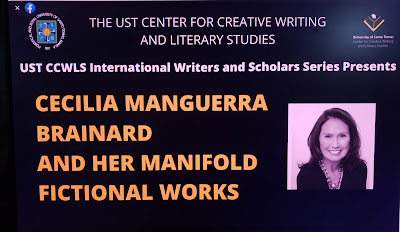
Author Cecilia Brainard Talk University of Santo Tomas CCWLS


https://www.youtube.com/watch?v=g4Y0aSYxs3Q

Filipino FilAm Author Cecilia Manguerra Brainard gives a talk for the University of Santo Tomas Center for Creative Writing and Literary Studies. This is part of their UST International Writers and Scholars Series.

This same video can be viewed in the Facebook site of UST Center for Creative Writing and Literary Studies:

https://fb.watch/9ZIg1qMcNg/


Following is the transcript of Cecilia's talk:

Celebrating Writing and My Selected Short Stories

For the International Authors Series of UST Center for Creative Writing and Literary Studies

by Cecilia Manguerra Brainard, copyright by Cecilia Brainard

Wednesday, October 9, 2013

Short Story by Cecilia Brainard - 1943: TIYA OCTAVIA

This short story is set in the Philippines during World War II. It is part of my collection, Vigan and Other Stories (Anvil, Kindle, Nook). This short short, or flash fiction piece uses the Second Person Point of View, which is unusual.

1943: TIYA OCTAVIA
by Cecilia Manguerra Brainard 

You dream of fried bananas, sizzling hot in bubbling coconut oil, golden brown, its sweet aroma bringing back childhood memories of your mother in the kitchen — happy times. With a metal spatula, you lift the banana-halves from the wok and roll them in a mound of precious sugar. The irresistible sight of the white grains of sugar clinging to the red-brown surface make your mouth water, pushes your sister's words out of your mind: "No matter what happens, don't leave the house." Ever since the Japanese occupied Vigan, you have not eaten fried bananas. Meals consist of sweet potatoes, cooked with mongo beans, dried fish, and coconut milk. You're fortunate, you realize that, because many have only watery soup to drink.

Thursday, January 1, 2009

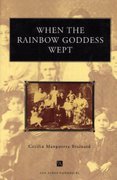
Leonard Casper's Possibilities of Humaneness in an Age of Slaughter (critique of When the Rainbow Goddess Wept)


Song of Yvonne (or When the Rainbow Goddess Wept)
Possibilities of Humaneness in an Age of Slaughter

By Leonard Casper

(From Sunsurfers Seen From Afar Critical Essays 1991-1996, by Leonard Casper, Anvil 1996)

Also published in Philippine Studies
Recommended Citation Casper, Leonard (2012) "Song of Yvonne: Possibilities of Humanities in An Age of Slaughter," Philippine Studies: Historical and Ethnographic Viewpoints: Vol. 41: No. 2, Philippine Studies vol. 41, no. 2 (1993): 251–254 
Article 8. DOI: https://doi.org/10.13185/2244-1638.4830 Available at: https://archium.ateneo.edu/phstudies/vol41/iss2/8  

With each passing generation, Filipinos are more inclined to let slip from their collective memories the horrendous events of the Japanese Occupation fifty years ago. One result is that unwittingly, they become accomplices to the attempt of Japanese revisionists, in recent “historical” accounts, to deny that their war ministry ever dreamed of aggressive empire building and to assert that they were forced by American treachery to invade the Philippines. In addition, during nearly half of the “postwar period” Filipinos had had reason to examine violence done by themselves against their hopes of national fulfillment; and therefore to be grateful for gifts and loans from the financial giant which Japan has become since determining to leave war and the production of war materials to other countries. Who then would feel guilty of having no knowledge whatsoever of A.V. H. Hartendorp’s The Japanese Occupation of the Philippines, I and II (1967), or Teodoro Agoncillo’s The Fateful Years (also in two volumes, 1965), or Hignio de Uriarte’s A Basque Among the Guerrillas of Negros (1962), or Jesus A. Villamor’s They Never Surrendered (1982), or the many books about Bataan and Corregidor, the Death March, guerrilla action in Mindanao, liberation of survivors in Sto. Tomas and Los Baños, recorded by American writers? Only in the early 1990s did the United States begin to honor its battlefield promise of American citizenship to Filipino veterans, should they choose it. Nationalists were properly outraged by the protracted delay; but how many Filipinos themselves cared to know details of those war years, not out of perpetual thoughts of revenge or reparation, but so that lessons learned would not be lost; and so that the heroic or powerless dead would not be “killed again” by forgetfulness?

Faded from memory too is the fiction by those who personally endured the hardships, the soul-testing, of the early forties: such as J.C. Laya’s This Barangay (1950); Stevan Javellana’s Without Seeing the Dawn (1947); Edilberto tiempo’s Watch in the Night (1953), More than Conquerors (1964), and The Standard-Bearer (1984). More memorable perhaps are Wilfrido D. Nolledo’s But for the Lovers (1970; 1994) and F. Sionil Jose’s Ermita (1985) whose events flow largely from the rape of a Filipina by a Japanese soldier; but their seriousness may be lost on readers attracted only to their pungent eroticism.

Unlike these authors, Cecilia Manguerra Brainard was born, in Cebu, after the war. However her father was a guerrilla engineer, just as Papa is in Song of Yvonne; and both real and fictional fathers brought their families temporarily to Mindanao, to survive under the renowned Col. Wendell Fertig. Brainard has listened to “endless” anecdotes about the war, until she began to imagine herself the child Yvonne narrating this composite story. In her preface she laments the fact that “Unlike Filipinos, the Japanese are very good at immortalizing injustices to them”; they remember Nagasaki and Hiroshima, while Filipinos forget their own numerous dead, their own cultural as well as material wounds. Yet her principal motive in memorializing the days of wrath and wounds, Brainard says, is not to authenticate that victimization so much as thereby to dramatize the “triumph of the Filipino spirit over foreign oppression.”

She does not flinch from describing atrocities: the rape and mutilation of a nurse; the beheading of Doc Mendez’s family; the torture of a former governor, after his wife is shot and his sons bayoneted because he refuses to join the puppet government; the massacre of entire towns; the loss of limbs from booby traps. Other events equally terrible but not caused by the enemy are presented: Nida’s pregnancy, which results when she distracts a Japanese guard from imminent discovery of contraband in Mama’s possession; Bitong’s accidental severing of his toe with a bolo; Doc’s nearly fatal penitential self-crucifixion; the betrayal of guerrilla leaders by Martin Lewis, an American amok. Each episode is as carefully detailed as if the narrative were autobiographical. Yet Brainard prevents the novel from descending into either melodrama or polemic by maintaining young Yvonne as her singular narrator through, a gilr not yet in her teens. “I lived that terrible War through Yvonne,” she writes in her preface, meaning that in a special way she intended a story of innocence/naivete gradually tested and tempered but never wholly torn to shreds by a violence for which the close, simple family life in Ubec (Brainard’s code word for Cebu) could hardly prepare Yvonne. Even as the girl’s experience darkens and she realized that only a thin line separates night and day, death and life, the perspective of a growing child is faithfully kept. Adults are making war. Her share of its pain is naturally scaled down – except as she is constantly aware of and responding to the greater trials of her family or their friends.

It is this controlled resonance which raises Song of Yvonne even beyond its evident importance as a documentary of Visayan resistance to the Japanese invasion; and which adds an unexpected dimension to this story of ritual passage into premature adulthood. By the time of liberation Yvonne finds herself bleeding, and her mother explains to her that this is the beginning of her period. What is symbolized but not stated is the fact that blood, so recklessly shed in ambush and torture chamber, also signifies life and the promise of continuity. Her menstruation, for example, parallels Nida’s ultimate decision not to abort the child which rape has placed inside her; Biton’s determination to go on despite loss of a crucial big toe; crucified Doc Mendez’ near-death experience and “resurrection”; Engineer Macaraig’s vision of Ubec rebuilt, based on his understanding of even pre-history: “I saw people living in Ubec centuries before me and centuries after me – an endless parade of humanity through time. And I knew that invaders would not really destroy Ubec, could never destroy its people.” He is including self-interested Americans like Lewis among those who threaten the Filipino dream not just of nationalism but of peaceful, communal life. The question of excessive American interference (Lolo Peping and Gil Alvarez’ grandparents have all witnessed the atrocities and needless deaths of famine which occurred during the Philippine-American War) is treated forthrightly, though with forgiveness for those who later fought alongside the Filipino scouts and guerrillas.

What is acknowledged is that the resoluteness of Filipinos under fire is final proof of their loyalty not to American sovereignty but to democratic ideals of self-determination consonant with a viable Filipino nation. The Macaraigs and Alvarezes take no lasting in their victories; war weariness, both in conscience as well as in body, sets in early. Their sole wish is merely to return safely to one another, once more. Symbolic of the price of violence eve in self-defense is the loss of Doc Mendez’ strange ability to judge the health of his patients on the basis of colorful auras surrounding them, as he engages more and more in military action.
Though Yvonne herself understands that the prewar world can never be wholly regained (the lost eden theme common to much of Philippine literature), in the midst of change she senses the need to conserve/restore constancy drawn from the native culture’s narratives of faith. At first it is only curiosity which makes her listen to Laydan, the family cook, tell of her youth as a disciple of Inuk, singer of epic tales. Laydan herself once briefly became a singer of legendary events, until excessive pride stole her voice away because she failed to follow Inuk’s advice, to become the epic; to surrender self-image to folk feeling and need. But having been humbled by war, Laydan’s voice is restored by the serenity of the land. Meanwhile her stories of many-breasted goddess Meybuyan, mother to all those in need, and of woman warrior Bongkatolan who helped save the Ilianon tribe from rapacious Maguindanaos, teach Yvonne the means of comforting those who suffer and sorrow. When Laydan dies (apparently summoned by a companionate angel of death across a country river), it is Yvonne who chants the tale of Tuwaang and the Maiden of the Buhong Sky: the rainbow brings promise of sunnier days, after a giant creates havoc; the slain are raised to life through the application of betel juice. (In the 1992 U.S. edition the novel’s title became When the Rainbow Goddess Wept.)

Other mythic remembrances become similar counterforces to the horrors of war. Nida’s unwanted pregnancy moves Yvonne to sing of how Tuwaang rescued the Maiden of Monawon from Deathless Man by discovering his soul concealed in a flute and smashing it. When Yvonne finds the corpse of a Japanese airman and contemplates the possibility that he too might have a child at home, she sings of Lam-ang whose bones were reassembled after he was swallowed by a monster fish and his mother’s apron restored him to life. Later Yvonne distracts Cris, the distraught survivor of the Alvarez family, with the tale of Banna, turned into a python that restored to full humanity and to marriage by a stranger’s betel juice. Finally, at the time of liberation and the family’s return to Ubec City, Yvonne rediscovers Inuk’s vet originally given her on Laydan’s deathbed. Immediately the girl thinks of how the Ilianons, ravaged and dispirited by Maguindanao warriors, were resurrected and, by ship, guided by Agyu to a place of paradise, Nalandagan…

Like Laydan, Yvonne has become the spine and flesh of her people. They are her song. She is their future; the past recreated, recovered; her song is the spirit of healing, the resilience of trial/national memory that will not let essence die.

By splicing together folktale, family anecdotes, and the realities of slaughter mitigated by the possibility of humaneness, Brainard has herself become Yvonne; has become singer of the songstress who commemorates a people at their finest, in times at their worst; and Brainard has managed that singularity-rising -from-complexity by finally finding the proper form for images from her earlier work. Stories of Ubec previously occurred in Woman with Horns and Other Stories (1987) where however they were mixed indiscriminately with other sketches and anecdotes and where they were in careful disorder themselves. Several, for example, could have been arranged chronologically but were not. “1521” offers as Lapu-Lapu’s reason for killing Magellan revenge for the death of his infant son at Spanish hands. “Alba” is more acquiescent to the mixed heritage brought to the islands by Europeans when, during the English occupation of Manila in 1763, Doña Saturnina gives birth to a fair-skinned son who nevertheless is tacitly accepted by her husband. And in “The Black Man in the Forest” old guerrilla general Gregorio, seeking Macario’s troops for a linkup in 1901, kills an Afro-American soldier but, despite his own men being near starvation, does not allow the body to be cannibalized. The title story recounts how, in 1903, an American Public Health director/widower finds a renewal of interest in life with seductive widow Agustina whose flirtation, though unconventional, is considered less than scandalous. The postwar period is marked, in “Miracle of Santo Niño Church,” by Tecla’s dreams of the Japanese who bayoneted her family; the 1960s, in “The Blue-Green Chiffon Dress,” when Gemma has a brief encounter with a GI headed back to Viet Nam; and the updating, in “The Discovery,” of a Filipina’s torn loyalties between her American husband and a former Filipino lover who however, like her homeland itself, seems corrupted and ravaged by time. The remaining stories are less amenable to chronological sequencing, yet do reach toward one another through the recurrence of identical characters, as if in search of a novel form.

Brainard’s occasional control over her short story, combining quietude with certitude, perhaps is best exemplified by “Friday Evening at the Seashore,” in which a young priest tries to console a lovelorn girl without realizing that he is the object of her love and despair. In Song of Yvonne the author joins this reliance on restraint and the focus on Ubec to a growing girl’s plainsong, further dimensioned by a chorus of folk echoes finally heard as one irrevocable voice, one song of diversified unity that sings itself.
~end~

Read also

tags: Philippine literature, Filipino, author, writer, novel, fiction, World War II, Philippines, Cebu, Cecilia Manguerra Brainard, Cecilia Brainard

Thursday, November 14, 2013

Fiction: TYPHOON (1912) Novel Excerpt by Cecilia Manguerra Brainard


My heart and mind are focused on the victims of the super typhoon, Haiyan, that recently devastated the Philippines.

I'm sharing with you an excerpt from my novel, Magdalena, entitled Typhoon (1912). This is a work of fiction.

I'm also sharing my article that appeared in CNN.com, Childhood in the Path of Typhoons.

Please include the victims of Haiyan in your prayers.

Cecilia

~~~


TYPHOON (1912)
It was still dark when the sound of shattering glass cut through his deep sleep. Nestor held his breath at the sharp, splintering crash, and he turned his head toward the bedroom door and listened through the rain and wind for more noise. There were footsteps then the muffled voices of people. He wondered about the commotion and speculated these had something to do with last night’s events.
Last night, the storm had not raged as violently as it now did. The wind had not howled as loudly through the pines and coconut trees. It had been different last night. Things had been all right yesterday, unlike this cold, dark, early morning. He could sense the change, smell the moisture in the air, feel the prickling tension as people padded back and forth and the house strained against the wind and lashing rain that fell in hard rapping sounds on the rooftiles. 

Friday, October 11, 2013

Fiction by Guest Blogger, ERLINDA KRAVETZ, "Song from the Mountain"

Dear Readers,
For your weekend reading, we have a Guest Blogger, Erlinda V. Kravetz, author of Krystal Hut: Stories. 
~~~
Link: facebook.com/KrystalHut
Enjoy Song from the Mountain, a short story from her collection, Krystal Hut: Stories. The story is also part of the collection, Fiction by Filipinos in America, edited by Cecilia Manguerra Brainard.

Introduction to the short story, Song from the Mountain by Erlinda V. Kravetz

          These stories were culled from the scores of short stories I’ve written over the years starting in the late 80’s when I gave up journalism to write fiction.
        I had always wanted to write fiction but I also had to make a living. Journalism was a happy and serendipitous compromise – it allowed me to write, meet all kinds of people, travel, and collect experiences.  All those people  (they had to be, in one way or another,  ‘newsworthy’ to deserve a write-up) I met in my reporting career stayed with me and fed my imagination. As a graduate student and, briefly, an employee of the United Nations, I had also met and befriended - in addition to many Americans, one of whom I married  -  Latinos, Russians, Chinese, Japanese, French and others from all corners of the world.

Friday, January 24, 2014

Philippine Literature: The Phenomenon of "Woman With Horns"

I'm calling this a "phenomenon" because this is a case where a story has taken on a life of its own.


I'm referring to one of the first stories I wrote "Woman With Horns."This was inspired by a woman in Cebu, where I was born and grew up in. This woman was rumored to have horns. When we ran into her, the older folks would whisper that she hid her horns under her bulging hairdo.

Wednesday, July 17, 2013

Fiction - Flip Gothic, by Cecilia Manguerra Brainard


Fiction - This short story is part of Brainard's collection, Acapulco at Sunset and Other Stories, available from Kindle and Anvil.


FLIP GOTHIC
by Cecilia Manguerra Brainard

Dear Mama,
Thank you for agreeing to have Mindy. Jun and I just don’t know what to do with her. I’m afraid if we don’t intervene, matters will get worse. Mia, her Japanese American friend, had to be sent to a drug rehab place. You’d met her when you were here; she’s the tiny girl who got into piercing; she had a nose ring, a belly ring - and something in her tongue. Her parents are distraught; they don’t know what they’ve done, if they’re to blame for Mia’s problem. I talked to Mia’s Mom yesterday and Mia’s doing all right; she’s writing angry poetry but is getting over the drug thing, thank God.
 
There’s so much anger in these kids, I can’t figure it out. They have everything - all the toys, clothes, computer games and whatever else they’ve wanted. I didn’t have half the things these kids have; and Jun and I had to start from scratch in this country - you know that. That studio we had near the hospital was really tiny and I had to do secretarial work while Jun completed his residency. Everything we own - this house, our cars, our vacation house in Connecticut - we’ve had to slave for. I don’t understand it; these kids have everything served to them in a silver platter and they’re angry.

Wednesday, November 14, 2012

War Novel - Winning Hearts and Minds, by Cecilia Brainard


WINNING HEARTS AND MINDS (1967)

(A chapter from Brainard's novel, MAGDLENA, available Amazon, UST Press Bookstore in the Philippines, Lazada, and Shopee. It has been translated into Arabic (Egyptian Office for Publishing and Distribution), Greek (Lemvos), North Macedonian (Bata Press), with forthcoming Portuguese translation by the Brazilian publisher Editora Rua do Sabao.

copyright 2012 by Cecilia Manguerra Brainard 


DURING A VISIT to Nakhon Panom Air Base in Thailand, Colonel March Adams heard that Major Ron O’Connor had been shot down during a strike near the Plain of Jars, in Laos. When he returned to Mactan Air Force Base, which he commanded, he told his men about O’Connor, how he had been a member of the reputed 602nd Special Operations Squadron, which was primarily a search-and-rescue (SAR) outfit, responsible for all of Laos and parts of Cambodia. Known as the Sandy Mission, the 602nd also conducted strikes in Northern Laos and made sorties against the Vietcong enemy truck and troop convoys along Ho Chi Minh Trail; but they were famous for their rescue efforts. O’Connor and his wingman, Captain Jose Cass, had been on a rescue mission to save a gunned-down pilot when the enemy got their plane. The pilot whom they had tried to save in the first place, survived; but Major O’Connor “bought the farm,” as the colonel called it.

He said this matter-of-factly. This was his second war, and he had learned to look at war in terms of winnings and losses, as if it were a giant chess game with pawns and horses sacrificed for the more important chess pieces.

His men, however, were young; and they assumed a somber tone. “I knew Ron,” someone said, “he’s got a wife and two kids.”

Another spoke: “Once I went with Ron to Francois Restaurant. He had heard that Francois was the best French restaurant in Vietnam. Only problem was, Francois was in VC territory. No problem, Ron said, the VC left Francois’ clients alone. So one Friday, a group of us went, three jeeps, and guys holding machine guns all the way through VC territory to Francois. We picked a table that backed up against a wall and guys continued taking turns with the machine guns throughout the entire meal. We ate and had a lot of laughs. Oh, man, I can’t believe he’s gone.”

Thinking to console them, the colonel added, “His commanding officer recommended he be listed as MIA (missing in action) instead of KIA-NBR (killed in action, no body recovered) so his widow will continue collecting 20 grand a year. If he’s KIA-NBR, she’ll get a lump-sum settlement and less than half the continued compensation.”

The airmen proceeded to talk about their preferred listing if something did happen to them in Southeast Asia. Some men agreed that KIA-NBR was a better deal for their families; others thought the psychological anguish would be torture on them. The overall tone of the conversation turned so grim that all of them jumped at the suggestion to go to St. Moritz Bar.

Monday, January 9, 2023

A Locational Feminist Reading of Filipina American Fiction by Ma. Elena L. Paulima


Many thanks to Dr. Erlinda Alburo for calling my attention to this academic paper about Filipino American fiction published in KINAADMAN Vol, XL, 2018 (A Jounral of Southern Philippines, published by Xavier University).  The study includes discussions of stories from books I edited, including Fiction by Filipinos in America, and Growing Up Filipino 2. 

Dr. Ma. Elena L. Paulma looks at the works of Amelia Bueno, Lesliann Hobayan, Rashaan Meneses, Julia Palarca, Veronica Montes, Evelina Galang, Leny Stroble, and other Filipino American authors and academics. 

Thanks to Dr. Ma. Elena L. Paulma and Kinaadman for this study. 


Source: Kinaadman Vol XL, 2018,  All rights reserved

ARTICLES

A Locational Feminist Reading of

Filipina-American Fiction: A Non-Fiction

Ma Elena L Paulma

Abstract

This paper tackles the concept of epistemic violence described by Michel Focault and Gayatri Spivak as the erasure of cultures, languages and identities. Taking into consideration several voices, to wit: those of feminist literary theorists, characters from selected Filipina-American fiction, voices of Filipina-Americans whom the writer has had conversations with in America, the creative non-fiction voice of the writer and the writer’s own voice in weaving together this collective experience, this paper elucidates that the search for “home” is the context for the international diaspora of Filipinos. Interlacing critical analysis with creative non-fiction, the paper outlines the creation of the reterritorialized “third space.” By applying Susan Friedman’s five locational tropic patterns, namely: the metaphorics of “glocation”, migration, nation, borders and conjuncture, the paper examines seven selected short stories written by Filipina-Americans, all focusing on Filipina-American characters. The paper shows that Filipina-Americans experience a continuing sense of marginalization as they are neither entirely included in, nor completely excluded from, the American landscape.

Tuesday, March 13, 2018

Fiction Short Story "Friday Evening at the Seashore" by Cecilia Manguerra Brainard



I'm sharing a story that's part of my first short story collection, Woman With Horns and Other Stories.  The collection is available in Kindle form  http://www.amazon.com/dp/B004EPYZ4Y ~ Cecilia Manguerra Brainard


FRIDAY EVENING AT THE SEASHORE
 by Cecilia Manguerra Brainard
            Padre Zobel locked the rectory and, leaving the center of town, headed toward the seashore. He was a young Spaniard from the coastal village of Mojacar and he felt a special bond with the sea. It made his soul echo; it was home.

Thursday, October 31, 2013

Fiction by Guest Blogger BRIAN ASCALON ROLEY, "Old Man"


Dear Readers,
For your weekend reading, we have a Guest Blogger, BrianAscalon Roley, who writes in several genres. His novel AMERICAN SON (W.W. Norton) received the 2003 Association for Asian American Studies Prose Book Award and was a Los Angeles Times Best Book, New York Times Notable Book, and Kiriyama Pacific Rim Prize finalist among other honors. He has been a Visiting Fellow at the University of Cambridge and is currently Associate Professor of English and Creative Writing at Miami University of Ohio. More information can be found at his website www.brianroley.com
Enjoy his story, "Old Man."
Cecilia
 ~~~
INTRODUCTION BY BRIAN ASCALON ROLEY

Cecilia asked me to choose a story to post as guest blogger. I decided on a piece she published a couple years ago called “Old Man” in the anthology, Growing Up Filipino II.


A note on this story’s origins. This story is a sequel of sorts to my novel, American Son (W.W. Norton), so let me begin there.


Back in the early 1990s, I returned to Los Angeles after living for years in Connecticut and London. I found a city transformed. This was the era of the Rodney King Riots. This was a time of racial tension; gangs of one race or ethnicity would target bystanders of other races on the streets in Venice. This was a time of gang wars in which they became a sort of fashion among teens, even spreading to suburban high schools. It was an odd return after living in the London neighborhood of Camden Town.