I'm reprinting this from: http://pawainc.blogspot.com/search/label/Books
This holiday season, why not give the gift of literature? We will be posting reading lists and book buying suggestions from Filipino American authors here. This first one's from Eileen Tabios:
THE CHAINED HAY(NA)KU ANTHOLOGY Curated by Ivy Alvarez, John-Bloomberg Rissman, Ernesto Priego & Eileen Tabios. More info.
ARCHIPELAGO DUST by Karen Llagas (Meritage Press, 2010).
STAGE PRESENCE: CONVERSATIONS WITH FILIPINO-AMERICAN PERFORMING ARTISTS, Ed. Theodore S. Gonzalves (Meritage Press, 2007).
REQUIEM FOR THE ORCHARD by Oliver de la Paz (University of Akron Press, 2010).
TRAJE DE BODA by Aileen Ibardaloza (Meritage Press, 2010).
KALI'S BLADE by Michelle Bautista (Meritage Press, 2006).
THE THORN ROSARY: Selected Prose Poems & New (1996-2010) by Eileen R. Tabios, Edited with an Introduction by Thomas Fink and Afterword by Joi Barrios (Marsh Hawk Press, 2010). I realize I'm citing my book but I really want to draw attention to Dr. Barrios' essay which is useful in terms of discussing Filipina women's poetry. Ordering info: Hardback and Paperback.
PRAU by Jean Vengua (Meritage Press, 2007).
THE TRANSLATOR'S DIARY by Jon Pineda (New Issues Poetry and Prose, 2008). Semi-finalist in very competitive SF State Poetry Center Book Award contest that I judged.
POEMS OF THE BLACK OBJECT by Ronaldo Wilson (Futurepoem Books, 2009). Winner of 2010 AAWW Poetry Award that I judged with John Yau and Sesshu Foster.
DIWATA by Barbara Jane Reyes (BOA Editions, 2010).
~~~
Luis Francia: Holiday Gift Book List
The Beauty of Ghosts, by Luis H. Francia (Manila: Ateneo de Manila University Press, 2010). (Order at Philippine Expressions.)
Autobiography of Mark Twain: The Complete and Authoritative Edition, Vol. 1 (Berkeley: University of California Press, 2010).
Haywire: Flash Fictions, by Thaddeus Rutkowski (New York: Starcherone/Dzanc Books, 2010).
Poems of the Black Object, by Ronaldo Wilson (New York: Futurepoems Books, 2009).
Ilustrado, by Miguel Syjuco (New York: Farrar Straus & Giroux, 2010).
The Verso Book of Dissent: From Spartacus to the Shoe Thrower in Baghdad, edited by A. Hsiao & A. Lim (New York: Verso Books, 2010).
~~~~~
This list is from Karen Llagas:
Baker of Tarifa by Shadab Zeest Hashmi (Poetic Matrix Press, 2010).
Bulaklak sa Tubig: Mga Tula ng Pag-ibig at Himagsik / Flowers on Water: Poems on Love and Revolt by Joi Barrios (bi-lingual, Tagalog-English; Anvil Publishing, 2010).
The Place That Inhabits Us: Poems of the San Francisco Bay Watershed, edited by Sixteen Rivers Press (Sixteen Rivers Press, 2010).
Independence, by Sarah Lapido Manyika (Legend Press, 2008).
Crown of Dust, by Mary Volmer (Soho Press, 2010).
A Thousand Threads, by Steve Orlen (The Hollyridge Press Chapbook Series, 2009).
~~~~~
This list is from Veronica Montes:
What It Is (Drawn & Quarterly, 2008) and Picture This: The Near-Sighted Monkey Book (Drawn & Quarterly, 2010) by Lynda Barry. Writers and artists will be inspired by these two unorthodox “manuals” for the creative life. Written by hand and filled with Barry’s color-saturated collages, drawings, doodles, and whatnot, they're pretty much impossible to put down.
Pinoy Capital: The Filipino Nation in Daly City, by Benito M. Vergara, Jr. (Temple University Press, 2009). Like thousands of Filipinos before me, and hundreds of thousands after me, I grew up in Daly City. This is a fascinating anthropological take on my hometown, written in a style that is somehow both academic and conversational. A must-have for the bookshelf of anyone with even a tangential interest in a landscape that holds special meaning for Filipinos.
A History of the Philippines from Indios Bravos to Filipinos by Luis Francia (Overlook Press, 2010). A history of the Philippines written by a poet/journalist? Who could resist such a fine book? Pick up two copies: one for yourself, and one to offer as a gift to someone who has been very, very good this year.
Imago by Joseph O. Legaspi (CavanKerry Press, 2007). I had the chance to hear Joseph read from the poems in Imago when he participated in the PAWA Reading Series earlier this year, and was instantly drawn to his work. He captures all the beauty and innocence of childhood, tempered by the inevitable intrusion(s) of death, violence, sex (the confusing parts, that is). So good.
Diwata by Barbara Jane Reyes (BOA Editions, Ltd., 2010). Lush, lovely, inspired. These poems are filled with startling imagery, strong women, and story, story, story.
The Solemn Lantern Maker, by Merlinda Bobis (Delta, 2009). This novel begins just six days before Christmas with a mute boy trawling the streets selling his handmade paper lanterns. Add to this his best friend Elvis (who holds a terrible secret), an injured and missing American tourist, and a post-9/11 let’s-freak-everybody-out media frenzy, and what do you have? A really good story.
Growing Up Filipino II: More Stories for Young Adults, Cecilia Brainard, ed. (PALH Books, 2009). I would recommend this anthology even if I didn’t have a story in it. It’s one of those books I’d wished I’d had as a teenager and young adult, simply because it’s affirming to have our experiences transformed into a narrative on the page. You’ll find bits and pieces of yourself and yours in these stories, for sure.
I’d also like to recommend subscriptions to literary journals that seem to consistently support the work of Filipino writers. Bamboo Ridge Press, The Asian American Literary Review, and Manoa instantly come to mind.
~~~~~
Here's Vangie Buell's:
Sky High: The True Story of Maggie Gee, by Marissa Moss, illustrated by Carl Angel (Tricycle Press, 2009).
Cora Cooks Pancit, by Dorina K. Lazo Gilmore, illustrated by Kristi Valiant (Shen's Books, 2009).
Twenty Five Chickens and a Pig for a Bride: Growing up in an Filipino Immigrant Family, by Evangeline Canonizado Buell, illustrated by Carl Angel (T'Boli Publishing, 2006).
Images of America: Filipinos in the East Bay, by Evangeline Canonizado Buell, Evelyn Luluquisen, Ellie Luis, and Lillian Galledo (Arcadia Publishing, 2008).
Look for these books at Arkipelago Books and Eastwind Books of Berkeley.
~~~~
Here are Oliver de la Paz's recommendations:
In Canaan, by Shane McCrae (Rescue Press, 2010).
Burnings, by Ocean Vuong (Sibling Rivalry Press, 2010).
Each Crumbling House, by Melody S. Gee (Perugia Press, 2010).
Sweet Grass, by Micah Ling (Sunnyoutside Press, 2010).
~~~~~
Here's Barbara Jane Reye's list:
Lola: A Ghost Story, by J. Torres and Elbert Or (Oni Press, 2010).
Growing Up Filipino II: More Stories for Young Adults, edited by Cecilia Brainard (PALH Books, 2010).
breaking poems (Cypher Books, 2008), and Born Palestinian, Born Black (UpSet Press, 2010), by Suheir Hammad.
A History of the Philippines: From Indios Bravos to Filipinos (Overlook Press, 2010), and Eye of the Fish: A Personal Archipelago (Kaya Press, 2001), by Luis Francia.
The Solemn Lantern Maker (Delta, 2009), and Banana Heart Summer (Delta, 2008), by Merlinda Bobis.
In the Company of Strangers, by Michelle Cruz Skinner (Bamboo Ridge Press, 2009).
The Salt-Wind, Ka Makani Pa'akai, by Brandy Nalani McDougall (Kuleana 'Oiwi Press, 2009).
Outlaw: The Collected Works of Miguel Piñero (Arte Publico Press, 2010).
The Gods We Worship Live Next Door, by Bino A. Realuyo (University of Utah Press, 2006).
from unincorporated territory [saina], by Craig Santos Perez (Omnidawn Press, 2010).
Up Jump the Boogie, by John Murillo (Cypher Books, 2010).
Migritude, by Shailja Patel (Kaya Press, 2010).
Also remember, you can shop online at Arkipelago Books and Eastwind Books of Berkeley.
~~~
~~~~
Cecilia's List:
Lim, Paulino, Jr. REQUIEM FOR A REBEL PRIEST. New Day, 1996, First Edition, softcover, 225 pp., Paulino Lim is a professor of English at Cal State Long Beach.You can read his short story, Curacao Cure, in Our Own Voice (March 2002) http://www.oovrag.com/stories/stories2002a-3.shtml, Requiem for a Rebel Priest is his 3rd novel of a trilogy set during the Marcos and Aquino regimes follows the return of an ex-Jesuit to the Philippines when restless segments of the military were attempting to overthrow the Aquino government. You can find this and his other books in amazon.com
Ty-Casper, Linda. DREAM EDEN. Ateneo de Manila University Press, 1996, First Edition, softcover, 460 pp.,
One of the most prolific Filipino American writers is Linda Ty Casper who has written over 15 books. She is one author who should be admired not only for her talent but for her grace. This novel by Linda Ty-Casper is a portrait of the Philippines just before the Peaceful Revolution of 1986 up to the last coup of 1989.
Ty-Casper, Linda. AWAITING TRESPASS. New Day, 1989, First Edition, softcover, 180 pp.,
New York Times Book Review says: "Linda Ty-Casper pulls no punches in this unusual novel, which she describes as "a pasión" - yet she wears silk gloves. With jobs so deft they avoid the didactic but sting mightily, she indicts everything, from the values of the well-to-do to martial law.."
Brainard, Cuizon, Evangelista, Montes, and Sarreal. ANGELICA'S DAUGHTERS, A DUGTUNGAN NOVEL. Anvil, 2010, First Edition, softcover, newsprint, 200 pp,
Angelica's Daughters is a collaborative novel by five established Filipina writers, called a "dugtungan." A dugtungan is a genre of Tagalog novel popular early in the 20th century, in which each writer creates a chapter and hands it off to the next, who writes another chapter without direction. The result, in this case, is an ensemble performance that contains something of the exhilaration of theatrical improv. One watches these accomplished authors inventively weave a historical romance, creating gripping heroines and turns of plot, crossing decades and national boundaries, tapping into cultural roots of the Philippines, Spain and America. Reading Angelica's Daughters is a gripping experience.~ Brian Ascalon Roley, Author of American Son (W.W. Norton)
Briones, Concepcion G. LIFE IN OLD PARIAN. Kaguiakan 2000, softcover, new, 99 pages.
I love this hard to find book about historic old Cebu, especially because the Parian district is undergoing gentrification. Concepcion Briones writes about growing up in the old Parian district of Cebu. She writes about the old families who lived there; she describes the houses and landmarks of the place; she records gossip of the time. This book is a must-read for anyone interested in Cebu.
Evangelista, Susan. GROWING INTO ASIA AND OTHER ESSAYS. UP Press, First Edition, softcover, 102 pp.
This is a collection of charming and insightful essays by Susan Evangelista who straddles many worlds. She hails from Michigan but is married to a Filipino. She has traveled to Japan, China, Thailand, Cambodia, and many other places. In this collection, she explores her life as an American in the Philippines, and reflects on the many other facets of her fascinating life. Evangelista taught writing and literature at the Ateneo de Manila.
Wednesday, December 15, 2010
Holiday Gift Book List - reprinted from Barbara Jane Reyes/PAWA blog

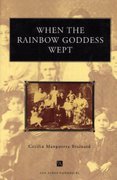
 Cecilia Manguerra Brainard's official website is ceciliabrainarddotcom. She is the award-winning author and editor of 22 books, including When the Rainbow Goddess Wept, The Newspaper Widow, Magdalena, Selected Stories, Vigan and Other Stories, and more. She edited Growing Up Filipino 1, 2, & 3, Fiction by Filipinos in America, Contemporary Fiction by Filipinos in America, and other books..
Her work has been translated into Finnish and Turkish; and many of her stories and articles have been widely anthologized.
Cecilia has received many awards, including a California Arts Council Fellowship in Fiction, a Brody Arts Fund Award, a Special Recognition Award for her work dealing with Asian American youths, as well as a Certificate of Recognition from the California State Senate, 21st District, and the Outstanding Individual Award from her birth city, Cebu, Philippines.
She has lectured and performed at UCLA, USC, University of Connecticut, University of the Philippines, PEN, Shakespeare & Company in Paris, and many others. She has served in the Board of literary arts groups such as PEN, PAWWA (Pacific Asian American Writers West), among others.
Cecilia Manguerra Brainard's official website is ceciliabrainarddotcom. She is the award-winning author and editor of 22 books, including When the Rainbow Goddess Wept, The Newspaper Widow, Magdalena, Selected Stories, Vigan and Other Stories, and more. She edited Growing Up Filipino 1, 2, & 3, Fiction by Filipinos in America, Contemporary Fiction by Filipinos in America, and other books..
Her work has been translated into Finnish and Turkish; and many of her stories and articles have been widely anthologized.
Cecilia has received many awards, including a California Arts Council Fellowship in Fiction, a Brody Arts Fund Award, a Special Recognition Award for her work dealing with Asian American youths, as well as a Certificate of Recognition from the California State Senate, 21st District, and the Outstanding Individual Award from her birth city, Cebu, Philippines.
She has lectured and performed at UCLA, USC, University of Connecticut, University of the Philippines, PEN, Shakespeare & Company in Paris, and many others. She has served in the Board of literary arts groups such as PEN, PAWWA (Pacific Asian American Writers West), among others.
Wednesday, December 8, 2010
UPDATE NEIL SEDAKA CONCERT AT DISNEY HALL

Even though I was looking forward to the Neil Sedaka Concert at Disney Hall (December 7, 2010), I felt some nervousness. I wondered what he'd look like, and if he could still sing. A few years ago, my husband and I saw the Burt Bacharach concert at the famous Sydney Operahouse, and while we enjoyed the experience, we noticed that Burt was passing off a lot of the singing parts to his backup singers. Put simply, Burt could no longer sing well.
Those thoughts were running through my mind as I looked at the single grand piano on the stage - no full orchestra as Burt had - just a single piano. I wondered if Neil, at 71 years old, still had the voice.
When Neil Sedaka walked on to the stage,I am sure I was not alone in sizing him up. Thank God, he still looked like the Neil Sedaka of the 1960s. Okay,he looked older and he shuffled a bit but he still looked enough like that Neil of my youth.
He didn't say much - a short greeting, then he sat and played the piano and sang - and a wave of relief ran through me. The music was still good! More than good, great. The quality of his voice was still thankfully great. He seemed to avoid the high notes, but the voice itself was fine.
He started off with the old hits, giving bits of information about each song, and encouraging the audience to sing-along. The audience, clearly old fans, did just that, belting out 50 year old lyrics. And I have to admit, that so did I. Who would forget: Breaking Up Is Hard to Do, The Diary, Oh Carol, Calendar Girl, Happy Birthday Sweet Sixteen?
These songs brought me right back to my teens when I used to plaster my ear against the radio to listen to those hits. We all had a crush on Neil Sedaka. I had 45pm records that I also played (yes, I was one of the 40 million who bought Oh Carol). I also bought those Song Hits booklets with the words of the songs, and croon away at night. (I can still remember the lyrics of Run Samson Run, Little Devil, and his other songs.)
Here's a couple of things that he did last night that I liked: he'd turn his head now and then so the audience behind and to his side could see him; and he'd get up after each song and acknowledge the clapping by sweeping his right hand, and nodding to the audience all around him. (While it wasn't exactly a theater-in-the-round,there were a few seats behind him and to his left side, who had his back most of the time.)
From the old songs, he went on to songs he'd composed after the Beatles showed up and he suddenly ceased being popular. The Hungry Years had a haunting, melancholic sound as opposed to the perky cheerful songs of the '60s. I read somewhere that during his "hungry years" it was Australia that continued to give him work. So did England,the English continued to support him even while Americans had dumped him for the English boys. Last night he mentioned that a musical based on his life, "Laughing in the Rain," will be presented in London this March.
Good for Neil! Really, it's wonderful that this man, who has been playing the piano and singing for over half a century is getting the attention that he's getting now. Look at his contemporaries, I hardly hear about them - Paul Anka, Fabian, Connie Francis, Pat Boone. But here Neil Sedaka is still giving concerts to full houses.
I enjoyed the songs. His early songs were delightful,not only because of the joyful melody but because of the associated memories. His latter songs were pleasant to listen to and they were effective in evoking emotion, but they were difficult to remember. They didn't have that "jingle" effect that some of the early popular ones had.
The audience loved his old songs and his new songs. They gave him a standing ovation at the end so he had to come back and play some more.
I was left with respect for a man who has been true to his art. This was what I got from last night's concert. When a man has such a gift from God, he needs to honor that gift whether or not he is popular; you just have to use the gift.
This was what Neil did. He had the gift from the start. Son of Turkish-Jewish immigrants, he grew up in Brooklyn. His second grade teacher in a choral class suggested to his parents that he take piano lessons. His mother took a part-time job in a department store for six months to pay for a second-hand upright piano. In 1947, he attended the Julliard School of Music on Saturdays. He was big in the 1950s and the early 1960s, but by the late 1960s was losing popularity in the US. But he kept at it and found his audience outside the US. It seems he kept his life together - one wife, children, no drugs. And now at 71 years old, he's still doing his thing. That's what I call a blessing straight from God.
Go Neil!
Cecilia Manguerra Brainard's official website is ceciliabrainarddotcom. She is the award-winning author and editor of 22 books, including When the Rainbow Goddess Wept, The Newspaper Widow, Magdalena, Selected Stories, Vigan and Other Stories, and more. She edited Growing Up Filipino 1, 2, & 3, Fiction by Filipinos in America, Contemporary Fiction by Filipinos in America, and other books..
Her work has been translated into Finnish and Turkish; and many of her stories and articles have been widely anthologized.
Cecilia has received many awards, including a California Arts Council Fellowship in Fiction, a Brody Arts Fund Award, a Special Recognition Award for her work dealing with Asian American youths, as well as a Certificate of Recognition from the California State Senate, 21st District, and the Outstanding Individual Award from her birth city, Cebu, Philippines.
She has lectured and performed at UCLA, USC, University of Connecticut, University of the Philippines, PEN, Shakespeare & Company in Paris, and many others. She has served in the Board of literary arts groups such as PEN, PAWWA (Pacific Asian American Writers West), among others.
Tuesday, December 7, 2010
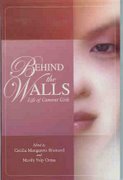
ARTICLE RE BEHIND THE WALLS, Edited by Brainard & Orosa

THE COLEGIALA EXPERIENCEby Maria Clarissa Estuar (The Philippine Star), Dec. 5, 2010
THIS WEEK’S WINNER
MANILA, Philippines - Maria Clarissa Estuar, 34, is a scriptwriter for ABS-CBN. She is part of the creative teams behind the primetime soap opera Kristine and a soon-to-be-launched teen drama. She has seven Palanca awards to her name.
In a couple of weeks, a wedding will bring my high school barkada together for the first time in 13 years. We were sophomores when we gravitated towards each other at the exclusive school for girls where we were enrolled. E-mails and Facebook helped keep the friendship alive even though half of our group has settled in North America, and the other half has remained in the Philippines. I’ve been feeling understandably sentimental, so when I chanced upon the book Behind the Walls: Life of Convent Girls, I got myself a copy and started skimming it.
Behind the Walls is a collection of essays from women who went to convent schools from before World War II to the 1990s. I immediately skipped to the essay by Eunice Noelle Lucero after figuring out that she went to the same school on Leon Guinto just a few years after my friends and I graduated from there. The soundtrack to my barkada’s high school experience was New Kids on the Block while hers was Pearl Jam, but I discovered that not much had changed during her time. Our ancient Filipino teacher still terrorized girls on a daily basis. The typing teacher still made her students wear brown paper bags on their heads during touch-typing exercises. She wielded a small triangle that she hit to signal the class to start pounding on their typewriters’ keys. To help keep the pace, she played music from a portable cassette recorder and stomped her foot to the beat. I suddenly remembered somebody telling me that once, the typing teacher’s heel got stuck in a hole on the teacher’s platform. Apparently, she timed her efforts to pull herself free to the beat of the music.
Reading that piece was a nice start because it brought me down memory lane, but I wondered if I would enjoy the essays written by women who went to other schools. As students, we held biases against girls from our rival schools and old prejudices die hard, I suppose, but I promised myself I’d keep an open mind as I plowed through the other essays.
I was amused by what appeared to be a universal difficulty in following our schools’ dress codes. Several essayists mentioned how they waged battles on skirt lengths, the resentment they felt for being forbidden to wear colored (and not just neutral) hair accessories, and how they managed to experiment with makeup even though the nuns who ran their schools frowned upon the use of mere pressed powder. Our own blue and white uniforms caused us a fair amount of grief whenever our teachers caught us walking around with one jumper strap artfully dangling off one shoulder or when we were basically using our skirts as mops whenever we sat down on the floor and slid to our friends to gossip with them.
As Holy Ghost alumna Milagros Delgado Enage pointed out, colegialas have always been expected to live out the virtues of order, simplicity and modesty, but honestly, the indoctrination process wasn’t exactly painless.
For the record, I did not go to school with a bunch of well-behaved girls. For the most part, we behaved like high-spirited teens who refused to be caged in. “Boisterious” was how fellow Scholastican Neni Sta. Romana-Cruz described us.
Through the years, colegialas have tried to stretch the boundaries in different ways. Rosemarie Montañano related that back in the 1960s, she was on her way back to school with her fellow internas when they made an unplanned detour to pick guavas by the roadside even though they knew they’d be severely reprimanded. Maria Concepcion Abeleda-Beltran confessed to procuring a contraband copy of Lady Chatterly’s Lover, only to be disappointed by how badly written it was.
In a way, the good nuns who ran these schools contributed to the cultivation of this daring side of many colegialas. In keeping with their goal to provide a well-rounded education to their girls, many of these institutions had outreach programs that required students to go to depressed areas to teach catechism, distribute food and clothing, and be exposed to certain social realities for the first time in their lives.
Karina Africa Bolaso pointed out how ironic this was, for she was sent to a “harmless convent school” because her parents believed no harm could come to her there because it was a place where “fine, well-bred young gentlemen went to look for their future wives.” Little did her parents know that within a year, their precious daughter would be joining protest rallies and going to evacuation centers with the blessings of her school’s administration.
Many colegialas do look back and remember how their schools gave them the chance to get out of their gated communities sans parents and amahs for the first time in their lives, forcing them to be a little more independent. Bettina Rodriguez Olmedo asserted though that in her own experience, these outreach activities “were not sufficiently involving to be capable of bursting life’s lovely bubble for the average Theresian who was usually equipped with a pair of ‘blinders’… For her, life’s problems were magnified a hundredfold. Papa’s refusal to raise her allowance was a disaster. Having to wear the same dress at another party attended by the same circle of friends was a catastrophe. Failing to catch the eye of a heartthrob was a major tragedy.”
Lolita Delgado Fansler seemed to support this view, for she wrote, “Ours was a sheltered childhood. Separated or divorced parents didn’t inhabit our tiny world because parents never gossiped about troubled marriages in front of us. Going to non-Catholic schools in the United States — or even the University of the Philippines — for college was not something colegialas were supposed to do, lest we become atheists, communists, rebels, or fallen women.”
For the most part, my own colegiala experience was peppered with trivial concerns. At times, my barkada’s discussions revolved around the stone tables, and how they became our school’s most prestigious tambayan even though it meant eating lunch on top of bathroom tiles and constantly worrying about the very real threat of higad falling from the tree that provided shade to those tables.
Other times, we tried balancing chemical equations while I nagged my friends into helping me decide if I should risk asking my crush who had spiked hair to go to the prom with me, or if I should just settle for my best friend’s cousin. I think being in the school pergola with a panicky friend when the big earthquake struck in mid-1990 was the most traumatic event in my stint as a Kulasa.
A Theresian and a Maryknoller contributed essays to the book, which spoke about a particular aspect of colegiala life that doesn’t come up often. Despite the high tuition fees, some middle class girls do manage to enroll in these schools, and I was one of them. Even though we got to wear the same uniform and learned the same lessons, we didn’t experience convent school life in the same, exact way as our more affluent peers.
Alma Clutario-Patist related how a swimming party turned sour when her friend’s mother came home to find her there: “Casually, she asked me a few questions — what’s your name, where do you live? From her look of disinterest, I knew that that would be the last time I would be swimming in their pool. My family background did not come up to her family’s standards.”
In her own essay, Sonia Carreon admitted to being subjected to “verbal bullying” from one of her classmates. She wrote, “I never pretended to be rich nor even acted rich, but I guess my effort at trying to blend in was not working. Someone actually did not like me because I was poor and from the province. What had I done to make this girl hate me?”
Luckily, I didn’t go through anything as dramatic. It helped that I was surrounded by friends who also had parents who worked hard and pinched centavos just to pay our tuition. It made things a little easier, but I still remember feeling bad — no, ashamed — because I couldn’t afford those Marks and Spencers crocheted socks that almost everybody else was wearing. Actually, I probably could have extorted enough money from my parents to buy one pair, but it didn’t feel right to indulge myself when they sacrificed so much just so that I could continue studying in that rich girls’ school.
Years after this, I got my first paycheck and was tempted to use part of it to buy myself a pair of those socks even though I had no idea where I’d wear them because my days of wearing shiny Mary Janes were long gone. I was able to fend off the impulse though because by then, I had learned that it is possible not to define one’s self through designer labels. I’d like to think that because of this, I’ve made our school’s Benedictine nuns proud.
The preface of Behind the Walls posed this question: “Is being a colegiala today of as great significance as it was then?” Almost all of the essayists in this book asserted that they developed a taste for higher learning that probably wouldn’t have germinated in another environment. We learned to push ourselves, we became comfortable competing with others, partly because we didn’t have to worry about male peers watching us and thinking, “That’s not ladylike behavior at all.” Without realizing it, being driven to succeed was seared into our system little by little.
But most of all, the essayists and I appreciate our colegiala experience because this was when we established lifelong friendships. I met Pia, Hannah and Joy when we were silly school girls who spent an inordinate amount of time teasing our bangs into a tsunami shape while trying to breathe under a cloud of Aqua Net. We drank from one Coleman during breaks and suffered through trigonometry, arnis and carpentry classes together.
Our lives now are infinitely more complex, but I have a feeling when we see each other again, it would be as if we hadn’t been apart. It would be just like old times.
~~~~
BEHIND THE WALLS: LIFE OF CONVENT GIRLS
Edited by Cecilia Manguerra Brainard & Marily Y. Orosa
Anvil Publishing, softcover, 222 pages
(www.anvilpublishing.com)
email: anvilpublishing@yahoo.com
Cecilia Manguerra Brainard's official website is ceciliabrainarddotcom. She is the award-winning author and editor of 22 books, including When the Rainbow Goddess Wept, The Newspaper Widow, Magdalena, Selected Stories, Vigan and Other Stories, and more. She edited Growing Up Filipino 1, 2, & 3, Fiction by Filipinos in America, Contemporary Fiction by Filipinos in America, and other books..
Her work has been translated into Finnish and Turkish; and many of her stories and articles have been widely anthologized.
Cecilia has received many awards, including a California Arts Council Fellowship in Fiction, a Brody Arts Fund Award, a Special Recognition Award for her work dealing with Asian American youths, as well as a Certificate of Recognition from the California State Senate, 21st District, and the Outstanding Individual Award from her birth city, Cebu, Philippines.
She has lectured and performed at UCLA, USC, University of Connecticut, University of the Philippines, PEN, Shakespeare & Company in Paris, and many others. She has served in the Board of literary arts groups such as PEN, PAWWA (Pacific Asian American Writers West), among others.
Sunday, December 5, 2010
Introduction ~ VIGAN AND OTHER STORIES by PROF. OSCAR CAMPOMANES

Introduction to VIGAN AND OTHER STORIES, a short story collection by Cecilia Manguerra Brainard (Anvil, 2011)
by Oscar V. Campomanes
Cecilia Manguerra Brainard, Scenographer It gives me great pleasure to introduce this new anthology of Cecilia Manguerra Brainard’s fiction even as she really needs no introduction to a Philippine readership. As the young scholar Marge Rafols discovered in a recently completed study of Brainard’s institutional politics and creative work, Cecilia has consistently pursued a rather telling strategy, of which the publication by Anvil of this collection is only the latest example. Despite extended residence in the US for much of her adult life, and her considerable publishing success in that country, Cecilia has primarily oriented her writing to—and sought to circulate/publish it for the most part in—the Philippines, wanting Filipino readers to have first access to the fruits of her labors as a literary artist. Rafols reads this bifocality of Brainard’s career as an institutional politics on the writer’s part that addresses two major concerns: the constant need for diasporic storytellers like her to affirm and sustain a connection to and an investment in the cultural development of the ancestral homeland; and the endemic institutional invisibility or exclusion of Filipino Americans and migrants in the American cultural and political arenas (Rafols 2010). One, obviously, has everything to do with the other, and both can make sense, as Rafols amply demonstrates in her accomplished study, when construed in the context of the “special” (that is, neocolonial) relationship between the Philippines and the United States.
The cultural and political liminality in US society to which Filipino Americans and migrants had been historically and chronically doomed (a fate that is beginning, fortunately, to look up)—on account of the politics of self-disavowal of the American Empire which is now the object of a flourishing Filipino American postcolonial critique—might in some way explain the effet de retour of diasporic identity politics of the kind Brainard manifests. And the strategy to reorient one’s work as a writer to readers back ‘home’ without much care as to its potential for recognition from an American or international audience could perhaps mean, at one and the same time, an investment in Philippine literary culture, and an oblique but pragmatic realization of the nearly irremediable lot of Filipino American and migrant marginality in the colonizer’s context. One is then led to the unlikely wager that by contributing to homeland cultural development as the priority, the diasporic writer might effectively escape from the limiting and oppressive determinations of American institutional invisibility or paradoxically induce American establishment culture and institutions (still the arbiters of global literary visibility and celebrity) to take notice of one’s iconoclastic work or perspectives resulting from such a politics of location and self-displacement.
Whatever the actual results of such an institutional and publishing strategy in terms of critical and publishing coups in the United States, Cecilia’s ‘wager’ has been rewarded by an unusual number of local critical studies devoted to her writing, and the sustained interest expressed by Filipino academic students in her literary innovations, cultural activism, and personal identity politics. Apart from Rafols at Ateneo and others I know, University of Santo Tomas literature professor John Jack Wigley wrote his splendid MA thesis (2004) on the strategic and political gynocentrism of Woman with Horns and Other Stories, and the up-and-coming local literary critic of Filipino American literature, Frances Jane Abao of the University of the Philippines has rigorously located When the Rainbow Goddess Wept in an emergent tradition of the ‘ethnic bildungsroman’ (2001). By the late 1990s and early 2000s, other Filipino American and migrant writers like the poets Eileen Tabios and Ma. Luisa Igloria, the fictionist M. Evelina Galang, even Filipino diasporic writers from other global locations like Australia, Europe, and Japan, had begun to follow Cecilia’s lead and, at the very least, to count publication in the Philippines and access to a Filipino readership as an important component of their individual quests or career aspirations. The ‘return effect,’ in Brainard’s own case, saw not only the eventual republication of When the Rainbow Goddess by both an American trade publisher and university press after first being published as Song of Yvonne by New Day in Manila, but also a spate of critical studies of this novel and her other works by feminist and Asian American literary critics like Helena Grice, Dolores de Manuel, Guiyou Huang, C. Hua, Rocio Davis, Alicia Otano, S.T. Leonard, etc. in American learned journals, critical anthologies, and reference volumes.
What has been said of Carlos Bulosan’s village stories that “[they] are so simple as to seem effortless”—something similar having been said of N.V.M. Gonzalez by a crusty American critic that the latter’s stories are “so understated as to seem so artless”—may be said of Brainard’s fictions, generally, and of her stories in this collection, in particular. I qualify this seemingly left-handed assessment by citing a caveat made by the same critic of Bulosan’s village stories that, in fact, “such stories are the most difficult to write.” Cecilia’s style is even more spare or sparing, letting the words do the barest work possible of depicting action, description, or sequencing the events, for example. I’d call this style, which seems fairly unique to her (even when compared to that of old masters like Bulosan and Gonzalez), as scenographic, to borrow a term from cinema. In flash-fiction pieces like “The Dirty Kitchen,” “Flying a Kite,” and “The Che Guevarra Night,” this tendency and skill of staging fictional character, event, or setting as barely apprehensible scene/s—moving at a pace like that of briskly edited montage—is in most evidence. But the scenographic style also marks the stories that seem to form a cycle by their common setting of Ubec (Brainard’s noteworthy fictional inversion and immortalization of her beloved city of birth, Cebu), or are presented as separate pieces that can stand on their own, from their obvious provenance as chapters in an abortive novel (“Vigan,” “The Rice Field,” “Tia Octavia,” “The Last Moon-Game of Summer,” “Sagada” etc).
Like Manuel Puig’s cinematextual idiom in Kiss of the Spider Woman, Jessica Hagedorn’s filmic crosscuttings in Dogeaters, or M. Evelina Galang’s phototexts (as I call her ‘verbal pictures’) in One Tribe, but again less opulently so, Brainard’s fictional scenography seems calculated, by contrast, to allow for the emergence of what Walter Benjamin once predicted, marveling at the power of the cinematic, as a new habitus of perceiving and thinking, to which Benjamin gave the enigmatic appellation “the critic in a state of distraction” (1968 [1955]). This is another way of saying that Cecilia’s stories, by their narrative minimalism (they are so scenographic as to seem uneventful), ostensibly seem to create the ample space for a more active readerly collaboration that is not so much consciously thought out as reflexively elicited. Here I have in mind a story like “Romeo” which willfully violates the rule that first-person narration cannot be omniscient, suggesting that it can be scopic if the forgiving reader is willing to supply the missing angles of vision—a pretty defamiliarizing strategy of rendering fictional action as scene/s best exemplified and demonstrated by the clairvoyant narrator of “My Mother is Dying” or in the epistolary exchanges between immigrant mother Nelia and the Old World grandmother (‘Mama’) about the errant Filipino American daughter Mindy/Arminda in the delightful yet poignant story “Flip Gothic.” In short, Cecilia’s compositional aesthetic allows for that strange physics that the technology of cinematic vision and storytelling—one that penetrates and dissolves dimensional planes—enables, or makes eminently imaginable, according to Water Benjamin.
I would like to speculate that this scenographic style is very much in accord with what the late Southeast Asianist scholar Les Adler once determined to be Brainard’s historiographic politics of keeping the lives of her men and women characters—set as these are in both historical and contemporary milieux—“continually in the camera’s eye” (Adler 1996). Watch these stories unfold, do not simply read them, in other words. When watching them—like they were projected on the screen of one’s osmotic imagination—do so, as Walter Benjamin says, as if one is engulfed by the flood of scenic images (mindful in some way that they are strategically arranged or sequenced by the writer’s filmic and historiographic sensibility), and thus as if moved to connect them, if only half-consciously, to one’s subliminal image-repertoires of a history shared with so many others, which would otherwise remain fragmentary and unarticulated, but, in the hands of a skillful and unobtrusive verbal auteur like Brainard, now form some absorbing montage of seamless and crosscut continuity shots.
Works Cited
Abao, Jane Frances P. 2001. “Retelling the Stories, Rewriting the Bildungsroman: Cecilia Manguerra-Brainard’s When the Rainbow Goddess Wept.” Humanities Diliman (January-June).
Adler, Les. 1996. “Acapulco Sunset and Other Stories: A Review.” Pilipinas 26 (Spring).
Benjamin, Walter. 1968 [1955]. “The Work of Art in the Age of Mechanical Reproduction.” In Reflections, transl. Harry Zohn and ed. Hannah Arendt. New York: Harcourt Jovanovich Inc.
Rafols, Margarita. 2010. “Hide and Seek: Redefining ‘Filipino’ in Cecilia Manguerra-Brainard’s Fiction by Filipinos in America (1993) and Contemporary Fiction by Filipinos in America (1997).” BA Literature Thesis, Ateneo de Manila University
Wigley, John Jack. 2004. “Representations of the Female Body in Cecilia Manguerra-Brainard’s Fiction.” MA Literature Thesis, University of Santo Tomas.
PROFESSOR OSCAR V. CAMPOMANES teaches critical theory and literary/cultural studies in the Department of English, Ateneo de Manila University; and semiotics, media criticism, and culture theory in the Communication Program of the UST Graduate School. His recent essays regarding American empire critique, Filipino American postcoloniality and literary history, and cultural semiotics have appeared in such journals as PMLA, Japanese Journal of American Studies, and Philippine Studies; and the anthologies Positively No Filipinos Allowed (Temple 2006; Anvil 2008) and Vestiges of War (NYU Press/Anvil 2002). An anthology of his critical writings is currently under preparation for publication both in the Philippines and the United States

For copies of Vigan and Other Stories, contact ANVIL (www.anvilpublishing.com)
email: anvilpublishing@yahoo.com
Vigan and Other Stories is available as a Kindle Edition at Amazon.com
In the US contact Philippine Expressions or PALHBOOKS.COM.
Cecilia Manguerra Brainard's official website is ceciliabrainarddotcom. She is the award-winning author and editor of 22 books, including When the Rainbow Goddess Wept, The Newspaper Widow, Magdalena, Selected Stories, Vigan and Other Stories, and more. She edited Growing Up Filipino 1, 2, & 3, Fiction by Filipinos in America, Contemporary Fiction by Filipinos in America, and other books..
Her work has been translated into Finnish and Turkish; and many of her stories and articles have been widely anthologized.
Cecilia has received many awards, including a California Arts Council Fellowship in Fiction, a Brody Arts Fund Award, a Special Recognition Award for her work dealing with Asian American youths, as well as a Certificate of Recognition from the California State Senate, 21st District, and the Outstanding Individual Award from her birth city, Cebu, Philippines.
She has lectured and performed at UCLA, USC, University of Connecticut, University of the Philippines, PEN, Shakespeare & Company in Paris, and many others. She has served in the Board of literary arts groups such as PEN, PAWWA (Pacific Asian American Writers West), among others.
Wednesday, December 1, 2010
VISITING COLONIAL MEXICO, Travel article Zee Lifestyle Nov 2010

VISITING COLONIAL MEXICO
by Cecilia Manguerra Brainard
This article first appeared in Zee Lifestyle Magazine, November 2010
Grab a copy, if you can; they sell quickly.
When some friends rented a huge house in San Miguel de Allende and invited my husband and me to stay with them, we quickly said yes. We’d visited San Miguel once before and loved this picturesque Mexican colonial city. San Miguel de Allende’s pleasant weather, its splendid houses and gardens, its arts and language schools, its high residency of American and Canadians have made San Miguel de Allende a popular tourist spot.
San Miguel is located in a mountainous area of central Mexico 6,000 feet above sea level, north of Mexico City. The Centro or historic center sits in a basin and is surrounded by mountains. To get there my husband and I took a three-hour flight from Los Angeles, California to the city of Leon. From there we had another 90 minute ride on a shuttle, mostly over rolling hills populated by cows and mesquite trees. By 8:30 a.m. our driver dropped us in front of our place on #4 Murrillo Street, three blocks from the Centro. Doug, Myrna, and Hilary greeted us and showed us around the house. I love Spanish colonial houses and this one had a sunny inner-courtyard with flame-colored bougainvillea and blue-flowered plumbago climbing along the walls all the way to the rooftop deck. Each of the en suite bedrooms was on different levels with private patios brimming with colorful plants. The place was wonderful; company was good; we were ready for a memorable visit of San Miguel de Allende.

Because San Miguel de Allende is a UNESCO World Heritage Site, all buildings in the Centro are built in the colonial style, meaning houses are built to the property line and gardens are found within the walls. Many doors are left open so passersby can catch a glimpse of tiled inner courtyards with tinkling fountains and glorious potted plants. The streets are narrow, winding, and made of irregular cobblestones and flagstones – quaint, but murder to the feet, so I was glad I had my Birkenstock sandals.
Doug, who knew the place quite well, took us on several walking tours, including one to the charming Juarez Park on the eastside of San Miguel, with children playing in the yard and lovers holding hands on the benches. Doug showed us the fabulous gardens of the Hotel Santa Monica as well as the Allende Institute, an arts and language school.

We meandered to the westside of San Miguel to the Biblioteca Publica (Mexico’s second largest English language library and where many Americans and Canadians hang out). The Biblioteca is run by the North American expats who sponsor exhibits, book sales, house tours, and other activities, most of which cater to other expats and tourists.

We lunched in Doug’s favorite Café San Agustin, which had a variety of American and Mexican dishes to offer, but I zeroed in on their chocolate drinks and churros. The café offered three kinds of chocolate drinks: Mexican, Spanish, and French, and during our five day stay in San Miguel I tried them all, concluding that the Spanish chocolate is closest to our Filipino chocolate – rich, thick, with a hint of bitterness. The Mexican and French chocolate drinks are too sweet and lack character, especially the French drink.
We spent a lot of time in San Miguel’s main square, El Jardin, referred to as the heart of the place, since this is where events happen – fireworks, dancing, music, eating, paseos, catching up with friends. Practically every night, some event went on at the Jardin, and every day fireworks could be heard. San Miguel celebrates many festivals: Semana Santa, Semana Celtica, Fiesta de San Antonio de Padua, Fiesta de SanMiguel Arcangel, Festival de Musica de Camara, Festival de Cortometraje, Festival Internacional de Jass, Fiesta de Navidad, and so on. During our visit there were festivities related to Emiliano Zapata, which included a march by laborers through the streets toward El Jardin.

Fronting the Jardin is the Parroquia or the Parish Church, which has become the symbol of San Miguel. The pink neo-Gothic church originally built in 1683 was rebuilt in 1880 by a man who based his design on French postcards of churches. It has been reviled and praised but one cannot deny its imposing presence in the center of town.
San Miguel has other churches (San Agustin, San Francisco, Immaculate Conception, Our Lady of Good Health, Loreto Chapel, etc) most of them built in the 17th century. The churches are made of stone, well-preserved, and filled with antique Santoses. The façade of the San Francisco Church is of the unique Churrigueresque (Mexican Gothic) style, with elaborate carvings, a style we saw in the City of Guanajuato.

We visited Museo Casa de Don Ignacio Allende Y Unzaga, a two-story baroque style colonial house built in the 18th century; this was the birthplace of the Mexican hero Ignacio Allende who was one of the leaders of the Mexican revolutions against Spain. The museum has archeological artifacts and documents about the Mexican War of Independence. I liked it mostly for its solid stone architecture with inner courtyard.
One day, my husband and I went on a house tour (sponsored by the Biblioteca) and saw three fabulous houses owned by North American expats. One of the reasons expats choose to live in Mexico is that it’s cheaper to live there than in the US. However the presence of thousands of North Americans has driven property prices and all other prices up in San Miguel. Some boutiques and stores are expensive, but the Mercado de San Juan de Dios has bargains. San Miguel also has Tianguis where they sell fresh produce, food items, clothes, furniture and just about anything. You have to haggle.

San Miguel is known for their great restaurants. We had a wonderful dinner at the Bogambilia Restaurant where I had Chile en Nogadas, a classic Mexican dish made of stuffed poblano peppers, smothered with a creamy walnut sauce and pomegranate seeds. We ate in other restaurants and they were all fine, but perhaps the best meal we had was on our rooftop where we had pizza and margaritas and watched the sunset over the rooftops and church towers of San Miguel.
*
From San Miguel, we drove to Guanajuato, the capital city of the state with the same name. Guanajuato is rich in silver deposits, accounting for its early colonization by the Spaniards in 1548. One silver mine has been operating for over 400 years. Guanajuato is one of the Mexico’s top three silver mining districts, having produced an estimated 1.2 billion ounces of silver and 5-6 million ounces of gold. At their peak in the 1700s, the silver mines of Guanajuato were among the largest and richest in the world, accounting for impressive 17th century buildings and impressive churches in Guanajuato.
Also a World Heritage site, the city of Guanajuato is considered the most-beautifully preserved colonial city in Mexico. Called the center of culture and education, Guanajuato is dominated by the University of Guanajuato. While San Miguel has a strong North American presence; Guanajuato has students.
Guanajuato is built on a gorge, and houses cascade along the sides of this gorge down to the Centro which extends lengthwise and can be walked easily. Walking is recommended since cars have a difficult time negotiating the winding narrow colonial streets. The colonial houses in Guanajuato are painted bold primary colors of red, blue, yellow. The Parish Church that fronts the main square is golden-yellow with red-brown trim.

We stayed in the historic Hotel Posada Santa Fe, built in 1862, in front of the popular Jardin Union. Guanajuato has many Jardins; every other street has a plaza to give people a place to relax and get fresh air. When we checked into our hotel, we could hear Renaissance music floating from the Jardin. In the afternoon, mariachi groups walked around the Jardin offering their music for a tip. The band-stand in the center of the triangular Jardin also offered musical entertainment in the evening. The place teemed with people of all ages, walking, sitting, eating ice cream, or dining in the nearby cafes. One afternoon as we made our own paseo, we ran into a man selling lemon-filled donuts; people were buying from him. Throwing caution to the wind, we bought donuts and sat on a bench in a small park across the Cervantes Theater, and like the other folks munched on the delicious donuts. It was probably because of the ambiance of the place – the donuts were the best I ever had.

We visited the eclectic Quixote Iconographic Museum, which has all sorts of artifacts related to Don Quixote, from books to tapestries. For some reason, the Spanish writer Miguel de Cervantes is big in Guanajuato. In October, the city hosts the Cervantino International Arts Festival, and operas, ballets, orchestras, acrobats and so on perform in Guanajuato’s numerous venues: the Teatro Juarez, the Teatro Principal, the Teatro Cervantes, the State Auditorium, the Plaza San Roque, the Esplanade of the Alhondia, the Teatro de Minas, and many other venues. For a small city, the place does have a lot of museums and exhibition places. Tourists are warned to reserve hotel rooms months in advance because the city fills up with international visitors.

Even without the Cervantino festival, we had much to see and do in Guanajuato. We took a funicular up the steep hill to see the huge statue of El Pipila, which immortalizes Juan Jose Martinez, a hero of the Mexican revolution against Spain. From there we had a grand view of the city, multicolored houses spreading to our left and to our right and up the hills. We visited the childhood house of the Mexican artist, Diego Rivera, a three story structure with a small inner courtyard. We drove to the Church of Valenciana (built by the owner of the Valenciana mine) famous for its lavishly gold leafed altars. We visited the Granary (Alhondiga de Grandanitas), a historic fortress-like building which had been the setting the fire lit by El Pipila to allow revolutionaries to enter the granary and overrun the Royalists holed up inside. In retaliation, the Spanish officials hung the heads of the leaders of the revolution on the four corners outside the building – one of them was General Ignacio Allende from San Miguel.

While the sites were interesting, what my husband and I enjoyed most was walking and taking in the pleasant ambiance of the city. The youthful energy gave Guanajuato a sense of hope and vibrancy. In the daytime, the college students had a sense of purpose as they hurried down the streets to the university. In the late afternoon, they sat on the steps of the Juarez Theater to relax. The younger students sat on the monument of the main square, goofing off and flirting with one another. It was all very amusing. I was tempted to return one October to catch the Cervantino Festival.
~~
Photos:
Top, l-r: Doug Noble, Lauren Brainard, in the Cafe San Agustin;
Group photo in the Jardin, l-r: Doug Noble, Myrna Horton, Lauren Brainard, Ceiclia Brainard, and Hilary Walling;
Bottom, Lauren Brainard in front of Guanajuato's Basilica
~~
Read also
The Many Faces of Mexico
Gigantes at Wedding in San Miguel de Allende
Pictures of San Miguel de Allende & Guanajuato
House San Miguel de Allende
Visiting Colonial Mexico
~~~
 Cecilia Manguerra Brainard's official website is ceciliabrainarddotcom. She is the award-winning author and editor of 22 books, including When the Rainbow Goddess Wept, The Newspaper Widow, Magdalena, Selected Stories, Vigan and Other Stories, and more. She edited Growing Up Filipino 1, 2, & 3, Fiction by Filipinos in America, Contemporary Fiction by Filipinos in America, and other books..
Her work has been translated into Finnish and Turkish; and many of her stories and articles have been widely anthologized.
Cecilia has received many awards, including a California Arts Council Fellowship in Fiction, a Brody Arts Fund Award, a Special Recognition Award for her work dealing with Asian American youths, as well as a Certificate of Recognition from the California State Senate, 21st District, and the Outstanding Individual Award from her birth city, Cebu, Philippines.
She has lectured and performed at UCLA, USC, University of Connecticut, University of the Philippines, PEN, Shakespeare & Company in Paris, and many others. She has served in the Board of literary arts groups such as PEN, PAWWA (Pacific Asian American Writers West), among others.
Cecilia Manguerra Brainard's official website is ceciliabrainarddotcom. She is the award-winning author and editor of 22 books, including When the Rainbow Goddess Wept, The Newspaper Widow, Magdalena, Selected Stories, Vigan and Other Stories, and more. She edited Growing Up Filipino 1, 2, & 3, Fiction by Filipinos in America, Contemporary Fiction by Filipinos in America, and other books..
Her work has been translated into Finnish and Turkish; and many of her stories and articles have been widely anthologized.
Cecilia has received many awards, including a California Arts Council Fellowship in Fiction, a Brody Arts Fund Award, a Special Recognition Award for her work dealing with Asian American youths, as well as a Certificate of Recognition from the California State Senate, 21st District, and the Outstanding Individual Award from her birth city, Cebu, Philippines.
She has lectured and performed at UCLA, USC, University of Connecticut, University of the Philippines, PEN, Shakespeare & Company in Paris, and many others. She has served in the Board of literary arts groups such as PEN, PAWWA (Pacific Asian American Writers West), among others.
Tuesday, November 16, 2010
VIGAN AND OTHER STORIES by Cecilia Manguerra Brainard Released in the Philippines

WITHOUT any fanfare, my third short story collection will be released on November 17 in the Philippines by Anvil. If you're in the Philippines and find this book in National Bookstore or Powerbooks, do pick up a copy of the orphan. I haven't even seen the actual book! The cover study with the blurbs below is not the final one. I am sure that Philippine Expressions in the U.S. will have copies of this book in a few months time.
I'll be writing more about my three short story collections, what the stories are about, the publishers, and other anecdotes related to the books, so visit my blog again.
“In this, her third collection of short stories, Cecilia Manguerra Brainard shows an uncanny talent for speaking in varied voices that bridge time and place: she is at home in Vigan, the mythical Ubec (Cebu), Sagada, Manila, Cusco, Peru, Calcutta, Chartres, California, bringing each location alive with loving detail. She speaks as a school girl, an older woman, a love-struck boy, a stolen child, an underground revolutionary. She writes of her own family and childhood with love and sadness and a deep sense of humanity. Most charming? “Meeting Che Guevara”, which starts out “I was nineteen when I met Che Guevara.”’ ~ Susan Evangelista, Professor, Palawan State University
“This is a rich and generous collection of stories. They spring from various sources--autobiographical, anecdotal and experimental. It entertains the casual reader, instructs aspiring and practising writers alike, and enriches the country's culture. “ ~ Paulino Lim, Jr., Professor Emeritus, California State University
“Cecilia’s style is even more spare or sparing, letting the words do the barest possible work of depicting action, description, or sequencing the events in the collected narratives…I’d call this style, which seems fairly unique to her (even when compared to that of old masters like Bulosan and Gonzalez), as scenographic, to borrow a term from cinema.” ~ Oscar V. Campomanes, Professor, Ateneo de Manila University
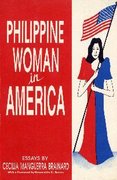
Cecilia's Bio:Cecilia Manguerra Brainard is the award-winning author of eight books, including the internationally-acclaimed novel, When the Rainbow Goddess Wept, Magdalena, Vigan and Other Stories, Acapulco at Sunset and Other Stories, Philippine Woman in America, Woman With Horns and Other Stories, Cecilia's Diary 1962-1968, and Fundamentals of Creative Writing. She edited four books: Growing Up Filipino I and II, Fiction by Filipinos in America, Contemporary Fiction by Filipinos in America. Cecilia co-edited six books, including Journey of 100 Years: Reflections on the Centennial of Philippine Independence; Behind the Walls: Life of Convent GirlsAla Carte: Food and Fiction, and Finding God: True Stories of Spiritual Encounters. She has also written a novel with four other women entitled, Angelica's Daughters, a Dugtungan Novel. Her work has been translated into Finnish and Turkish; and many of her stories and articles have been widely anthologized.
Cecilia has received a California Arts Council Fellowship in Fiction, a Brody Arts Fund Award, a Special Recognition Award for her work dealing with Asian American youths, as well as a Certificate of Recognition from the California State Senate, 21st District. She has also been awarded by the Filipino and Filipino American communities she has served. In 1998, she received the Outstanding Individual Award from her birth city, Cebu, Philippines. She has received several travel grants in the Philippines, from the USIS (United States Information Service). In 2001, she received a Filipinas Magazine Award for Arts.
She has lectured and performed in worldwide literary arts organizations and universities, including UCLA, USC, University of Connecticut, University of the Philippines, PEN, Beyond Baroque, Shakespeare & Company in Paris, and many others. She teaches creative writing at the Writers Program at UCLA-Extension.
She is married to Lauren R. Brainard, a former Peace Corp Volunteer to Leyte, Philippines; they have three sons.
 Cecilia Manguerra Brainard's official website is ceciliabrainarddotcom. She is the award-winning author and editor of 22 books, including When the Rainbow Goddess Wept, The Newspaper Widow, Magdalena, Selected Stories, Vigan and Other Stories, and more. She edited Growing Up Filipino 1, 2, & 3, Fiction by Filipinos in America, Contemporary Fiction by Filipinos in America, and other books..
Her work has been translated into Finnish and Turkish; and many of her stories and articles have been widely anthologized.
Cecilia has received many awards, including a California Arts Council Fellowship in Fiction, a Brody Arts Fund Award, a Special Recognition Award for her work dealing with Asian American youths, as well as a Certificate of Recognition from the California State Senate, 21st District, and the Outstanding Individual Award from her birth city, Cebu, Philippines.
She has lectured and performed at UCLA, USC, University of Connecticut, University of the Philippines, PEN, Shakespeare & Company in Paris, and many others. She has served in the Board of literary arts groups such as PEN, PAWWA (Pacific Asian American Writers West), among others.
Cecilia Manguerra Brainard's official website is ceciliabrainarddotcom. She is the award-winning author and editor of 22 books, including When the Rainbow Goddess Wept, The Newspaper Widow, Magdalena, Selected Stories, Vigan and Other Stories, and more. She edited Growing Up Filipino 1, 2, & 3, Fiction by Filipinos in America, Contemporary Fiction by Filipinos in America, and other books..
Her work has been translated into Finnish and Turkish; and many of her stories and articles have been widely anthologized.
Cecilia has received many awards, including a California Arts Council Fellowship in Fiction, a Brody Arts Fund Award, a Special Recognition Award for her work dealing with Asian American youths, as well as a Certificate of Recognition from the California State Senate, 21st District, and the Outstanding Individual Award from her birth city, Cebu, Philippines.
She has lectured and performed at UCLA, USC, University of Connecticut, University of the Philippines, PEN, Shakespeare & Company in Paris, and many others. She has served in the Board of literary arts groups such as PEN, PAWWA (Pacific Asian American Writers West), among others.
Thursday, November 11, 2010
Growing Up Filipino II - Readings by Contributors
Here are YouTube video clips of Readings by some contributors to the book, Growing Up Filipino II: More Stories for Young Adults:

YouTube - Veronica Montes Reads from Growing Up Filipino II
YouTube - Rashaan Alexis Meneses Reads from Growing Up Filipino II
YouTube - Amalia Bueno's Story in Growing Up Filipino II (read by Barbara Jane Reyes)
YouTube- Marianne Villanueva Reads from Growing Up Filipino II
YouTube - Tony Robles Reads from Growing Up Filipino II
The book is Available from: www.palhbooks.com, Philippine Expressions, Arkipelago, Amazon.com, The Book House, Follet Library Resources, Midwest Library.
SCHOOL LIBRARY JOURNAL BOOK REVIEW 5/1/2010:
BRAINARD, Cecilia Manguerra, ed. Growing Up Filipino II: More Stories for Young Adults. 254p. PALH. 2010. Tr $29.95. ISBN 978-0-9719458-2-1; pap. $21.95. ISBN 978-0-9719458-3-8. LC 2002104406.
Gr 9 Up—This collection of 27 short stories, the follow-up to the critically acclaimed Growing Up Filipino (PALH, 2003), reflects the impact of post-9/11 wartime sensibilities among Filipino writers living in the Philippines, the United States, and Canada. Although similar topics of family, memoir, and coming-of-age thread through both collections, the pieces are not grouped by theme, but nevertheless weave a constantly shifting tapestry of Filipino identity. The challenges and conflicts of unique ancestry and struggles for identity provide a rich background for modern urban realism. The brittle memoirs reflected in "Here in the States," "Nurse Rita," and "Hammer Lounge"; original legend in "A Season of 10,000 Noses"; and breathtaking tragedy in "How My Mother Flew," among others, are compelling reading. Some selections have terse, spare language; others are almost commonplace in their apparent simplicity; all capture moments and nuances of the modern Filipino experience that will envelop readers. Brainard has again selected powerful, evocative stories of family: of promises and disappointment, failure and resentment, tenacious and all-consuming love, anxiety and transcendent hope. There is plenty here to stimulate discussion and encourage an appreciation of Filipino writing and culture. This anthology is a worthy successor to the first volume and has appeal to an audience beyond high school literature courses.—Roxanne Myers Spencer, Western Kentucky University, Bowling Green
Source: http://www.schoollibraryjournal.com/article/CA6727442.html?industryid=47067

YouTube - Veronica Montes Reads from Growing Up Filipino II
YouTube - Rashaan Alexis Meneses Reads from Growing Up Filipino II
YouTube - Amalia Bueno's Story in Growing Up Filipino II (read by Barbara Jane Reyes)
YouTube- Marianne Villanueva Reads from Growing Up Filipino II
YouTube - Tony Robles Reads from Growing Up Filipino II
The book is Available from: www.palhbooks.com, Philippine Expressions, Arkipelago, Amazon.com, The Book House, Follet Library Resources, Midwest Library.
SCHOOL LIBRARY JOURNAL BOOK REVIEW 5/1/2010:
BRAINARD, Cecilia Manguerra, ed. Growing Up Filipino II: More Stories for Young Adults. 254p. PALH. 2010. Tr $29.95. ISBN 978-0-9719458-2-1; pap. $21.95. ISBN 978-0-9719458-3-8. LC 2002104406.
Gr 9 Up—This collection of 27 short stories, the follow-up to the critically acclaimed Growing Up Filipino (PALH, 2003), reflects the impact of post-9/11 wartime sensibilities among Filipino writers living in the Philippines, the United States, and Canada. Although similar topics of family, memoir, and coming-of-age thread through both collections, the pieces are not grouped by theme, but nevertheless weave a constantly shifting tapestry of Filipino identity. The challenges and conflicts of unique ancestry and struggles for identity provide a rich background for modern urban realism. The brittle memoirs reflected in "Here in the States," "Nurse Rita," and "Hammer Lounge"; original legend in "A Season of 10,000 Noses"; and breathtaking tragedy in "How My Mother Flew," among others, are compelling reading. Some selections have terse, spare language; others are almost commonplace in their apparent simplicity; all capture moments and nuances of the modern Filipino experience that will envelop readers. Brainard has again selected powerful, evocative stories of family: of promises and disappointment, failure and resentment, tenacious and all-consuming love, anxiety and transcendent hope. There is plenty here to stimulate discussion and encourage an appreciation of Filipino writing and culture. This anthology is a worthy successor to the first volume and has appeal to an audience beyond high school literature courses.—Roxanne Myers Spencer, Western Kentucky University, Bowling Green
Source: http://www.schoollibraryjournal.com/article/CA6727442.html?industryid=47067
Cecilia Manguerra Brainard's official website is ceciliabrainarddotcom. She is the award-winning author and editor of 22 books, including When the Rainbow Goddess Wept, The Newspaper Widow, Magdalena, Selected Stories, Vigan and Other Stories, and more. She edited Growing Up Filipino 1, 2, & 3, Fiction by Filipinos in America, Contemporary Fiction by Filipinos in America, and other books..
Her work has been translated into Finnish and Turkish; and many of her stories and articles have been widely anthologized.
Cecilia has received many awards, including a California Arts Council Fellowship in Fiction, a Brody Arts Fund Award, a Special Recognition Award for her work dealing with Asian American youths, as well as a Certificate of Recognition from the California State Senate, 21st District, and the Outstanding Individual Award from her birth city, Cebu, Philippines.
She has lectured and performed at UCLA, USC, University of Connecticut, University of the Philippines, PEN, Shakespeare & Company in Paris, and many others. She has served in the Board of literary arts groups such as PEN, PAWWA (Pacific Asian American Writers West), among others.
Wednesday, November 10, 2010
FIL-AM AUTHORS WRITING, by Libay Linsangan Cantor, The Manila Times
I just found this article that mentions me. Thanks to Libay Linsangan Cantor for this:
Fil-Am Authors WritingThe Manila Times, 7/4/10
With all the buzz about Filipino YouTube singing sensation Charice finally making it to Hollywood’s “it” show of the moment, Glee, I wonder if fellow Pinoys are familiar with other Filipino talents already making names for themselves as Filipino-American authors. If we would take a look at Pinoys getting published in the USA, we might have more pride about our race making it in the land of milk and honey when it comes to the literary field.
Most people might have missed Jessica Hagedorn when she visited Manila a few years ago to promote her latest novel, Dream Jungle, published by Viking Books in 2003. She is more identified with her very postmodern take on the Marcos regime in her novel Dogeaters published by Penguin Books in 1990. While it might sound very political, this novel of hers is a very interesting read, given the very eclectic voices of the characters we encounter in Metro Manila amid the backdrop of many pop culture trappings we Filipinos drown in on a daily basis. Hagedorn was born and raised in the Philippines and moved to San Francisco when she was a teenager. In the US, she also dabbles in other art forms as a poet, performance artist and playwright.

Cecilia Manguerra Brainard is another person that comes to mind when we talk about Fil-Am authors. She is the author of the 1990s novel When The Rainbow Goddess Wept published several times by different international and local publishing houses. She has also authored various creative nonfiction books to her name, and sometimes visits the Philippines to promote them or to give talks during their launch here.
Brainard is also active as an editor of various short story collections and nonfiction anthologies like Growing Up Filipino: Stories For Youth Adults, a collection of how it’s like to grow up as a Filipino in the Philippines and in other parts of the world. I’m proud to have an essay of mine included in that 2003 young adult anthology of hers, and I’m also happy to learn that this anthology is being used in some US schools in teaching children and young adults about Filipino experiences. Brainard was born in Cebu and finished college here in the Philippines before migrating to the USA and settling down there to start a family. She is currently active as a teacher at the Writer’s Program of the University of California Los Angeles (UCLA) Extension.

Another Fil-Am author with an acclaimed novel is Bino Realuyo, author of Umbrella Country published in 1999 by Ballantine Reader’s Circle. The novel is a heartwarming tale about a boy living in an impoverished urban poor community in Manila who undergoes a lot of challenges in his life, including dealing with sexuality issues. The son of a Bataan Death March survivor, Realuyo was born and raised in the Philippines and moved to the US where he made New York his home for many years. He is also a poet, educator and works on various labor rights and human rights issues.
Just these three Fil-Am authors’ achievements alone make us proud that they uphold their Pinoy roots through their literature. Next time, we’ll try to discover more Fil-Am writers writing about our worlds.
Fil-Am Authors WritingThe Manila Times, 7/4/10
With all the buzz about Filipino YouTube singing sensation Charice finally making it to Hollywood’s “it” show of the moment, Glee, I wonder if fellow Pinoys are familiar with other Filipino talents already making names for themselves as Filipino-American authors. If we would take a look at Pinoys getting published in the USA, we might have more pride about our race making it in the land of milk and honey when it comes to the literary field.
Most people might have missed Jessica Hagedorn when she visited Manila a few years ago to promote her latest novel, Dream Jungle, published by Viking Books in 2003. She is more identified with her very postmodern take on the Marcos regime in her novel Dogeaters published by Penguin Books in 1990. While it might sound very political, this novel of hers is a very interesting read, given the very eclectic voices of the characters we encounter in Metro Manila amid the backdrop of many pop culture trappings we Filipinos drown in on a daily basis. Hagedorn was born and raised in the Philippines and moved to San Francisco when she was a teenager. In the US, she also dabbles in other art forms as a poet, performance artist and playwright.

Cecilia Manguerra Brainard is another person that comes to mind when we talk about Fil-Am authors. She is the author of the 1990s novel When The Rainbow Goddess Wept published several times by different international and local publishing houses. She has also authored various creative nonfiction books to her name, and sometimes visits the Philippines to promote them or to give talks during their launch here.
Brainard is also active as an editor of various short story collections and nonfiction anthologies like Growing Up Filipino: Stories For Youth Adults, a collection of how it’s like to grow up as a Filipino in the Philippines and in other parts of the world. I’m proud to have an essay of mine included in that 2003 young adult anthology of hers, and I’m also happy to learn that this anthology is being used in some US schools in teaching children and young adults about Filipino experiences. Brainard was born in Cebu and finished college here in the Philippines before migrating to the USA and settling down there to start a family. She is currently active as a teacher at the Writer’s Program of the University of California Los Angeles (UCLA) Extension.

Another Fil-Am author with an acclaimed novel is Bino Realuyo, author of Umbrella Country published in 1999 by Ballantine Reader’s Circle. The novel is a heartwarming tale about a boy living in an impoverished urban poor community in Manila who undergoes a lot of challenges in his life, including dealing with sexuality issues. The son of a Bataan Death March survivor, Realuyo was born and raised in the Philippines and moved to the US where he made New York his home for many years. He is also a poet, educator and works on various labor rights and human rights issues.
Just these three Fil-Am authors’ achievements alone make us proud that they uphold their Pinoy roots through their literature. Next time, we’ll try to discover more Fil-Am writers writing about our worlds.
Cecilia Manguerra Brainard's official website is ceciliabrainarddotcom. She is the award-winning author and editor of 22 books, including When the Rainbow Goddess Wept, The Newspaper Widow, Magdalena, Selected Stories, Vigan and Other Stories, and more. She edited Growing Up Filipino 1, 2, & 3, Fiction by Filipinos in America, Contemporary Fiction by Filipinos in America, and other books..
Her work has been translated into Finnish and Turkish; and many of her stories and articles have been widely anthologized.
Cecilia has received many awards, including a California Arts Council Fellowship in Fiction, a Brody Arts Fund Award, a Special Recognition Award for her work dealing with Asian American youths, as well as a Certificate of Recognition from the California State Senate, 21st District, and the Outstanding Individual Award from her birth city, Cebu, Philippines.
She has lectured and performed at UCLA, USC, University of Connecticut, University of the Philippines, PEN, Shakespeare & Company in Paris, and many others. She has served in the Board of literary arts groups such as PEN, PAWWA (Pacific Asian American Writers West), among others.
Sunday, November 7, 2010
CECILIA BRAINARD & VERONICA MONTES READ FROM ANGELICA'S DAUGHTERS
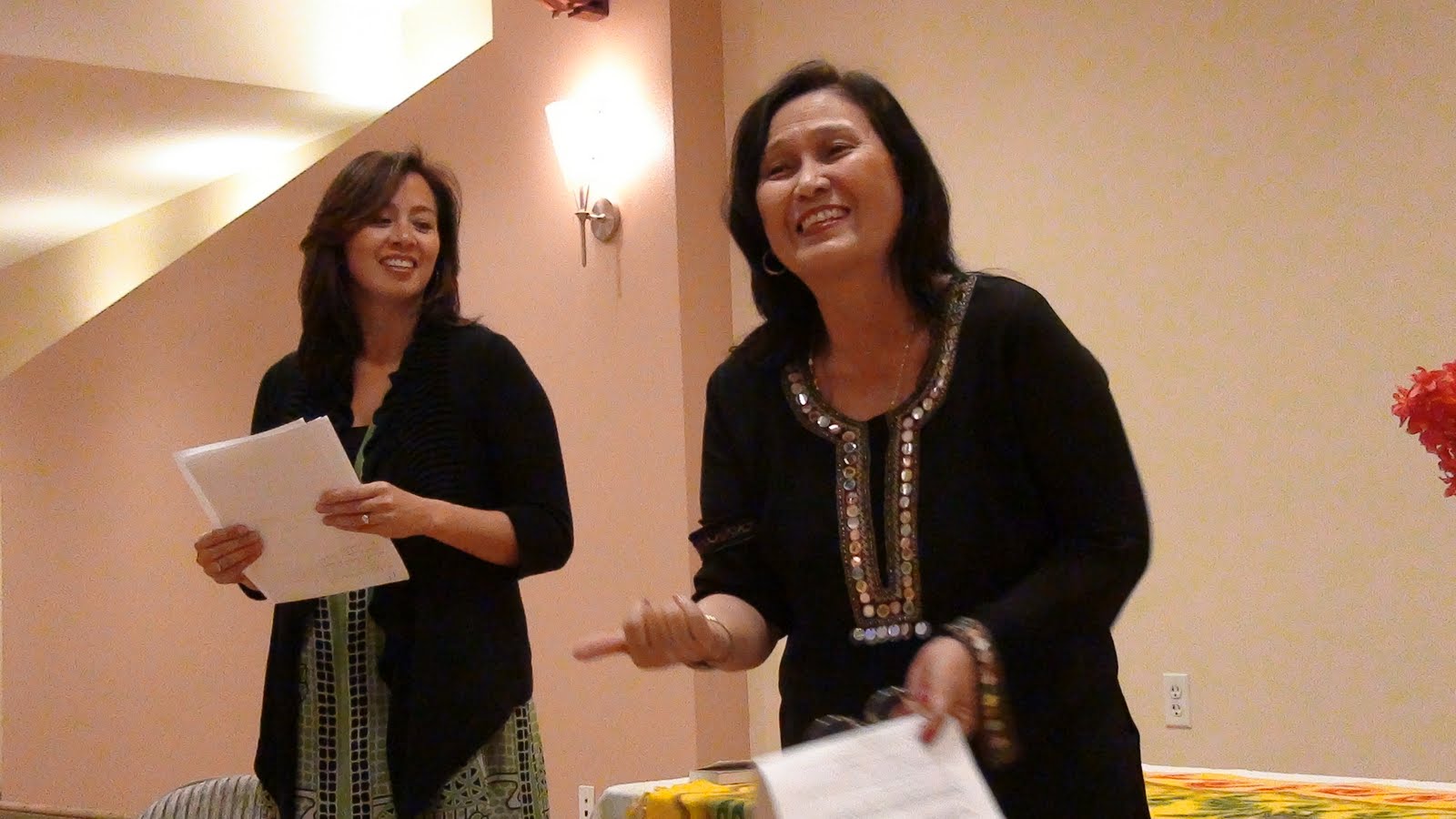

Literary Reading by Cecilia Brainard and Veronica Montes from the book, Angelica's Daughters, a Dugtungan Novel - enjoy! The reading was at the Book Launching of Angelica's Daughters in San Francisco, November 6, 2010, sponsored by PAWA and Arkipelago Bookstore.
http://www.youtube.com/watch?v=i4Hhg-YL29g

Pictures:
1) Veronica Montes and Cecilia Brainard ham it up at the Literary Reading;
2) Group photo shows l-r: Cecilia Brainard, Penelope Flores Carmen Domingo-Kirk, Veronica Montes
3) PAWA President Edwin Lozada and Cecilia Brainard
Cecilia Manguerra Brainard's official website is ceciliabrainarddotcom. She is the award-winning author and editor of 22 books, including When the Rainbow Goddess Wept, The Newspaper Widow, Magdalena, Selected Stories, Vigan and Other Stories, and more. She edited Growing Up Filipino 1, 2, & 3, Fiction by Filipinos in America, Contemporary Fiction by Filipinos in America, and other books..
Her work has been translated into Finnish and Turkish; and many of her stories and articles have been widely anthologized.
Cecilia has received many awards, including a California Arts Council Fellowship in Fiction, a Brody Arts Fund Award, a Special Recognition Award for her work dealing with Asian American youths, as well as a Certificate of Recognition from the California State Senate, 21st District, and the Outstanding Individual Award from her birth city, Cebu, Philippines.
She has lectured and performed at UCLA, USC, University of Connecticut, University of the Philippines, PEN, Shakespeare & Company in Paris, and many others. She has served in the Board of literary arts groups such as PEN, PAWWA (Pacific Asian American Writers West), among others.
Thursday, November 4, 2010
Upcoming Literary Events for Cecilia

Friday - Cecilia Brainard is giving a talk to some students at Galileo Science and Technology who have read the novel, When the Rainbow Goddess Wept in their classroom;
Saturday - Book launch of Angelica's Daughters in San Francisco, sponsored by PAWA, with Veronica Montes and Cecilia Brainard reading and signing the book.
Cecilia Manguerra Brainard's official website is ceciliabrainarddotcom. She is the award-winning author and editor of 22 books, including When the Rainbow Goddess Wept, The Newspaper Widow, Magdalena, Selected Stories, Vigan and Other Stories, and more. She edited Growing Up Filipino 1, 2, & 3, Fiction by Filipinos in America, Contemporary Fiction by Filipinos in America, and other books..
Her work has been translated into Finnish and Turkish; and many of her stories and articles have been widely anthologized.
Cecilia has received many awards, including a California Arts Council Fellowship in Fiction, a Brody Arts Fund Award, a Special Recognition Award for her work dealing with Asian American youths, as well as a Certificate of Recognition from the California State Senate, 21st District, and the Outstanding Individual Award from her birth city, Cebu, Philippines.
She has lectured and performed at UCLA, USC, University of Connecticut, University of the Philippines, PEN, Shakespeare & Company in Paris, and many others. She has served in the Board of literary arts groups such as PEN, PAWWA (Pacific Asian American Writers West), among others.
Thursday, October 28, 2010
BRAINARD KENYA SAFARI VIDEO - Reposted
Reposting our short video of our Kenya Safari. The baby rhino and baby elephant shown in the video died. The baby elephant who didn't make it is the one the child blesses. Very sad.
Click here to view the 6-minute YouTube video http://www.youtube.com/watch?v=eTt_5vtZfVg


Click here to view the 6-minute YouTube video http://www.youtube.com/watch?v=eTt_5vtZfVg

 Cecilia Manguerra Brainard's official website is ceciliabrainarddotcom. She is the award-winning author and editor of 22 books, including When the Rainbow Goddess Wept, The Newspaper Widow, Magdalena, Selected Stories, Vigan and Other Stories, and more. She edited Growing Up Filipino 1, 2, & 3, Fiction by Filipinos in America, Contemporary Fiction by Filipinos in America, and other books..
Her work has been translated into Finnish and Turkish; and many of her stories and articles have been widely anthologized.
Cecilia has received many awards, including a California Arts Council Fellowship in Fiction, a Brody Arts Fund Award, a Special Recognition Award for her work dealing with Asian American youths, as well as a Certificate of Recognition from the California State Senate, 21st District, and the Outstanding Individual Award from her birth city, Cebu, Philippines.
She has lectured and performed at UCLA, USC, University of Connecticut, University of the Philippines, PEN, Shakespeare & Company in Paris, and many others. She has served in the Board of literary arts groups such as PEN, PAWWA (Pacific Asian American Writers West), among others.
Cecilia Manguerra Brainard's official website is ceciliabrainarddotcom. She is the award-winning author and editor of 22 books, including When the Rainbow Goddess Wept, The Newspaper Widow, Magdalena, Selected Stories, Vigan and Other Stories, and more. She edited Growing Up Filipino 1, 2, & 3, Fiction by Filipinos in America, Contemporary Fiction by Filipinos in America, and other books..
Her work has been translated into Finnish and Turkish; and many of her stories and articles have been widely anthologized.
Cecilia has received many awards, including a California Arts Council Fellowship in Fiction, a Brody Arts Fund Award, a Special Recognition Award for her work dealing with Asian American youths, as well as a Certificate of Recognition from the California State Senate, 21st District, and the Outstanding Individual Award from her birth city, Cebu, Philippines.
She has lectured and performed at UCLA, USC, University of Connecticut, University of the Philippines, PEN, Shakespeare & Company in Paris, and many others. She has served in the Board of literary arts groups such as PEN, PAWWA (Pacific Asian American Writers West), among others.
Wednesday, October 27, 2010
GK's Tony Meloto Laud Filipino Women's Success in U.S. - from Asian Journal

Gawad Kalinga'S TONY MELOTO LAUD FILIPINO WOMEN'S SUCCESS IN U.S.
Tuesday, October 27, 2010, Asian Journal Press
La CANADA – In an afternoon tea event to celebrate Filipinas in Los Angeles, Gawad Kalinga Founder Antonio "Tony" Meloto praised successful Filipina women for achieving success in the United States and for being the backbone of GK.
"These Filipina women are quite accomplished in their chosen profession and have achieved success in the most competitive marketplace," said Meloto at the ‘Women Inspiring Women Inspiring Change’ event held at the home of Mark and Gloria Lilly.
"The Filipina women especially here in California in the early 2000 were the first supporters of GK when it wasn’t fashionable or popular. These women have supported us through the years. These women are game changers."
The event featured a who’s who of several successful Filipina women – from Chef Cecilia De Castro, who catered the event; film director and author of Abadeha: The Philippine Cinderella Myrna de la Paz Mulhern; authors Carina Monica Montoya, Cecilia Manguerra Brainard and Mae Respicio Koerner, among others.
Manguerra Brainard said it’s important to celebrate Filipina women.
"Throughout the years, we as women have often been marginalized or not taken seriously," said Manguerra Brainard who has written several books including When The Rainbow Goddess other titles such as Growing Up Filipino, Vols. l and ll. "It’s time for our community to recognize our achievements."De la Paz Mulhern agrees. She said this event is about women inspiring other women.
"It’s very challenging in the Filipino community but as you can see from the women in this event and the authors that we are doing that. Our work inspires other women to do their best."
Donations raised in the event benefited GK.
( www.asianjournal.com )
Cecilia Manguerra Brainard's official website is ceciliabrainarddotcom. She is the award-winning author and editor of 22 books, including When the Rainbow Goddess Wept, The Newspaper Widow, Magdalena, Selected Stories, Vigan and Other Stories, and more. She edited Growing Up Filipino 1, 2, & 3, Fiction by Filipinos in America, Contemporary Fiction by Filipinos in America, and other books..
Her work has been translated into Finnish and Turkish; and many of her stories and articles have been widely anthologized.
Cecilia has received many awards, including a California Arts Council Fellowship in Fiction, a Brody Arts Fund Award, a Special Recognition Award for her work dealing with Asian American youths, as well as a Certificate of Recognition from the California State Senate, 21st District, and the Outstanding Individual Award from her birth city, Cebu, Philippines.
She has lectured and performed at UCLA, USC, University of Connecticut, University of the Philippines, PEN, Shakespeare & Company in Paris, and many others. She has served in the Board of literary arts groups such as PEN, PAWWA (Pacific Asian American Writers West), among others.
NEIL SEDAKA SONG HITS ON YOUTUBE
We were supposed to have gone to a Neil Sedaka Concert at the Disney Hall tonight, but it's been postponed. Sigh!
So I got started listening to his songs on YouTube. They are good! Here are some YouTube sites with Neil Sedaka songs:
Love Will Keep Us Together http://www.youtube.com/watch?v=dYFrxUGCwxM
Laughter in the Rain http://www.youtube.com/watch?v=eKn8saVQbts
Calendar Girl http://www.youtube.com/watch?v=Rb-9PNgIeo0
Happy Birthday Sweet Sixteen http://www.youtube.com/watch?v=WusQjMnD0cs&feature=related
Breaking Up is Hard to Do http://www.youtube.com/watch?v=tbad22CKlB4&feature=related
Oh Carol http://www.youtube.com/watch?v=aHm7PnCCd4E&feature=related
.
So I got started listening to his songs on YouTube. They are good! Here are some YouTube sites with Neil Sedaka songs:
Love Will Keep Us Together http://www.youtube.com/watch?v=dYFrxUGCwxM
Laughter in the Rain http://www.youtube.com/watch?v=eKn8saVQbts
Calendar Girl http://www.youtube.com/watch?v=Rb-9PNgIeo0
Happy Birthday Sweet Sixteen http://www.youtube.com/watch?v=WusQjMnD0cs&feature=related
Breaking Up is Hard to Do http://www.youtube.com/watch?v=tbad22CKlB4&feature=related
Oh Carol http://www.youtube.com/watch?v=aHm7PnCCd4E&feature=related
.
Cecilia Manguerra Brainard's official website is ceciliabrainarddotcom. She is the award-winning author and editor of 22 books, including When the Rainbow Goddess Wept, The Newspaper Widow, Magdalena, Selected Stories, Vigan and Other Stories, and more. She edited Growing Up Filipino 1, 2, & 3, Fiction by Filipinos in America, Contemporary Fiction by Filipinos in America, and other books..
Her work has been translated into Finnish and Turkish; and many of her stories and articles have been widely anthologized.
Cecilia has received many awards, including a California Arts Council Fellowship in Fiction, a Brody Arts Fund Award, a Special Recognition Award for her work dealing with Asian American youths, as well as a Certificate of Recognition from the California State Senate, 21st District, and the Outstanding Individual Award from her birth city, Cebu, Philippines.
She has lectured and performed at UCLA, USC, University of Connecticut, University of the Philippines, PEN, Shakespeare & Company in Paris, and many others. She has served in the Board of literary arts groups such as PEN, PAWWA (Pacific Asian American Writers West), among others.
INVITATION - BOOK LAUNCH ANGELICA'S DAUGHTERS, NOV. 6, SAN FRANCISCO
PAWA INVITES YOU TO THE BOOK LAUNCHING OF
ANGELICA’S DAUGHTERS, A DUGTUNGAN NOVEL
By: Cecilia Brainard, Erma Cuizon, Susan Evangelista,
Veronica Montes, & Nadine Sarreal
Saturday, November 6, 2010, 5:30-7 p.m.
Bayanihan Community Center, 1010 Mission Street, San Francisco, CA
There will be a literary reading, book signing, & light refreshments. The event is free and open to the public. Cecilia Brainard & Veronica Montes will be there.

What they say about Angelica's Daughters, a Dugtungan Novel:
"Chick lit with a comfortable dose of smartness and historical verve. Angelica's Daughters celebrates audacious heroines primed by deep passion and fairytale romance! Set in the heat of a 19th-century Asian revolution and what its setting becomes by the 21st Century, Angelica's Daughters beguiles with its mythic splendor, threat of a generational curse, masterful betrayals, and female leads readers can fall in love with. The story is a delightful read by five writers who cherish their Hispanic, Filipino, and American cultural roots." ~ Felice Sta. Maria
“Part of the pleasure of reading Angelica's Daughters is seeing how deftly the authors deal with the challenge of writing in this resurrected literary form. The result, in this case, is an ensemble performance that contains something of the exhilaration of theatrical improv. One watches these accomplished authors inventively weave a historical romance, creating gripping heroines and turns of plot, crossing decades and national boundaries, tapping into cultural roots of the Philippines, Spain and America. Reading Angelica's Daughters is a gripping experience.” ~ Brian Roley
"This collective and collaborative novel proves that writers share much more than just an interest in, as one of the authors puts it, “the idea of creating something of rare beauty out of nothing at all.” They share a Creative Unconscious that, when working on a common text, comes up with startling and unpredictable imaginative delights and insights. This tale of two women living a century apart (and the women and men in their lives) told sequentially by five women is truly an ensemble performance worth a standing ovation." ~ Isagani R. Cruz, Philippine Star
The novel has a site at www.palhbooks.com/cbrainardangelica.html, and a blog at http://angelicasdaughters.wordpress.com/.
ANGELICA’S DAUGHTERS, A DUGTUNGAN NOVEL
By: Cecilia Brainard, Erma Cuizon, Susan Evangelista,
Veronica Montes, & Nadine Sarreal
Saturday, November 6, 2010, 5:30-7 p.m.
Bayanihan Community Center, 1010 Mission Street, San Francisco, CA
There will be a literary reading, book signing, & light refreshments. The event is free and open to the public. Cecilia Brainard & Veronica Montes will be there.

What they say about Angelica's Daughters, a Dugtungan Novel:
"Chick lit with a comfortable dose of smartness and historical verve. Angelica's Daughters celebrates audacious heroines primed by deep passion and fairytale romance! Set in the heat of a 19th-century Asian revolution and what its setting becomes by the 21st Century, Angelica's Daughters beguiles with its mythic splendor, threat of a generational curse, masterful betrayals, and female leads readers can fall in love with. The story is a delightful read by five writers who cherish their Hispanic, Filipino, and American cultural roots." ~ Felice Sta. Maria
“Part of the pleasure of reading Angelica's Daughters is seeing how deftly the authors deal with the challenge of writing in this resurrected literary form. The result, in this case, is an ensemble performance that contains something of the exhilaration of theatrical improv. One watches these accomplished authors inventively weave a historical romance, creating gripping heroines and turns of plot, crossing decades and national boundaries, tapping into cultural roots of the Philippines, Spain and America. Reading Angelica's Daughters is a gripping experience.” ~ Brian Roley
"This collective and collaborative novel proves that writers share much more than just an interest in, as one of the authors puts it, “the idea of creating something of rare beauty out of nothing at all.” They share a Creative Unconscious that, when working on a common text, comes up with startling and unpredictable imaginative delights and insights. This tale of two women living a century apart (and the women and men in their lives) told sequentially by five women is truly an ensemble performance worth a standing ovation." ~ Isagani R. Cruz, Philippine Star
The novel has a site at www.palhbooks.com/cbrainardangelica.html, and a blog at http://angelicasdaughters.wordpress.com/.
Cecilia Manguerra Brainard's official website is ceciliabrainarddotcom. She is the award-winning author and editor of 22 books, including When the Rainbow Goddess Wept, The Newspaper Widow, Magdalena, Selected Stories, Vigan and Other Stories, and more. She edited Growing Up Filipino 1, 2, & 3, Fiction by Filipinos in America, Contemporary Fiction by Filipinos in America, and other books..
Her work has been translated into Finnish and Turkish; and many of her stories and articles have been widely anthologized.
Cecilia has received many awards, including a California Arts Council Fellowship in Fiction, a Brody Arts Fund Award, a Special Recognition Award for her work dealing with Asian American youths, as well as a Certificate of Recognition from the California State Senate, 21st District, and the Outstanding Individual Award from her birth city, Cebu, Philippines.
She has lectured and performed at UCLA, USC, University of Connecticut, University of the Philippines, PEN, Shakespeare & Company in Paris, and many others. She has served in the Board of literary arts groups such as PEN, PAWWA (Pacific Asian American Writers West), among others.
Monday, October 25, 2010
More Re Gawad Kalinga's Activities
(I'm reprinting a letter from Benita Delfin about Gawad Kalinga. The first time I had heard about Gawad Kalinga was from my St. Theresa's college chums who talked about how Gawad Kalinga helped poor people build homes in the Philippines - perhaps something like Carter's Habitat for Humanity.)
Good evening/morning to all of you:
Yesterday, Tony Meloto was the guest speaker at one of the Methodist Church here in Cypress CA organized by its pastor, Jose Padilla and Ernie Delfin. Ernie and I had been involved in fund raising efforts especially Ernie who is currently out of town and had known Tony for quite some time since he has been a guest at our home, at University of CA Rotaract Club and now the Methodist Church.
He is a dynamic speaker who speaks from the heart-no “notes” at all and very knowledgeable about what is happening in the Philippines and around the world. He inspires and truly cares about people. Late President Cory Aquino supported Gawad Kalinga in her administration and now is being continued by her son, current President Noynoy Aquino. Tony has been offered government position but declined and wanted to work only as an “ordinary person”. He has a book called “ Builder of Dreams”. Please read more at http://www.asianjournal.com/aj-magazine/midweek-mgzn/4121-gawad-kalinga-founder-antonio-p-meloto-builder-of-dreams.html?start=2
Tony Meloto is such a powerful speaker and very positive and has a “can do” attitude that is influencing not only the poor, rich, middle class people in the Philippines, Canada and Europe that have been around him but also those local government units(LGUs) leaders (Mayor, Vice Mayor) including people that have been corrupt like Imelda Marcos and ex President Joseph Estrada. His goal is to change the mindset of people starting with themselves by having strong moral values, by caring (kalinga) and by sharing (bayanihan). He realizes the weaknesses and strengths of Filipinos and humble enough to share his beginnings as being poor and lucky enough to have scholarships that brought him to the United States where he finished his high school and Ateneo where he got his Masters. He is very visionary and I made a comment to him that he is such an inspiring leader and model and wished him good health and stamina to be able to continue his work and to handle all the challenges he has to deal with. I also said he talks like an architect - building from scratch to finish since my background includes knowledge in architecture. He talks about building, sustainability, preserving the environment –the basic tenets of Leadership in Energy and Environmental Design (LEED) and how Gawad Kalinga houses adopt to the location where they are going to be built such as some houses will be have to be on stilts because of existing water condition. Gawad Kalinga also teaches and makes the families proud and work for what they have such as making their own houses clean and beautiful and planting vegetables to help support themselves.
Observing him he doesn’t want people to be “in awe” with him as a person - very low key as far as his dress code as opposed to his projects - the Gawad Kalinga houses - the colors chosen are upbeat colors that attract people’s attention immediately! And I believe the reason is …. people will have the pride of ownership of having a home they never had or will never have if not for Gawad Kalinga’s supporters. Tony Meloto receives the Social Enterpreneur Award very recently and is very happy about it because he can participate in the World Entrepreneurs Sessions. With his work cut out for him he has to be a Master Enterpreneur! Gawad Kalinga is now involved on building roads and bridges with the local government units.
In the afternoon, Cely Adamo, a Rotarian and active Gawad Kalinga supporter and I went to a very beautiful home in La Canada, CA for “A Special Tea and Inspiration” event. This event is also to support Gawad Kalinga projects and at the same time meet Filipino Authors and their books sponsored by Philippine Expressions owned by our friends Linda Nietes and Bob. Tony Meloto spoke to the big crowd with his inspiring talk. I had also the opportunity to meet and bought their autographed books…Cecilia Manguerra Brainard - Growing Up as a Filipino, Dr.Ludy Ongkeko - Forty Years of Writing in America and Carina Montoya Forsythe – Filipinos in Hollywood and of course Tony Meloto - Builder of Dreams. We also met the parents of one of the members of Mango Quartet who performs at the White House. Met new people and old friends from different backgrounds while enjoying the music on the air (violin and piano and a lovely singer) and the food washed out by calamansi juice with spritzer prepared by one of the famous Los Angeles Filipina chef- Cecilia De Castro and her students.
It is always beautiful to be inspired and meet and enjoy the company of new and old friends. Faith in Action, Caring (Kalinga) and Sharing (Bayanihan) are words I took going home.
Please check out Gawad Kalinga’s website. http://www.gk1world.com/
Best to all of you.
Benita
Good evening/morning to all of you:
Yesterday, Tony Meloto was the guest speaker at one of the Methodist Church here in Cypress CA organized by its pastor, Jose Padilla and Ernie Delfin. Ernie and I had been involved in fund raising efforts especially Ernie who is currently out of town and had known Tony for quite some time since he has been a guest at our home, at University of CA Rotaract Club and now the Methodist Church.
He is a dynamic speaker who speaks from the heart-no “notes” at all and very knowledgeable about what is happening in the Philippines and around the world. He inspires and truly cares about people. Late President Cory Aquino supported Gawad Kalinga in her administration and now is being continued by her son, current President Noynoy Aquino. Tony has been offered government position but declined and wanted to work only as an “ordinary person”. He has a book called “ Builder of Dreams”. Please read more at http://www.asianjournal.com/aj-magazine/midweek-mgzn/4121-gawad-kalinga-founder-antonio-p-meloto-builder-of-dreams.html?start=2
Tony Meloto is such a powerful speaker and very positive and has a “can do” attitude that is influencing not only the poor, rich, middle class people in the Philippines, Canada and Europe that have been around him but also those local government units(LGUs) leaders (Mayor, Vice Mayor) including people that have been corrupt like Imelda Marcos and ex President Joseph Estrada. His goal is to change the mindset of people starting with themselves by having strong moral values, by caring (kalinga) and by sharing (bayanihan). He realizes the weaknesses and strengths of Filipinos and humble enough to share his beginnings as being poor and lucky enough to have scholarships that brought him to the United States where he finished his high school and Ateneo where he got his Masters. He is very visionary and I made a comment to him that he is such an inspiring leader and model and wished him good health and stamina to be able to continue his work and to handle all the challenges he has to deal with. I also said he talks like an architect - building from scratch to finish since my background includes knowledge in architecture. He talks about building, sustainability, preserving the environment –the basic tenets of Leadership in Energy and Environmental Design (LEED) and how Gawad Kalinga houses adopt to the location where they are going to be built such as some houses will be have to be on stilts because of existing water condition. Gawad Kalinga also teaches and makes the families proud and work for what they have such as making their own houses clean and beautiful and planting vegetables to help support themselves.
Observing him he doesn’t want people to be “in awe” with him as a person - very low key as far as his dress code as opposed to his projects - the Gawad Kalinga houses - the colors chosen are upbeat colors that attract people’s attention immediately! And I believe the reason is …. people will have the pride of ownership of having a home they never had or will never have if not for Gawad Kalinga’s supporters. Tony Meloto receives the Social Enterpreneur Award very recently and is very happy about it because he can participate in the World Entrepreneurs Sessions. With his work cut out for him he has to be a Master Enterpreneur! Gawad Kalinga is now involved on building roads and bridges with the local government units.
In the afternoon, Cely Adamo, a Rotarian and active Gawad Kalinga supporter and I went to a very beautiful home in La Canada, CA for “A Special Tea and Inspiration” event. This event is also to support Gawad Kalinga projects and at the same time meet Filipino Authors and their books sponsored by Philippine Expressions owned by our friends Linda Nietes and Bob. Tony Meloto spoke to the big crowd with his inspiring talk. I had also the opportunity to meet and bought their autographed books…Cecilia Manguerra Brainard - Growing Up as a Filipino, Dr.Ludy Ongkeko - Forty Years of Writing in America and Carina Montoya Forsythe – Filipinos in Hollywood and of course Tony Meloto - Builder of Dreams. We also met the parents of one of the members of Mango Quartet who performs at the White House. Met new people and old friends from different backgrounds while enjoying the music on the air (violin and piano and a lovely singer) and the food washed out by calamansi juice with spritzer prepared by one of the famous Los Angeles Filipina chef- Cecilia De Castro and her students.
It is always beautiful to be inspired and meet and enjoy the company of new and old friends. Faith in Action, Caring (Kalinga) and Sharing (Bayanihan) are words I took going home.
Please check out Gawad Kalinga’s website. http://www.gk1world.com/
Best to all of you.
Benita
Cecilia Manguerra Brainard's official website is ceciliabrainarddotcom. She is the award-winning author and editor of 22 books, including When the Rainbow Goddess Wept, The Newspaper Widow, Magdalena, Selected Stories, Vigan and Other Stories, and more. She edited Growing Up Filipino 1, 2, & 3, Fiction by Filipinos in America, Contemporary Fiction by Filipinos in America, and other books..
Her work has been translated into Finnish and Turkish; and many of her stories and articles have been widely anthologized.
Cecilia has received many awards, including a California Arts Council Fellowship in Fiction, a Brody Arts Fund Award, a Special Recognition Award for her work dealing with Asian American youths, as well as a Certificate of Recognition from the California State Senate, 21st District, and the Outstanding Individual Award from her birth city, Cebu, Philippines.
She has lectured and performed at UCLA, USC, University of Connecticut, University of the Philippines, PEN, Shakespeare & Company in Paris, and many others. She has served in the Board of literary arts groups such as PEN, PAWWA (Pacific Asian American Writers West), among others.
Sunday, October 24, 2010
Re GAWAD KALINGA'S "AN AFTERNOON TEA" IN PASADENA, CALIFORNIA

October 23, 2010 -
I just got back from the Gawad Kalinga's (www.GKIWorld.com)"An Afternoon Tea" with the theme of "Women Inspiring Women Inspiring Change." Honorees included 6 authors and Chef Cecilia de Castro. Tony Meloto, the founder of Gawad Kalinga flew in from the Philippines to attend the program. Chef Cecilia De Castro handled the elegant fare with scones, sandwiches and other delicious tidbits with tea, coffee, and calamansi seltzer, served in bone china and silver.
The six authors were: Cecilia Brainard, May Respicio Koerner, Carina Monica Montoya, Myrna De La Paz, Marjorie Light, and Ludy Ongkeko. Philippine Expressions made the books by these authors available. The writers' bios follow:
A gathering of trail blazers...
Cecilia Manguerra Brainard, author and editor of fourteen books which include the internationally acclaimed When The Rainbow Goddess Wept and other titles such as Growing Up Filipino, Vols. l and ll and her latest, Angelica's Daughters, A Dugtungan Novel, which she co-authored;
Carina Monica Montoya, also known as Carina Forsythe, author of Filipinos in Hollywood, Los Angeles's Historic Filipinotown and Let's Cook Adobo cookbook designed for children;
Mae Respicio Koerner, author of Filipinos in Los Angeles;
Myrna de la Paz Mulhern, writer, producer, director, lyricist and filmmaker of ABADEHA: The Philippine Cinderella.
Marjorie Light, a Fil Am writer, performer and DJ who has contributed an article in the book, Babaylan: Filipinos and the Call of the Indigenous on Decolonization and the Filipino Arts Community in LA.
Ludy Ongkeko, a columnist for the Philippine News since 1971, a tenured professor for many years with the University of Southern California and author of "Forty Years of Writing in America."
Live music was provided by Linda Madrid, Jane Provido, Andy Tecson, and Bob Schroeder. Floral artistry was provided by Grace Na; Jewelry design by Victoria Duque, professional makeovers by Au Mauricio.
A lovely afternoon put together by lovely women, including the hostess, Gloria Lilly, and Tess Castro.


~~~
Top photo: l-r:Myrna De La Paz, Linda Nietes, Cecilia Brainard, Hermie Ongkeko, Ludy Ongkeko
Next down: l-r: Cecilia Brainard, Chef Cecilia De Castro, Guest
Third down: l-r: Cecilia Brainard, Carina Monica Montoya
Fourth down: l-r: Carina Monica Montoya, Gloria Lilly, Myrna De La Paz, Cecilia Brainard
Fifth down: l-r: Cecilia Brainard,Mae Respicio Koerner
Sixth picture down: l-r: Carina Monica Montoya, Myrna De La Paz, Linda Nietes, Cecilia Brainard,
Seventh down: l-r: Cecilia Brainard, Carina Monica Montoya
Eighth down: Mae Respecio Koerner, Myrna De La Paz, Linda Nietes, Carina Monica Montoya, Cecilia Brainard
Ninth down: With guest
Tenth down: The Lilly's backyard
Eleventh down: The Lilly's fabulous house
Twelfth down: High Tea
Cecilia Manguerra Brainard's official website is ceciliabrainarddotcom. She is the award-winning author and editor of 22 books, including When the Rainbow Goddess Wept, The Newspaper Widow, Magdalena, Selected Stories, Vigan and Other Stories, and more. She edited Growing Up Filipino 1, 2, & 3, Fiction by Filipinos in America, Contemporary Fiction by Filipinos in America, and other books..
Her work has been translated into Finnish and Turkish; and many of her stories and articles have been widely anthologized.
Cecilia has received many awards, including a California Arts Council Fellowship in Fiction, a Brody Arts Fund Award, a Special Recognition Award for her work dealing with Asian American youths, as well as a Certificate of Recognition from the California State Senate, 21st District, and the Outstanding Individual Award from her birth city, Cebu, Philippines.
She has lectured and performed at UCLA, USC, University of Connecticut, University of the Philippines, PEN, Shakespeare & Company in Paris, and many others. She has served in the Board of literary arts groups such as PEN, PAWWA (Pacific Asian American Writers West), among others.
Subscribe to:
Posts (Atom)