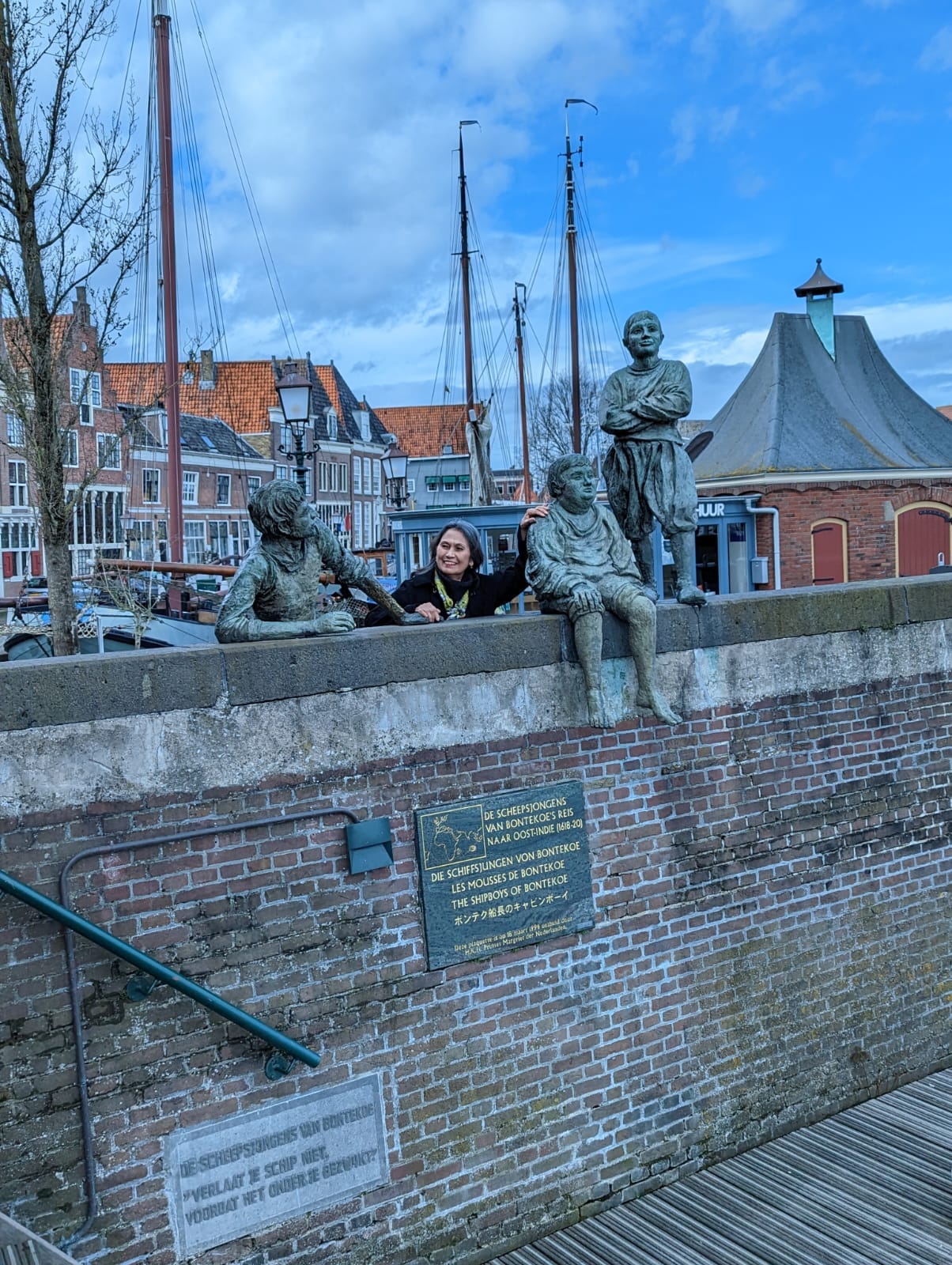
My Guest Blogger is Caroline Kennedy, who shares with us the first part of a historical novel-in-progress. British-born Caroline has worn many hats as journalist, radio producer, actor, director, TV presenter, and author. She was a humanitarian aid worker in Bosnia and Croatia during the war from 1992-95. She co-authored, How the English Establishment Framed Stephen Ward. She was former president of The Little Theater Group of Costa Rica.
Thanks for being my Guest Blogger, Caroline Kennedy!
~~

Excerpt from Diamonds, Pearls and Spice
Historical Fiction Novel by Caroline Kennedy
copyright 2020 by Caroline Kennedy, all rights reserved.
Prologue: Diamonds
The government of Spain, distracted by the Seven Year War in Europe, had begun to ignore its far-flung colony of the Philippines. This was due, in most part, to the challenges involved in administering such a distant country. But it was also due to the fact that the Spanish religious orders in Manila, preferring to remain autonomous, refused to subordinate to the King’s colonial government in Manila, the Royal Audiencia.
In 1759, taking advantage of the retirement of the Governor-General of Manila, Pedro Manuel de Arandia, and the late arrival of his replacement from Spain, the Archbishop of the Philippines, Manuel Rojo del Rio y Vieyra, nominated himself Governor General.
Under constant threat by the Portuguese, Dutch and British forces to wrest the lucrative trade in silks, gold and ceramics with local Chinese merchants in Manila and the pearl and spices trade with the Sultan in Sulu, the new Governor-General, with no knowledge of commercial trade, military affairs or diplomacy was forced to fight off foreign assaults using untrained soldiers and sailors from the local Filipino and Chinese communities.
Following first the Portuguese and then the Dutch into India, the British, through the Honorable The East India Company, an ever-expanding band of self-governing, semi-autonomous merchants, traders and mercenaries, were assimilating vast areas of the sub-continent under their control and protection. Exploiting the local tyrannies, the avaricious squabbles over territory and the natural animosities between the local princes, rulers and nawabs, the British stepped in, took sides and were able to reap huge profits. Many personal fortunes were won and lost in the various battles for the control of this immense and bountiful land.
Fired by tales of Eastern romance and exoticism and seduced by promises of unimaginable opulence, property and power, young men left England to stake their claims to India’s abundant riches. Once there they would gamble, trade or fight in the service of bestial princes in exchange for staggering fortunes, virgin lands or some of the world’s most precious gems.
If they did not die ignominiously in battle or succumb to the prevalent and often fatal diseases of smallpox, typhoid, cholera or blackwater fever, many returned home exceedingly wealthy men. With their newly-acquired fortunes they bought lands, titles and political patronage in England, founding family dynasties, political appointments and guaranteeing secure and comfortable incomes for their descendants.
Yet others, and there were many of these too, lost their fortunes, not once but several times, their sense of adventure and intrigue crushed beyond hope and, too mortally ashamed to return home, died in penury, unmourned, unnoticed and forgotten in the squalour, privation and poverty of the other India.
But, always on the sidelines, the French too in their own stronghold of Pondicherry, had their designs to increase their own domains and a share in the untold wealth of India. Biding their time they periodically involved the British East India Company troops in local engagements and skirmishes while all the time testing the strengths and weaknesses of the British defences. By the middle of the 18th century the East India Company’s principal settlements and trading posts had been seriously threatened and were in danger of being totally annihilated and their lucrative trade destroyed by the superior French forces.
Complacency, over-confidence and an indifference born of arrogance had allowed the British cities, forts and garrisons to fall easy prey to the detested French. Calcutta, Arcot, Vellore, Areny, St Thome and Madras, once the most treasured jewels in the Company’s crown, had fallen in swift succession and with considerable loss of life, to the relentless imperialistic ambitions of the French governor of Pondicherry.
In the face of this remorseless onslaught the once-proud British East India Company was left helpless, hopeless and floundering, its profits having been dissipated by the increasing need to protect its swelling interests and territories to the neglect and detriment of its trade. Too late the British realized that while their horizons had been expanding over the sub-continent of India their markets had been on the decline in Europe. Faced with devastating defeats on all fronts they eventually found themselves beating a hasty and dishonorable retreat.
But help was to come from two very unlikely sources.
Even the triumphant French could not have predicted that one of their English prisoners-of-war who marched humiliatingly stripped and bound in their victory parade through the streets of Pondicherry would, with a small but courageous band of just a few hundred starving and demoralized men, rise up successfully against them.
British face, honour, reputation and dreams of a future empire in India, were about to be restored by the spirit, vigor and audacity of one inspired young East India Company clerk, Robert Clive.
And, while Robert Clive was being feted by Governor George Pigot in Fort St George Madras for repelling the odious French and restoring British pride, possessions and fortunes in India, a stowaway, a lad of no more than sixteen years of age, clambered unseen out of the cargo hold of an East Indian Merchantman anchored offshore.
Weak, emaciated and blinking from weeks crouched in the unlit bowels of the ship, the boy stood unsteadily on deck, massaging the temporary paralysis in his limbs and filling his lungs with the humid, salty air. Unaware that his childhood had now abruptly ended and that he would never again see the familiar Scottish highlands of his recent memories, Christopher Courtney gazed out over the green, rippling water of the Indian Ocean towards the unfamiliar shoreline of Fort St George. Unknown to him his life, a life that became every bit as noteworthy as Robert Clive’s, was just beginning.

Chapter 1
Jolo, Sulu Archipelago, Philippine Islands, 15 April 1753
My head bowed I paused for a moment to compose myself. Then, with eyes closed, teeth clenched and muscles tensed against pain, I drew the ornate, double-bladed dagger slowly and deliberately across my forearm.
“For God, for King and for the East India Company!”
I tried to pronounce the words calmly and defiantly, silently willing my voice not to betray any hint of the fear that had seized my mind, freezing the very words on my lips.
By my own design I had returned here, to these remote Philippine islands, far from my native Scottish hills where I was born twenty-one years ago. And whatever terrible fate might befall me now I was resolved to confront it as befitting a British gentleman. And, in so doing, fail neither my benefactor Governor-General Sir George Pigot in Madras nor my King in England. For, although lacking in any love for King and country when I fled, as a stowaway, on board an East India Merchantman bound for Madras five years past, my service in the employ of Governor Pigot, had finally instilled in me an uncharacteristic sense of national pride and identity.
Keeping my head bowed but opening my eyes, I passed the bloodied weapon to the resplendently-attired native seated on the raised bamboo dais above me. I then watched, mesmerized, as a trickle of blood traced the dagger’s short path down my arm, eventually spilling in crimson droplets onto my grey breeches.
As the raw, unmistakable smell of freshly-spilled blood filled the dank air, the other smells that pervaded the fetid room appeared fleetingly to subside. For, it seemed to me, that every odour on God’s earth was here in the house of this Moro Sultan, wafting up through the generous cracks in the wide, red narra floorplanks on which I sat cross-legged, a virtual prisoner among the Sultan’s Council of Ministers. The putrid stench of rotting debris, stale urine and pigs excrement and the pungent, salty smell of the lapu-lapu fish drying on the roof in the last sultry rays of the tropical sun, vied with the sweet aroma of burning copra oil and the delicate, redolent fragrances of the evening ylang-ylang, sampaguita and frangipani blossoms.
Momentarily forgetting that speaking without permission of the Sultan was strictly forbidden, I raised my head to address my faithful Sepoy servant, Corporal Comshaw, hovering protectively at my side.
“How did I do, Comshaw?”
The old Indian hesitated, uncertain whether to risk incurring the Sultan’s displeasure.
“Well, Comshaw?” I insisted.
The Corporal’s pockmarked face, ravaged by a recent and particularly virulent bout of smallpox, cracked into a wide, toothless grin.
“If you don’t mind me saying, Sahib,” he whispered, “the sentiment was right but the order was wrong!”
I studied Comshaw quizzically. For almost five years we had served together, both in Madras and in these islands. We had fought together alongside Governor Robert Clive and Governor Pigot in the Siege of Arcot and, at all times, the old warrior had demonstrated unquestionable loyalty, fearlessness and strength. I had grown to like the faithful old soldier, even respect him, but rarely have I understood him. By way of explanation, the wise old man pointed a grimy finger to the East India Company colours on his ragged, peaked cap.
“The Company always comes first, Sahib, isn’t that what Governor Pigot taught us?” adding more deferentially, “with all due respect to his gracious Britannic Majesty, of course!”
Despite the intense pain from my self-inflicted wound, I even managed to smile before once again turning my attention to the conceited figure of the Moro Sultan above me.
The dark, brooding gaze of Alim-ud-din, Honourer of the Faith, Light of the Universe, Most Highly Venerated and a dozen other titles besides, seemed temporarily preoccupied as he twirled the double-edged kris dexterously in his jeweled and perfectly manicured fingers. Contemptuously spitting aside the remnants of a dark red betel nut, he brought the dagger towards his mouth. Slowly turning the gold-studded ivory handle in his palm he started to lick my blood from the slim, wavy blade – swilling it around in his mouth with his tongue much as a wine-taster would savour a good wine, before allowing it to trickle down his throat. I watched, feeling both alarmed and sickened, as the small wiry man wiped his lips lasciviously, arching his carefully-plucked eyebrows at me as he did so.
Raising his left arm and stripping back the finely-woven sleeve of his gold brocade jacket, the Sultan pierced the smooth, hairless skin of his inner arm just above his elbow. As the punctured vein spewed blood, he proudly held up his arm for all to see. Seated respectfully at his feet his motley court of warrior attendants, regal ministers, paid retainers and prisoner slaves who owed their exalted position or abject existence to his patronage and whim, nodded their turbaned heads approvingly.
The Sultan beckoned disdainfully to me, urging me to step up towards the dais. Being careful not to appear taller than the diminutive Sultan, a sign or disrespect punishable by death, I obeyed.
Had I been right to trust these people, I wondered. To judge by their looks, they were certainly a bloodthirsty bunch. I fervently wished at that moment that I was back in the comparative safe and civilized confines of the Company headquarters in Fort St George, Madras.
Before I had left India Governor Pigot, had warned me not to risk my life again among these little known savages.
“There are plenty of cautionary tales,” Governor Pigot had warned me, “about eager young adventurers offering their services to distant and despotic rulers who might, on the one hand, offer fortunes beyond man’s most extravagant dreams but, on the other, punish by torture and death the unforgivable crimes of failure and disrespect.”
“But in this case, Sir,” I argued, “the stakes for the Company are so high, the omens so good and the promise of reward so great that I feel compelled to take the ultimate gamble.”
Governor Pigot had given me his blessing. “If you succeed, Christopher,” he had replied, “then a high position for you in the Company is assured.”
“I am resolved, Sir,” I replied.
“I’m sure they think nothing of killing a man,” Pigot had continued, still attempting to discourage me, “particularly a white man. And then drinking his blood and eating his intestines. They believe it makes them stronger, you see! “
I smiled. I knew the Governor’s fears were based more on an inherent mistrust of any native than from any real knowledge of the Moro ruler and his people. In fact all the Governor General did know of this wild, untamed tribe was based on Company reports furnished by me from my previous visits to Sulu over the past few years.
But I told him again I had made up my mind. And nothing he could say would change it, whatever the consequences, whatever the dangers, whatever the deprivations and whatever the future might hold for me.
The Governor patted me on the back. “Then go, young man. But just be warned, that although Sultan Alim-ud-din is, by all accounts, a fair man, the rest of the Suluans are duplicitous bastards – capable of unspeakable cruelty and quite prepared to murder their best friends should it benefit them. So look after yourself well, take no foolish chances and God speed! Long live the Company and the King!”
I had, of course, during my earlier brief visits to these islands, heard many stories of innocent men, being kidnapped for slaves, tortured or sacrificed in odious native rituals while trying to win the trust, wealth or conversion of these murderous local tribes. These victims were mainly local Spanish government officers, captured French and Dutch pirates or over-zealous Catholic priests who had crossed the Suluans in one way or another. None had been shown mercy.
And now here I was with only my one trusted Sepoy servant with me to witness this blood ceremony. What if both of us were killed?
But I was a realist and, as such, it was obvious to me that I had gone too far now to turn back. I also recognized that as a representative of the East India Company I could not afford to lose face with these natives or show any indication of the sense of foreboding that coursed through my whole being. My austere upbringing in a proud but impoverished Highland clan had long ago taught me that loss of face and signs of fear were both evidence of weakness. And any display of weakness on my part right now might unnecessarily risk my life and jeopardize my plans for the Company to wrest the lucrative East Indies spice trade away from the detestable Dutch.
I realized too, with a mixture of pride and alarm, that if I came through this blood ceremony unharmed I would very likely be the first foreigner since the Spanish conquistador, Miguel Lopez de Legazpi, to have sealed a blood pact with a chief of this vain, unconquered Sulu race.
Following Legazpi’s arrival in 1565 the Spanish colonial government in Manila had tried and failed to subdue them many times, as had the Dutch and the French since. For this reason alone, as an Englishman, I was determined to succeed.
Kneeling respectfully at the Sultan’s knee, I resolutely gripped Sultan Alim-ud-din’s bleeding arm. Clasping his small bony hand in mine, I rubbed the Sultan’s forearm against my own, the two wounds momentarily grazing each other and the two bloods mingling.
God be merciful, it is done, I thought.
Facing me directly for the first time, our eyes meeting fleetingly, Alim-ud-din’s arrogant chiseled features, framed by a gaudy gold silk turban, softened into a smile, revealing a set of carefully filed and blackened teeth edged in gold. Fascinated by my courage, the Sultan reached out to touch me, stroking the skin of my neck with his dark bony fingers. And then, as though tenderly undressing a woman, the Sultan carefully unfastened my shirt down to my waist and, slowly, peeled it back over my shoulders, exposing my naked flesh beneath.
I swiftly came to the realization that all was not yet over. The hardest part of the ritual was yet to come. I glanced helplessly towards my long-suffering Indian companion. But even faithful Comshaw was powerless to come to my rescue. The Indian’s clothes had been removed and his arms expertly tied behind his back to prevent him escaping. The old man could only watch forlornly and in silent indignation as a fearsome Sulu warrior stood guard over him and, with the broad leaf-shaped blade of his barong knife, idly toyed with the Sepoy’s shriveled genitals, threatening to remove them altogether if the Indian soldier made one false move.
Without warning Alim-ud-din released a grisly, bloodcurdling scream, its echo splintering through the bamboo rafters of the palm-thatched roof and shattering the unearthly calm of the parched tropical evening. Before I had time to react, the Sultan had seized me forcefully by the shoulders, roughly pulling me forward to meet the shaved iron tip of his lance that he thrust into my chest, savagely piercing me below the nipple. At that precise moment, with the Sultan’s scream resounding in my ears and the raging pain engulfing me, I imagined my very soul passing from my desecrated body. For one fleeting moment I knew I was going to die, here in this remote, uncompromising land among a perfidious, unfriendly and ferocious people whose Sultan combined a sophisticated knowledge of the Q‘ran with a primitive skill in torture and whose friendship and total trust I now realized I could never dare hope to win.
It was this thought that pulled me to my senses. Instead of crumbling in agony at the Sultan’s feet which, as a cowardly foreigner, I was expected to do, I straightened myself up to my full height, arching my shoulders back, jutting my chin out and thrusting my torn and bloodied breast, still transfixed by the crude native lance, defiantly forward.
This display of arrogance obviously pleased Alim-ud-din. He clapped his hands in almost childish delight. Then, with deft and precise movements of his manicured fingers, he delicately extracted the weapon from the wound in my chest, avoiding inflicting further damage to my torn skin. Then, grabbing my raw flesh between his fingers and thumb, he expertly directed the erupting spurt of blood into a jewel-encrusted goblet held aloft by one of his slaves.
Triumphantly clutching the cup and raising it above his head with both hands, the Sultan commanded Rajah Laut, his Chief Minister, to pierce his own breast in a similar fashion. As the primitive spear penetrated Alim-ud-din’s hairless chest below the heart he never once flinched but sat, haughty and resolute, on a thick nest of silken cushions, bravely refusing to display any outward emotion or pain.
Respectfully Rajah Laut pinched the bleeding hole as the Sultan lowered the goblet beneath it to catch the escaping flow of his own blood. Careful not to spill the contents the Chief Minister removed the cup from the Sultan’s grasp and proceeded to mix the two bloods together, stirring them rhythmically with a stick.
Filling the entire room, the Sultan’s band of slaves, Ministers and bodyguards, until then silent witnesses to the ritual, rose as one to their feet. Then, uttering unintelligible, demented cries and brandishing their lances, they threatened Comshaw and myself with cabalistic gestures and atavistic guttural shrieks.
Snatching the cup back from Rajaj Laut, Alim-ud-din raised it to his lips and drank lustily from it, reminding me of the resident priest in the small English church of St Mary’s at Fort St George, consuming the remainder of the communion wine.
Filled with foreboding I knew instinctively I was not to be spared this final indignity. And, rather than be regarded as a coward or a reluctant participant, I eagerly reached forward waiting for the Sultan to offer me the golden goblet. Lifting it to my mouth, I threw my head back and poured the warm, rich stream of blood down my throat. May God forgive me, I thought. Governor Pigot had been right all along. I was now no better than any one of these barbarous infidels.
Alim-ud-din muttered some words of approval to me. A truce had been declared, a pact had been sealed and, may God have mercy on me, I was now his blood brother, willing to respect him as an equal, willing to fight for him against his enemies and, above all, willing to die in his name. The Sultan bent down to embrace me, holding me so close that I was sure I could feel the older man’s warm, wet breast grazing my cheek.
The Sulu bodyguards, bolder now, mounted the dais and encircled us. Their fanatic chant, reaching a wild and menacing crescendo, drowned out the droning of the nocturnal cicadas and the intermittent growls of the howler monkeys claiming their nightly domain amid the feathery fronds of the coconut palms. Through an opening I could make out a dense column of giant fruit bats as they rose out of the surrounding trees like a sudden black whirlwind scattering across the night sky in search of their evening feeding grounds.
Abruptly Alim-ud-din moved to subdue his unruly men, raising his wiry arms in a gesture of subjugation and, one by one, they dutifully fell silent, meekly bowing low and laying their wooden shields in a pile at the Sultan’s bejeweled feet. Filled with curiosity they leant forward to examine me, stroking my loose, sun-bleached hair, caressing my cheeks and poking their fingers into my eyes. Cautiously they tasted the fresh blood on my arm and breast, lewdly licking their betel-stained lips approvingly as they did so. Coyly they pressed up against me, rubbing my shoulders, squeezing my muscles and running their inquisitive fingers playfully over my buttocks and down my thighs. Tense and nervous, I stood my ground. I knew better than to react against this treatment, although my natural instinct bade me to do so. I had no wish to offend my new brother, the Sultan Alim-ud-din.
Releasing his grip the Sultan drew my face gently towards his and, almost tenderly, kissed me on both cheeks. Then, breaking the silence, in correct but archaic English, the Sultan Alim-ud-din, Honourer of the Faith, welcomed his new blood brother, proclaiming me “Datu”, a Royal rank traditionally reserved only for the Sultan’s male relatives.
“We all do entreat to make an agreement with you, Datu Courtney, that there be no discontent betwixt us even from this time for evermore to the end of the world. Thus pleasing us, Datu Courtney, you will remain our brother in perpetual harmony and devotion.”
~end of excerpt~
For more information about the author, please click on the links below.
Interview: https://anankemag.com/2016/10/18/the-fascinating-world-of-caroline-kennedy/
Book Trailer: https://mail.google.com/mail/u/1/#inbox/FMfcgxwKjTQrjnBkdSGTprcJPFxhwcJG?projector=1
Tags: historical fiction, literature, Sulu, Jolo